Quick Take
- Narration: Drew Baker reads Selous’s Victorian prose cleanly and without affectation; appropriate for the source material’s matter-of-fact field journal tone.
- Themes: Big game hunting in 19th-century Africa, early conservation awareness, frontier exploration
- Mood: Spare and documentary, occasionally gripping
- Verdict: A fascinating historical artifact at just over an hour, best appreciated by readers interested in Victorian Africa rather than listeners seeking a full narrative experience.
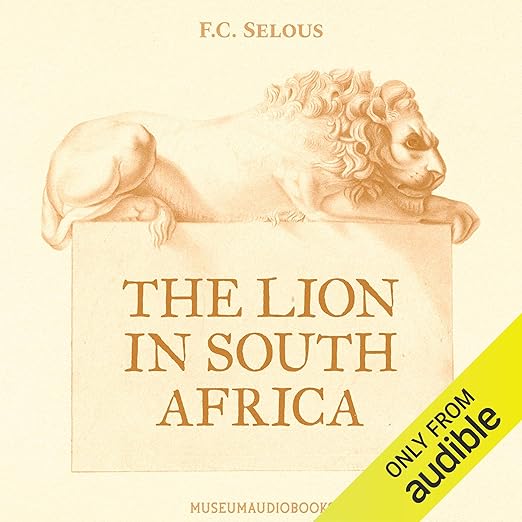
I found this one on a Sunday afternoon when I had an hour to fill and no patience for anything that would require me to keep track of characters or remember plot threads from the week before. The Lion in South Africa by F.C. Selous is exactly the right length for that kind of listening: sixty-two minutes of first-person accounts from one of the nineteenth century’s most remarkable field naturalists, read without ceremony by Drew Baker.
Frederick Courteney Selous arrived in South Africa at nineteen and spent decades moving through territories that European maps left largely blank. His real-life adventures were apparently compelling enough that Sir H. Rider Haggard based the fictional Allan Quatermain partly on him, which is a form of literary immortality most writers never approach. In this short work, Selous focuses specifically on lions: his encounters with them, their behavior, and a phenomenon he noticed as early as the 1890s that was already alarming him.
Our Take on The Lion in South Africa
What makes this audiobook valuable in 2026 is not primarily the adventure content, though Selous writes those encounters with a directness that still holds attention. It is the fact that a man whose livelihood depended on abundant game was already noting, in the decade before 1900, that lion numbers were visibly declining from overhunting. Selous was himself a hunter. He was not writing as an activist. He was writing as a careful observer who kept meticulous records, and what he observed disturbed him.
That combination, the professional hunter as proto-conservationist, is historically significant and somewhat complicates the easy moral categories we might reach for when reading Victorian hunting literature. Selous was collecting specimens for museums, shooting elephants, and ranging through Matabeleland with King Lobengula’s permission. He was also noticing ecosystem change in ways that most of his contemporaries were not. The Lion in South Africa sits at that intersection.
Why Listen to a 62-Minute Historical Field Account
The honest answer is that the length is both the work’s strength and its limitation. Reviewer after reviewer notes that this piece ends abruptly, that it leaves you wanting more. One reader called it disappointing for coming to an abrupt end, another described it as making you clamor for more. A third reviewer compared it unfavorably to Selous’s longer A Hunter’s Wanderings in Africa, noting that work offers far more of what makes Selous worth reading.
Those criticisms are fair. If you want the full measure of Selous as a writer and naturalist, The Lion in South Africa is more of an appetizer than a meal. But as an introduction to his voice and to this particular slice of Victorian-era African natural history, it works. Baker’s narration serves the prose without imposing on it, which is exactly what this kind of first-person field writing needs.
What to Watch For in the Conservation Thread
The passages where Selous moves from adventure narrative into observation about lion population decline are the most historically interesting parts of this recording. He is not sentimental about it. He notes the diminishing numbers as a practical fact, the way a farmer might note a poor harvest. That unsentimental quality actually makes the observation more striking, not less. He is not arguing for policy change. He is simply recording what he saw, and what he saw was a warning that no one with the power to act on it was ready to hear for another century.
For listeners with an interest in environmental history or the origins of conservation thinking, this is worth the hour. For listeners primarily interested in adventure stories, the episodic structure of the lion encounters will satisfy on that level too, even if the whole adds up to less than you might hope.
Who Should Listen to The Lion in South Africa
This audiobook suits listeners with a specific interest: Victorian Africa, early conservation history, the literature of exploration, or the cultural context that produced characters like Allan Quatermain. It is also ideal for anyone who wants to hear an authentic nineteenth-century voice on the subject of African wildlife without committing to a longer work.
Skip it if you want a fully shaped narrative with a satisfying arc. At sixty-two minutes, Selous does not have room to build one, and the piece ends where it ends with the pragmatism of a field journal rather than the resolution of a composed book. For the right listener at the right moment, though, it is exactly enough.
Frequently Asked Questions
Is The Lion in South Africa suitable for listeners who have no prior interest in Victorian hunting literature?
It can work as an introduction to the genre, but readers with no prior investment in the period or subject may find the sixty-two-minute runtime leaves them wanting more context than the book provides. Selous writes for readers who share his frame of reference.
Does Selous’s perspective on hunting feel problematic to modern listeners?
His hunting is matter-of-fact and central to his identity as an observer and collector. He is writing from within a 19th-century framework that did not distinguish sharply between naturalist and hunter. Some modern listeners will find that difficult; others will engage with it as historical document rather than endorsement.
How does this compare to Selous’s longer work A Hunter’s Wanderings in Africa for audiobook listeners?
Multiple reviewers specifically flag that A Hunter’s Wanderings in Africa is the more satisfying and complete work. The Lion in South Africa is shorter and more focused but has an abruptness at the end that leaves readers wanting more. If you enjoy this, the longer work is the logical next step.
Is Drew Baker’s narration appropriate for this kind of Victorian prose?
Baker reads the material cleanly and without embellishment, which suits Selous’s direct, observational writing style. The narration does not impose modern dramatic pacing on 19th-century field writing, which is the right call for this material.