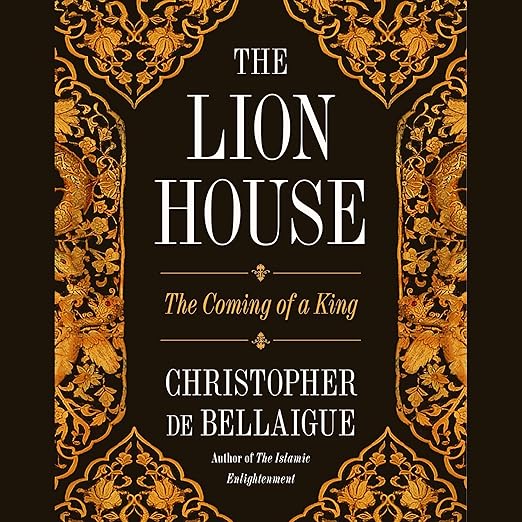
Quick Take
- Narration: Barnaby Edwards is a precise and authoritative narrator whose measured delivery suits the blend of intimate portraiture and large historical sweep that de Bellaigue is working toward.
- Themes: Power and its intimate costs, the fate of those who orbit greatness, sixteenth-century geopolitics and personal allegiance
- Mood: Rich and measured, with the texture of very good narrative history rather than historical fiction
- Verdict: A beautifully researched portrait of Suleyman the Magnificent and his inner circle that works best when it leans into biography and struggles slightly when it reaches for novelistic invention.
I came to The Lion House already carrying a light layer of knowledge about the Ottoman Empire, enough to know the outlines of Suleyman’s reign but not nearly enough to feel at home in its specifics. That turned out to be the right condition for this book. De Bellaigue writes for readers who are genuinely curious rather than already expert, and the depth of detail he brings to the inner life of Suleyman’s court is substantial enough to be illuminating without requiring any particular background.
Nobel laureate Orhan Pamuk’s endorsement appears prominently, calling de Bellaigue’s historical talent “magic.” That’s generous but not entirely wrong. The book’s particular gift is intimacy. This is not a wide-lens account of the Ottoman Empire or even of the Suleyman era in general terms. It is a close portrait of a specific court at a specific moment, seen through the eyes of a handful of figures: the Greek slave who becomes Grand Vizier, the Venetian jewel dealer who serves as go-between, the Russian consort Roxelana who becomes his most consequential wife.
Inside the Chamber, Not the Field
Barnaby Edwards narrates with the kind of restrained authority that suits a book about power exercised in small rooms. His voice has the texture of an informed guide rather than a dramatist, which is the correct instinct for de Bellaigue’s material. The book is not interested in the scale of Suleyman’s empire for its own sake, though the scale is genuinely staggering, twenty-five million souls from Baghdad to the walls of Vienna, more Christians under Muslim rule than at any other point in history. What interests de Bellaigue is the strange, cramped intimacy of proximity to power: the sultan who sleeps head to toe with his best friend and eats from wooden spoons with his infant son.
Those two images, the sleeping arrangement and the wooden spoons, appear in the synopsis for a reason. They do the work of humanization that is hardest to achieve in historical biography, and de Bellaigue returns to them throughout the book. Reviewer Annarella, who knows Istanbul and the Suleiman Mosque firsthand, wrote that the book captured an age of important change with a vividness she hadn’t found elsewhere. Reviewer Robert W. Bowden said simply that he didn’t want it to end.
The Genre Problem
Not everyone was satisfied, and the dissatisfaction is worth taking seriously. Reviewer “doc peterson” came expecting biography and found something he couldn’t fully categorize, neither history nor historical fiction, with internal monologues that read as invention rather than evidence. Reviewer “Patsy Clinelike” came expecting something in the register of Hilary Mantel’s Cromwell novels and found the narrative accumulation less satisfying, partly because the book ends thirty years before Suleyman’s death.
These are honest concerns. The Lion House occupies a genuinely contested space between documented history and imaginative reconstruction. De Bellaigue acknowledges his methods, but the book does not always make clear where the historical record ends and authorial extrapolation begins. For readers who require a firm line between biography and fiction, that ambiguity is a real problem. For readers who are comfortable with narrative history in the Dava Sobel or Simon Winchester tradition, where the author brings imaginative energy to verified material, the approach is less troubling.
What the Intimacy Achieves
What works is the sense of living inside the court’s particular atmosphere of danger and obligation. Every figure close to Suleyman exists in a condition of permanent contingency. The Grand Vizier’s elevation is real, but so is his vulnerability. Roxelana’s influence is genuine, but it requires constant management of the sultan’s emotional life and his mother’s rivalry. The Venetian jewel dealer is always one diplomatic failure from irrelevance. De Bellaigue renders this condition, the specific anxiety of being indispensable to a man who can have you killed with a nod, with sustained attention.
The audio format serves this well. Edwards’ pacing allows the claustrophobic interiority of the court scenes to build without the relief that chapter breaks provide in print. The nine-hour runtime feels appropriate for the material, neither overstuffed nor truncated.
Who Will Appreciate This Most
The Lion House is best suited for listeners with genuine curiosity about the Ottoman Empire who want something more intimate than a standard survey history. Readers who have enjoyed de Bellaigue’s earlier work, including his writing on the Islamic Enlightenment, will recognize his characteristic approach and find it applied with equal skill here. Those who need clear genre boundaries between biography and fiction will find the ambiguity harder to accept.
Come to it with patience and some background curiosity about the sixteenth century, and the rewards are considerable. Barnaby Edwards is the right guide for this particular journey through corridors of power.
Frequently Asked Questions
Is The Lion House biography, historical fiction, or something in between?
De Bellaigue himself describes it as narrative history, but the book uses internal monologue and imaginative reconstruction in ways that blur the genre line. Some readers find this enriching; others find it frustrating. It sits closer to the literary narrative history of writers like Dava Sobel than to conventional biography or historical fiction.
Does the book cover the full span of Suleyman’s reign?
No, and this is a genuine caveat. The narrative ends approximately thirty years before Suleyman’s death, covering the early and middle period of his reign rather than the full arc. Readers expecting a complete biography will feel the absence.
How does Barnaby Edwards’s narration handle the range of perspectives from different characters’ viewpoints?
Edwards uses a single, authoritative voice rather than character-specific vocal differentiation, which suits de Bellaigue’s approach. The book reads more like intimate narrative history than dramatized fiction, and Edwards’ measured delivery keeps the historical distance appropriate while still generating genuine intimacy.
Do I need prior knowledge of Ottoman history to follow The Lion House?
No prior knowledge is required. De Bellaigue grounds the narrative carefully for readers who are new to this period, and the cast of characters is small and well-established early. Some familiarity with the broad European historical context of the sixteenth century enriches the reading, but it isn’t necessary.