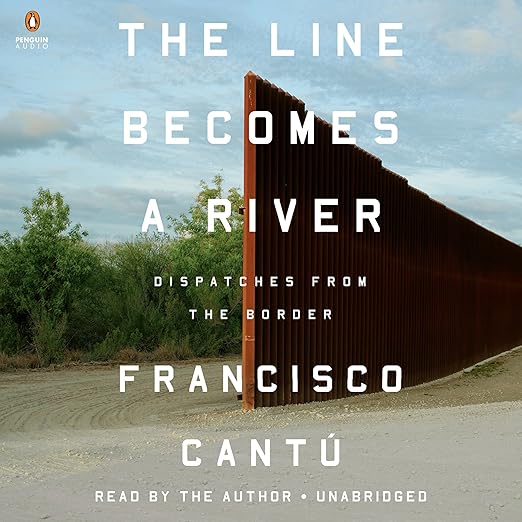
A memoir read by the person who lived it changes what an audiobook can do, and this is one of the clearer cases. Francisco Cantú wrote The Line Becomes a River, and Francisco Cantú reads it: the same name occupies the author field and the narrator field across six hours and thirty minutes. What that produces is not a performance in the ordinary sense. It is a man describing what he did while working for the Border Patrol, in his own voice, with whatever the memory of it does to that voice still audible in the recording.
Is The Line Becomes a River Worth Your Time?
One thing the description gets right is the shape of the story. Cantú's mother was a park ranger and the daughter of a Mexican immigrant, and she raised him in the scrublands of the Southwest. He joined the Border Patrol out of a wish to understand the landscape he loved. He and his partners learned to track other humans under blistering sun and through frigid nights, hauled in the dead, and delivered the living to detention. Then he left. The last movement begins when an immigrant friend travels to Mexico to see a dying mother and does not come back.
Under the title, and before a single sentence about the book itself, sits a stack of prizes. A top ten placement for 2018 from two outlets, a Los Angeles Times Book Prize in Current Interest, a finalist spot for the National Book Critics Circle nonfiction award, an instant bestseller line and a blurb from Esquire. Every one of those honors belongs to the printed edition. Not a word of it concerns the recording, the reading, or the six and a half hours Penguin Audio produced. The prize copy has been pasted straight across.
Most review columns run in one political direction. This one does not, and it is the most useful thing on the page. Elisa and Teddy, two names sharing a single reviewer field, open by describing themselves as strongly conservative and braced for a liberal bias that would label them a bigot, then report being surprised. The four-star entry, signed Matthew Rapaport, sets the book against the presently vocal anti-immigrant hysteria of the American political Right. F. VALDES Perezgasga files from Mexico and recommends it to usamericanos and mexicanos alike, because reading it brings both a little closer to what divides and what unites them.
The Best Parts of The Line Becomes a River
At six hours and thirty minutes this runs short for a memoir, and the structure explains why. EC calls it a series of mostly short vignettes that grab and keep your attention, which is close to the ideal shape for audio. A vignette ends before your attention does. You can lose thirty seconds at a traffic light and rejoin without having lost the thread, because the thread restarts every few minutes. Sustained argument punishes distracted listening; accumulated fragments survive it easily. The length works the same way. Most memoirs of this weight run twelve hours or more and lose people at the midpoint, while this one ends before the material can exhaust anybody.
That the author handles the reading matters more here than it would on most memoirs, because the book is an account of complicity. The description states it outright: he was plagued by a growing awareness of his complicity in a dehumanizing enterprise. Hearing a person say that about himself is a different transaction from reading it on a page. A hired reader would have to decide how much remorse belongs in the line. Cantú decides nothing. Whatever sits in the voice is simply what is there.
The five written responses discuss the book and never once touch the recording, which is a real loss on a title where the reading carries the argument. They praise the prose, the fairness, the vignettes, the honesty. Matthew Rapaport calls it an easy read. Alton Jones opens a sentence with the words After reading the book. All five are describing pages. Anyone who wants to know whether the delivery stays steady, or turns monotone, or becomes hard to take across long stretches, will not find out here.
Before You Commit to The Line Becomes a River
Listeners should understand what the job in this book involves before pressing play. The description does not soften it: agents haul in the dead and deliver to detention those they find alive. The responses add front lines, moral and human costs, and the tracking of people across desert country at night. Anyone close to this subject, or grieving someone lost to it, should approach with care. The record carries no content advisory whatsoever, and a memoir that opens onto the dead has clearly earned one.
Here the page contradicts itself. The vote counter reads two. Five written responses sit beneath it, every one of them graded, four at five stars and one at four. A counter cannot fall below the number of people who both graded and wrote, so the figure on display has fallen behind the column it is supposed to summarize. Read the responses and set the badge aside: the responses are dated, attributed and specific, while the number no longer describes anything visible on this page.
Should You Listen to The Line Becomes a River?
Whether this suits you depends less on politics than the column implies. Anyone who wants border enforcement described from the inside, by someone who walked away from the job, will get exactly that. It suits listeners who prefer memoir built from short scenes over sustained argument, and it suits people who read across their own political line, since the response that arrived braced for liberal bias found something else entirely. Six and a half hours is a manageable commitment for material this heavy, and manageable matters when the subject is bodies in the desert instead of a sequence of arguments you can pause and resume at will.
Both the pace and the subject rule this out for certain listeners. Anyone after policy analysis, statistics, or a systematic argument about immigration will meet a memoir instead, and a deliberately partial one at that. Anyone who needs a trained reader should note that an author's delivery is a different instrument. And anyone drawn in by the prize stickers should register that the prizes were awarded to a book rather than to this file. Six and a half hours makes a short recording about a very long problem, which is exactly the right proportion.
Common Questions
Who reads the audiobook edition of this memoir?
Francisco Cantú does, which is why the credit deserves a second look: author and narrator are the same person on this record. Penguin Audio runs it to six hours and thirty minutes. On a book about the writer's own part in border enforcement, self-narration removes a decision a hired reader would have been forced to make about how much regret belongs in a sentence.
Do the reviews say anything about the audiobook narration?
Not a word. All five discuss the writing, the fairness and the vignette structure, and their vocabulary throughout belongs to reading, never to hearing. On a self-narrated memoir that gap costs something real, because nobody here reports whether the delivery holds steady across a recording this heavy from one end to the other.
What do the awards listed on this page actually apply to?
The printed edition, every one of them. Two outlets named it among their ten best of 2018, a prize in the current interest category followed, a finalist place on a national nonfiction award followed that, and a bestseller line tops the whole stack. None of it was given to the recording, and none of it reveals how the reading itself actually sounds.