Quick Take
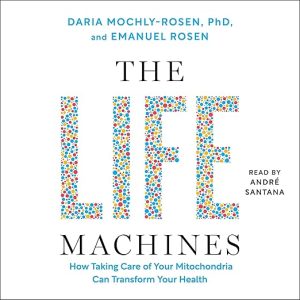
- Narration: André Santana reads the Stanford science with warmth and clarity, handling the mitochondrial biochemistry without making it feel like a textbook
- Themes: Mitochondrial health, longevity science, lifestyle and cellular function
- Mood: Intellectually curious and quietly hopeful, science writing that makes you want to take better care of yourself
- Verdict: The most scientifically substantive entry in this longevity batch, a Stanford researcher and her husband have written the first genuinely accessible book on mitochondrial health, and Santana’s narration makes the science navigable for non-specialist listeners.
I listened to The Life Machines on a Sunday afternoon in the particular frame of mind you enter when you’ve been reading about longevity and wellness for long enough that all the protocols have started to blur together. More protein, less inflammation, fix your sleep, reduce stress, these are correct prescriptions, but repeated often enough they lose their grounding in actual biology. What Dr. Daria Mochly-Rosen and her husband have done in The Life Machines is return the conversation to its cellular foundation: these lifestyle recommendations exist because of what they do to mitochondria, and understanding what mitochondria actually do transforms the advice from commandments into logical conclusions.
Mochly-Rosen is a leading researcher at the Stanford University School of Medicine, and her scientific authority is evident throughout. But the book is co-written with a bestselling author, and that collaboration has produced something unusual in the science-for-general-audiences genre: a book that is rigorous enough to satisfy readers who know some cell biology and accessible enough to be navigated comfortably by readers who don’t. André Santana’s narration is well-suited to this balance, he reads the technical passages with appropriate weight and the narrative passages with warmth, keeping the tone consistently engaging across eight and a half hours.
Beyond the Powerhouse: What Mitochondria Actually Do
Most listeners will arrive at this book knowing the powerhouse-of-the-cell definition from high school biology and not much else. The Life Machines spends its opening chapters systematically expanding that picture. Mitochondria, the authors explain, do not merely convert food to energy, they orchestrate a range of critical functions including immune signaling, apoptosis (the programmed death of damaged cells), calcium regulation, and the communication between cells and organs that coordinates metabolic function throughout the body. The implications of this expanded picture are significant: mitochondrial dysfunction has been linked to Alzheimer’s, type 2 diabetes, cardiovascular disease, cancer, depression, autism spectrum disorder, chronic fatigue syndrome, and infertility, not as a single cause but as a common underlying factor across multiple disease mechanisms.
This reframing has real practical consequences. If mitochondria are the common pathway through which exercise, nutrition, sleep, and stress management produce health outcomes, then the standard lifestyle recommendations stop feeling arbitrary and start having explanatory coherence. The authors make this connection explicit without overstating it, which is one of the book’s most valuable qualities.
The Practical Framework and Whether It’s Actionable
The six key questions the book addresses, how exercise improves brain and muscle mitochondria, what nutrients they thrive on and how gut microbiome is involved, how sleep quality affects mitochondrial health, how stress management reduces mitochondrial damage, how to protect against environmental toxins, and why mitochondria are the key to healthy aging, map neatly onto the lifestyle categories most longevity books address. What The Life Machines adds is not new recommendations but biochemical mechanism. A listener who already knows they should exercise and manage stress will come away understanding why those interventions work at the level of the organelle, which changes how they think about consistency and precision.
The book is not primarily a protocol, it doesn’t give you a six-week plan or a numbered framework. It’s a science-first explanation of the biology followed by practical implications for each lifestyle category. Reviewers describe it as an owner’s manual for life, which captures the aspiration accurately: this is the biology your lifestyle choices are operating on, here is how each choice affects that biology, draw your own conclusions.
The Storytelling That Makes the Science Land
Mochly-Rosen and her husband include what the synopsis calls surprising facts throughout, and these are among the book’s most memorable passages. The concept of mitochondrial Eve, the single female ancestor from whom all human mitochondrial DNA is descended, who lived in Africa approximately 200,000 years ago, establishes the evolutionary stakes of the subject immediately. The passage about rotors spinning inside mitochondria at what the authors describe as fantastic speed, the account of how cancer cells steal mitochondria from immune cells, the explanation of how mitochondria in the thigh muscles are linked to cognitive capacity, these are specific and unexpected enough to stick. Santana delivers them with appropriate wonder, treating the science not as inventory but as revelation.
Who Should Listen and Who Should Skip
The Life Machines rewards listeners who want to understand the biology underneath the lifestyle advice they’ve already been given. It’s especially valuable if you’ve read a lot of longevity and wellness content and want a unifying framework that explains why the recommendations are consistent across different protocols and authors. The accessibility of the writing makes it navigable for non-specialist listeners, and Santana’s narration keeps the technical sections engaging rather than fatiguing.
Skip if you’re looking for a specific protocol with numbered steps and weekly targets, this is a science book with practical implications, not a health program. For the protocol approach, Unbreakable or Hormone Havoc will serve you better. Pair The Life Machines with those books if you want both the mechanism and the implementation.
Frequently Asked Questions
Do I need a science background to follow The Life Machines, or is it accessible to general listeners?
No prior science background is required. Mochly-Rosen and her co-author have explicitly written for a general audience, reviewers describe the scientific advice as written in highly readable English. The complexity scales: listeners with cell biology backgrounds will find new depth in the research, while listeners coming to the subject fresh will find the core concepts explained clearly enough to follow the practical implications.
What is mitochondrial Eve and why does it matter to the book’s argument?
Mitochondrial Eve refers to the matrilineal most recent common ancestor of all living humans, the woman from whom all human mitochondrial DNA is traced, estimated to have lived in Africa around 200,000 years ago. Mochly-Rosen uses this concept to establish the evolutionary depth and universality of mitochondrial function: these organelles have been the engines of human life for the entirety of our species’ existence, which gives the book’s health recommendations a biological grounding that extends well beyond contemporary wellness culture.
How does The Life Machines differ from other longevity audiobooks like Unbreakable or Hormone Havoc?
The Life Machines is primarily a science book, it explains the biology of mitochondrial function and its links to aging and disease before drawing practical conclusions. Unbreakable is a protocol book focused on musculoskeletal health and exercise. Hormone Havoc is a nutritional framework for perimenopause. All three point toward similar lifestyle recommendations but from different angles; The Life Machines provides the cellular biology that unifies those recommendations under a single mechanism.
Does the book overstate the role of mitochondria in disease, is it credible science or wellness speculation?
The book is grounded in peer-reviewed research and authored by a leading Stanford researcher. The links it draws between mitochondrial dysfunction and conditions like Alzheimer’s, diabetes, and cardiovascular disease reflect legitimate and active areas of scientific inquiry rather than speculative wellness claims. Mochly-Rosen is careful to distinguish between established findings and emerging research, which is the appropriate epistemic standard for this type of science communication.