Quick Take
- Narration: Nick Mondelli handles Newberg’s neuroscience content with accessible authority, keeping technical brain-scan research from overwhelming the lay listener.
- Themes: Neurotheology, the biological overlap of sexual and religious experience, Orgasmic Meditation research
- Mood: Intellectually charged and quietly provocative
- Verdict: A serious neuroscientific argument for the biological unity of sexual and spiritual experience, grounded in brain scan data rather than speculation, though the small review base means community reception is still forming.
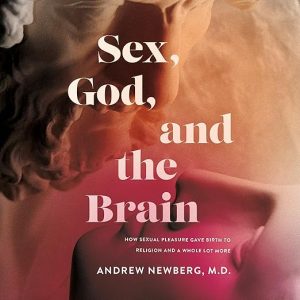
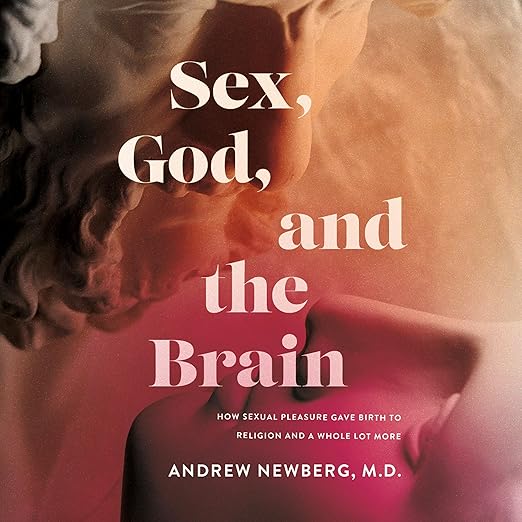
I finished a chapter of Sex, God, and the Brain on a quiet Tuesday morning, right after coffee and before anything else on my list had started. There is something about encountering a genuinely original scientific argument in that liminal space, before the day’s obligations crowd in, that lets it land differently. Andrew Newberg’s central claim landed for me that way: the biological mechanisms underlying religious and spiritual experience and those underlying sexual experience are, according to his brain scan research, not just similar but identical.
That is a provocative claim, and Newberg backs it with data rather than intuition. He is a neuroscientist whose work in neurotheology, the scientific study of spiritual experience in the brain, has been ongoing for decades. This book represents the extension of that work into territory that is uncomfortable for both the religious and the secular.
The Brain Scan Evidence
Newberg’s most significant methodological contribution here is the use of Orgasmic Meditation studies as a research tool. Orgasmic Meditation, a structured practice involving sustained genital stimulation without necessarily culminating in orgasm, generates measurable neurological states that Newberg and his collaborators have been able to scan and analyze. The resulting brain activity patterns, he argues, are functionally indistinguishable from the patterns produced during deep religious or spiritual experience.
This is not a minor finding. If it holds up to further scrutiny, it suggests that what we experience as spiritual transcendence and what we experience as profound sexual connection are produced by the same underlying neurological machinery. The implications for how we understand religious experience, how we understand sexuality, and how we understand the persistent tendency of religious traditions to regulate the latter, are significant.
Technical Research Made Accessible
One reviewer with a pharmacist and Tibetan Buddhist background describes the book as deeply insightful in the way it resists pharmaceutical-era reductionism, the tendency to isolate and diagnose rather than see systems in relationship. That description captures something real about Newberg’s approach. He is not simplifying the science; he is placing it in context rather than treating it as a collection of discrete data points to be catalogued.
Nick Mondelli’s narration handles this balance well. Neurotheology sits at an uncomfortable intersection for many narrators: too technical to be treated as popular nonfiction, too humanistic to be read like a medical textbook. Mondelli navigates it by taking the science seriously without letting it dominate the pacing. At just over seven hours, the book has room to develop its argument without rushing, and the narration honors that spaciousness. One reviewer notes having had to return and re-listen to sections because the ideas require active processing rather than passive absorption.
The Research Base and Its Limits
With only twenty-six Audible ratings, community reception for this title is still forming. The existing reviews are uniformly positive and specifically engaged, suggesting that the audience who found it found it meaningful rather than merely interesting. The sample size for the Orgasmic Meditation research is a legitimate scientific concern that Newberg acknowledges, describing the research as groundbreaking in the sense of opening new territory rather than settling it. The book is better understood as a serious scientific hypothesis with supporting data than as settled science with consensus backing.
Who Should Listen and Who Should Skip
Listen if you are genuinely curious about the neuroscience of religious or spiritual experience and willing to follow an argument that connects it directly to sexuality without either sanctifying or pathologizing either domain. The book works best for listeners who can hold scientific rigor and spiritual openness simultaneously.
Skip if you need a clear denominational or spiritual framework to anchor new ideas about sexuality, or if you are uncomfortable with the Orgasmic Meditation research context that provides much of the empirical foundation. Also skip if you want definitive conclusions rather than a well-supported opening hypothesis.
Frequently Asked Questions
What is neurotheology, and does this book require prior background in it to follow?
Neurotheology is the scientific study of how the brain produces and processes religious and spiritual experiences. Newberg is one of its primary researchers. The book does not assume prior knowledge of the field, though listeners familiar with his earlier work like Why God Won’t Go Away will have useful context going in.
How central is the Orgasmic Meditation research to the book’s argument?
It is central rather than peripheral. The OM studies provide some of the most direct brain scan evidence for Newberg’s argument about the shared neurological basis of sexual and spiritual experience. Listeners who are uncomfortable with this research context should know it is load-bearing for the book’s scientific case.
Does Sex, God, and the Brain take a position on whether spiritual experience is ‘real’ or reducible to biology?
No. Newberg’s argument is about biological mechanism, not metaphysical hierarchy. He is not arguing that spiritual experience reduces to sex or vice versa. He is arguing that they share the same neurological substrate, which is a different and considerably more interesting claim than either reductionism or spiritual essentialism.
Is Nick Mondelli’s narration appropriate for this level of scientific content?
Yes. Mondelli handles the technical sections with clarity and the more reflective philosophical passages with appropriate pacing. The seven-hour runtime benefits from a narrator who does not rush through complex material, and the approach rewards attentive listening rather than casual background play.