
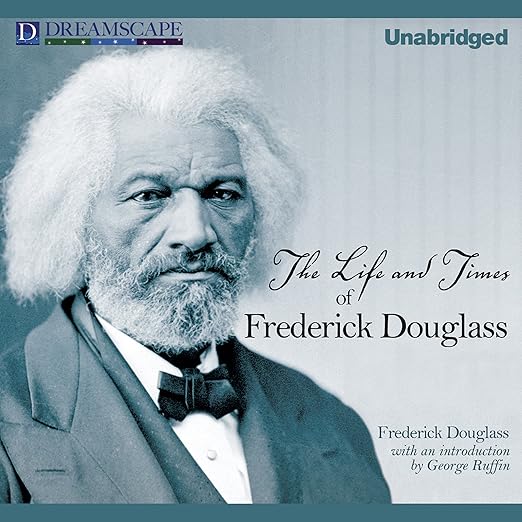
I came to The Life and Times of Frederick Douglass later than I should have. My formal education gave me the Narrative, the first autobiography, spare and searing, which remains one of the most devastating pieces of American writing produced in the 19th century. The third autobiography sat on my list for years before a conversation with a historian friend made clear what I was missing: this is the only version where Douglass could speak freely, where his family was safe, where the full span of his extraordinary life could be told without the constraint of danger. I started it the following week.
Richard Allen narrates this Dreamscape Media edition, which was released in 2012 and runs just over 21 hours. At 4.8 from 456 reviews, it is one of the highest-rated titles in the biography category, a rating that reflects both the extraordinary source material and the narration's ability to honor it.
How The Life and Times of Frederick Douglass Holds Up
This is the fullest portrait Douglass ever drew of himself, and its fullness is precisely what makes it essential beyond the earlier autobiographies. The Narrative covered slavery and escape with the urgency of a man still in danger. My Bondage and My Freedom expanded the early material with more detail and more explicit anger about northern racism. The Life and Times does everything the earlier books did and extends decades further: through the abolitionist movement, through the Civil War, through Reconstruction, through Douglass's encounters with Lincoln, Grant, and Garfield, through his appointment as US Marshal for the District of Columbia, through his ambassadorship to Haiti.
What reviewer RJM called "the power a motivated individual can have in learning outside the classroom" is demonstrated throughout, but the book's argument goes deeper than individual triumph. Douglass was a public intellectual at the highest level, and his analysis of the political failures of Reconstruction, written as someone who had lived through the hopes it raised and the violence that extinguished those hopes, is among the most clear-eyed political writing an American has produced on the subject of American democracy's failures.
The Best Parts of The Life and Times of Frederick Douglass
The audiobook format does something meaningful with 19th-century oratorical prose: it restores it to something closer to its original intention. Douglass was, as one reviewer described him, arguably the best political speaker of his time. His prose was written to be delivered, and hearing it delivered, by a narrator who approaches the material with genuine care, recovers a dimension that silent reading does not. The forensic power of his arguments against slavery, against the betrayal of Reconstruction, against the conceit that the moral arc of history bends automatically toward justice, is sharper in the ear than on the page.
Richard Allen handles the formal, sometimes ornate style of Douglass's later writing with patience and intelligence. He does not rush. This is the correct choice: the prose rewards unhurried attention, and the 21-hour runtime, which might seem daunting, is actually appropriate to the density and scope of the life being described.
Weak Spots in The Life and Times of Frederick Douglass
One reviewer accurately noted that the style is archaic and wordy by contemporary standards. Douglass wrote in the register of 19th-century formal discourse, long sentences, elaborate subordinate clauses, rhetorical repetition that was designed for spoken effect and can feel labored when encountered in isolation on a page. The audio format mitigates this considerably, because the pacing of speech reveals the structure that the sentence length can obscure in print. But listeners unaccustomed to 19th-century prose should be prepared to adjust their reading speed expectations.
The later sections of the book, dealing with Douglass's diplomatic appointments and his complex relationship with the Republican Party's post-Reconstruction retreat, are less emotionally immediate than the slavery narrative but historically significant in ways that reward patient attention. This is not a book that peaks in its first chapters and coasts to the end, the arc is long and the later material carries its own weight.
The Right Listener for The Life and Times of Frederick Douglass
This is for anyone who has read the Narrative and wants the complete story, who Douglass became after the escape, how he shaped American political life, and what he made of a country that had failed the promise it made to the people it had enslaved. It is for readers interested in the intellectual history of American abolitionism and Reconstruction. And it is, as reviewer elizabeth claire wrote, something every American should encounter, not because it is comfortable but because it is true, and because the moral clarity Douglass brought to the question of what America owed its Black citizens has not been superseded by anything written since.
Before You Listen
How does The Life and Times of Frederick Douglass differ from his earlier Narrative of the Life?
The Narrative was written in 1845 when Douglass was still legally enslaved and covers only his early life and escape. The Life and Times, published in 1881 and revised in 1892, covers the full span of his life including the abolitionist movement, the Civil War, Reconstruction, and his later diplomatic career. It is longer, more politically explicit, and significantly more comprehensive.
Does the audiobook include only the 1881 edition or the 1892 revised edition?
The Dreamscape Media edition narrated by Richard Allen covers the full autobiography as published. Readers interested in the specific differences between the 1881 and 1892 editions, Douglass added substantial material in the revision, particularly regarding his second marriage, may want to verify which version this edition reproduces.
At 21 hours, is this a good choice for someone new to Douglass?
Listeners who are entirely new to Douglass might consider starting with the shorter Narrative, which runs under 4 hours and provides the foundational story of his enslavement and escape. The Life and Times rewards prior familiarity, its power is partly cumulative, built on knowing the earlier version of the story it is expanding. But it is also entirely coherent as a first encounter, particularly in the audio format where the long-form prose works most naturally.







