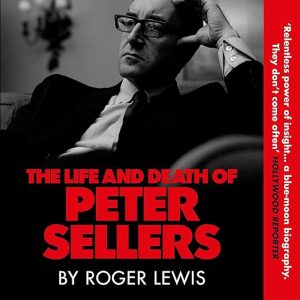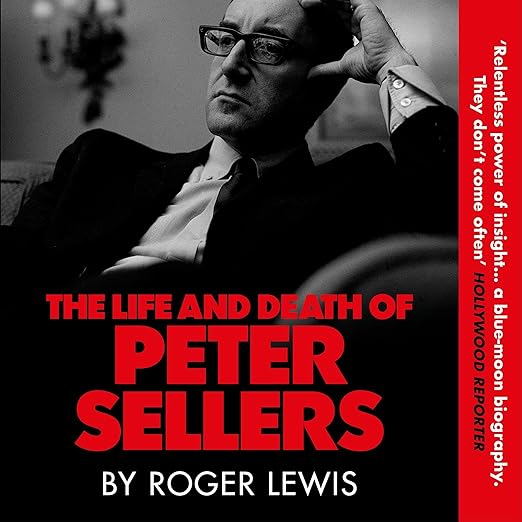
Peter Sellers once said he had no self when not performing a character. Roger Lewis's biography takes that admission seriously, and the 40 hours and 44 minutes of this audiobook pursue its implications with a ferocity that makes the book genuinely uncomfortable to listen to for extended stretches. Justin Avoth narrates, and his command of Lewis's prose, which one reviewer accurately describes as resembling a long-winded Edwardian poet performing in a Llandudno musical hall, is what makes this audiobook viable at its extraordinary length. The Life and Death of Peter Sellers is not a traditional biography; it is something closer to a prosecution, filtered through a sensibility that loves the films and cannot forgive the man who made them.
Lewis's central argument is that Sellers's genius and his cruelty were not incidentally related but causally linked. The actor who could inhabit Dr. Strangelove, Inspector Clouseau, and Being There's Chance the Gardener with such uncanny completeness had, Lewis contends, no stable self to retreat to. That vacancy produced both the performances and the psychotic violence, the compulsive promiscuity, the humiliating obsessions with Sophia Loren and Princess Margaret and Liza Minnelli, and the pattern of showering his four wives and children with gifts before threatening to kill them. Lewis does not modulate this portrait toward sympathy, and that refusal is where the book is both its most honest and its most exhausting.
Four Decades of Monologue Without Curdling
The Sunday Times described it as a mad book about a madman, which is accurate but undersells the craft. Lewis writes in a stream of consciousness that loops back, contradicts itself, and then comes back around to a point with the satisfaction of a closing argument. In audio form, this means Avoth is essentially performing an extended internal monologue across four decades of one man's deterioration, and his ability to sustain that voice without it curdling into monotony is the book's central technical achievement.
What emerges over the listening hours is a portrait that is devastating precisely because Lewis clearly loves the films. The attention given to Dr. Strangelove alone, the character's physical specificity, the way Sellers built Strangelove's right arm from a documented study of fascist body language, is the work of someone who has watched these performances dozens of times with genuine admiration. The cruelty of the biography comes from holding that artistic admiration in one hand and the human wreckage in the other and refusing to let either resolve the other.
Reading Aloud Rewards This Dense Prose
The case for the audiobook over the print edition is Avoth's performance. Lewis's prose is demanding in a way that rewards being read aloud: the rhythm of his sentences, their tendency to build through accumulation and then land on a single devastating phrase, lands better when heard than when scanned. One reviewer noted using the book as a reference, jumping via index to specific films and performances. That approach works in print but loses something in audio, where the cumulative effect of Lewis's argument is the point. This is a listen-through book, not a browse-through one.
At 40 hours and 44 minutes, the runtime is not a warning so much as a commitment statement. Listeners who make it through will have experienced something closer to a novel than a conventional biography, a sustained act of literary criticism and character pathology that uses Sellers as both subject and case study. The Literary Review's claim that Lewis reinvented the genre while reassessing its subject is not overstatement; this is genuinely unusual as a biographical form, and Avoth's narration honors its ambition.
Chance the Gardener's Blankness Reads as Inhabited
The treatment of Sellers's relationships with women is the section most likely to create friction for contemporary listeners. Lewis does not excuse the behavior, but his mode of documenting it, listing obsessions and humiliations with the same relentless accumulation he applies to everything, can feel at points as if the documentation itself is a form of voyeurism. This is worth knowing before you commit 40 hours, because Lewis never turns away, never softens, and never suggests that the cruelty was aberrant rather than systemic.
The coverage of specific films is outstanding for anyone who comes to the book as a Pink Panther or Kubrick devotee. Lewis's readings of Being There in particular, the way Sellers's own emotional vacancy made Chance the Gardener's blankness feel inhabited rather than performed, are among the most perceptive pieces of film criticism attached to a biography. The final chapters, covering Sellers's death at 54, sick at heart and alone in hotel rooms so recoiled from intimacy that no one really knew him, land with real weight after 40 hours of buildup.
No Comfort for Readers Wanting Redemption
Listeners who admire Sellers's film work and want the most unsparing account of the person behind it will get what they came for. Those who want a traditional, empathetic biography with narrative arc toward meaning or redemption should look elsewhere; Lewis offers neither comfort nor resolution. Avid readers of British literary biography who appreciate prose that performs its own argument rather than simply conveying one will find this audiobook exceptional. Anyone sensitive to extended documentation of domestic violence and sexual obsession should know that Lewis does not employ content warnings and does not elide the worst of Sellers's behavior.
Questions Listeners Ask
Is the audiobook version of The Life and Death of Peter Sellers manageable at over 40 hours?
It is long and demanding, but Avoth's narration gives Lewis's prose a rhythmic quality that makes extended listening sessions work better than page-by-page reading might. The book is built to accumulate rather than to sprint, and audio format suits that architecture.
Do I need to be a Peter Sellers fan to get value from this audiobook?
Familiarity with at least Dr. Strangelove, the Pink Panther films, and Being There will make the biographical argument significantly more resonant. Lewis assumes you know the films and then shows you what was happening behind them. Coming in without that context means the critical sections land less fully.
How does Roger Lewis portray Peter Sellers compared to other biographies of the actor?
Lewis is categorically more adversarial than any other Sellers biographer. Where other accounts balance the difficult personal life against the professional achievements, Lewis treats the cruelty and the genius as structurally linked and documents both with equal relentlessness. One reviewer compares it to a horror novel rather than a conventional biography.
Is The Life and Death of Peter Sellers audiobook suitable for listeners primarily interested in film history rather than personal biography?
Yes, with a caveat. The film analysis sections, particularly on Dr. Strangelove and Being There, are among the best close readings of Sellers's technique available anywhere. But they arrive embedded in the biographical argument and cannot be cleanly separated from the personal material that surrounds them.