Quick Take
- Narration: Jennie Allen reading her own work is a significant asset, her voice is warm, urgent, and personal in ways that a professional narrator could not replicate.
- Themes: Spiritual warfare and identity, freedom from shame and negative thought patterns, biblical truth as a corrective to internalized lies
- Mood: Intimate and earnest, with a sense of urgency that carries the shorter runtime effectively
- Verdict: For its intended audience of Christian women wrestling with persistent shame or self-limiting beliefs, this delivers both diagnosis and practical tools with real sincerity.
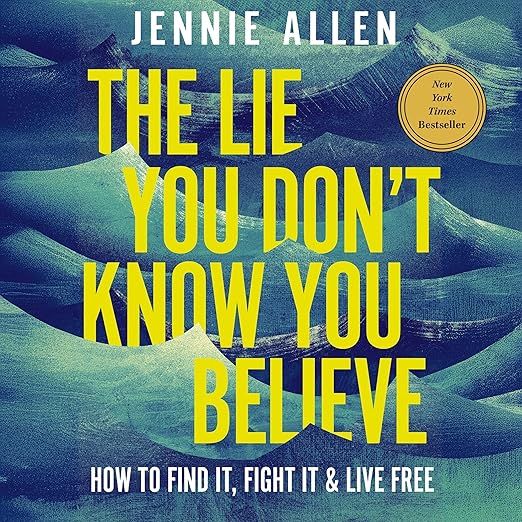
I listened to this one on a quiet Wednesday morning, walking a route I know so well I don’t have to think about where my feet are going. That kind of listening, where your body is occupied but your mind is fully available, turned out to be exactly the right context for Jennie Allen’s The Lie You Don’t Know You Believe. At four hours and twenty minutes, it is compact enough to finish in a single long walk, but it carries more weight than its runtime suggests.
Allen is the founder of the IF:Gathering women’s ministry and the author of several previous books including Get Out of Your Head, which explored the neurological and spiritual dimensions of thought patterns. This new title extends that territory into more theologically specific ground: the idea that beneath the various symptoms of anxiety, comparison, shame, and chronic frustration, most people are operating from a core lie about themselves or about God that they have held so long it registers as simple reality. Allen’s argument is that identifying and dismantling that specific lie is the foundation of genuine spiritual freedom.
Our Take on The Lie You Don’t Know You Believe
What works here is Allen’s willingness to be specific. She does not traffic in generic encouragement. She identifies three core lie structures she believes most people fall into, walks through how to locate the origin point of your particular lie, and then offers a framework for replacing it, not through willpower but through what she frames as spiritual authority already available to believers in Christ. The distinction she draws between behavior modification and genuine transformation is one of the more theologically careful moves in the book, and it keeps the content from sliding into the kind of positive-thinking self-help that Christian readers have rightly grown skeptical of.
Allen reading her own work makes a material difference to the listening experience. Her voice carries the texture of someone who has lived inside these questions for years, not someone performing conviction. One reviewer noted that “Jennie helps break it down and shows us how she isn’t above the problems the rest of us suffer from”, and that quality comes through in the audio in ways it might not in print. There is a confessional intimacy to her delivery that earns the book’s more demanding claims.
Why Listen to The Lie You Don’t Know You Believe
The reviews on this one are unusually unified for a religion and spirituality title, and the consensus is worth taking seriously: readers who have found Allen’s previous work transformative consistently report that this entry feels more direct and actionable than its predecessors. The structural approach, identify the lie, trace its root, cut its ties, replace it in real time, gives listeners something specific to do rather than a general disposition to cultivate. For people who want Christian self-examination that feels rigorous rather than vague, that is a genuine selling point.
The audiobook companion PDF, available in the Audible library, contains exercises and visual content that supplement the listening. This is an important note for serious engagers: the audio alone delivers the argument fully, but the companion material is designed to make the practice portion of the book more concrete. It functions almost as a workbook, and listeners who want to do more than simply absorb the ideas will find it worth downloading.
What to Watch For in The Lie You Don’t Know You Believe
Allen’s framework rests on the concept of the enemy’s strategic use of lies, what she describes as “the enemy’s oldest trick.” Listeners who are not working within an evangelical framework may find this language either alienating or easy to translate into secular psychological equivalents depending on their disposition. The content is theologically grounded in a way that assumes a shared cosmological framework; this is not a crossover title that has been watered down for a general audience.
One reviewer quoted a line early in the book: “the terrifying thing about lies we live with, they don’t show up with red flags. They show up like truth.” That observation is the emotional and intellectual core of the book, and Allen returns to it in various forms throughout. Listeners who find that premise resonant will get the most from what follows.
Who Should Listen to The Lie You Don’t Know You Believe
This is squarely for Christians, particularly women, given Allen’s ministry context, though the content is not exclusively gendered, who feel stuck in recurring thought patterns and want a biblically grounded framework for understanding why. Readers who have benefited from Allen’s earlier work will find this a natural next step. Those outside a Christian faith framework will find the theological assumptions limiting the book’s utility, though the underlying psychological observations about internalized self-narrative are broadly applicable regardless of tradition.
Frequently Asked Questions
Do I need to have read Jennie Allen’s previous books before this one?
No prior reading is required. Allen introduces her framework from the ground up and the book is designed to stand alone. Familiarity with Get Out of Your Head may add context but is not a prerequisite.
What is the audiobook companion PDF and how do I access it?
The companion PDF contains exercises and visual content designed to complement the audio. It is available to download directly from your Audible library after purchase and functions as a practical workbook for applying the book’s concepts.
Is this audiobook appropriate for men or is it primarily written for women?
The content and framework apply broadly, though Allen’s ministry background is specifically women-focused and some of her examples and language reflect that context. Male listeners in the target theological audience have found it useful, but the primary audience is women in Christian faith communities.
How does this compare to other Christian self-help audiobooks on thought patterns and identity?
Allen’s approach is more theologically grounded than many titles in this space. She explicitly frames the work in terms of spiritual authority and biblical truth rather than psychological techniques, which distinguishes it from crossover titles like those by Brene Brown that approach shame from a secular framework.