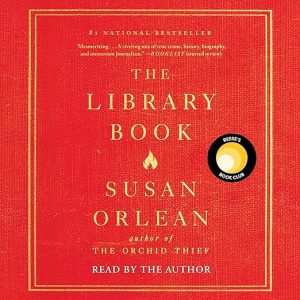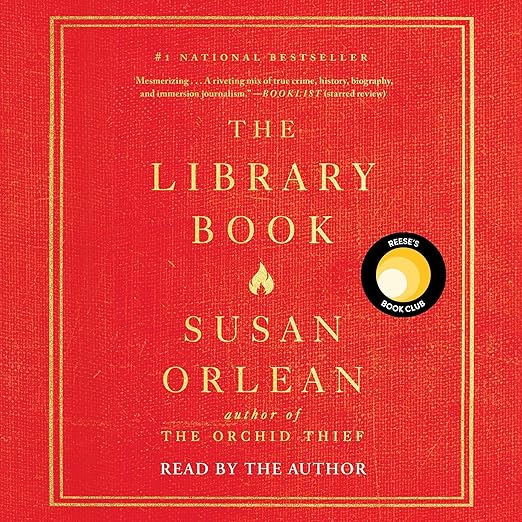
Susan Orlean begins The Library Book with a fire and never entirely leaves it. On April 28, 1986, a fire burned through the Los Angeles Public Library for more than seven hours, reached two thousand degrees, and destroyed four hundred thousand books while damaging seven hundred thousand more. The mystery of whether someone set it intentionally, and if so who, remains unsolved more than thirty years later. This audiobook, twelve hours and nine minutes long and narrated by Orlean herself, is simultaneously a fire investigation, a love letter to libraries, and an argument for why the institution matters in ways its budget line never captures. As a New York Times Notable Book and Reese's Book Club pick, it arrived with significant critical weight, and the narration is the reason it deserves every hour of your attention.
The Verdict, Briefly
Orlean is a New Yorker writer, which means she approaches nonfiction with a specific sensibility: deep reporting, structural patience, a resistance to arriving at the conclusion before the material earns it. The critical reception was strong enough that the press pulled superlatives from multiple outlets. USA Today called it a sheer delight. The Washington Post told book lovers to check it out. The New York Times described the writing as exquisitely written and consistently entertaining. One reviewer compared it favorably to Orlean's earlier The Orchid Thief while noting the different narrative register, less single-thread propulsive, more panoramic and meditative.
That panoramic quality is the book's most distinctive choice. Orlean does not treat the fire as merely a thriller hook. She weaves the investigation of Harry Peak, the blond-haired actor long suspected of setting the blaze, through a broader account of library history, the evolution of the Los Angeles Public Library specifically, the people who work in its departments, and the philosophical question of what it means when a collection burns. The approach demands patience from listeners but rewards it with the sense of having understood something you did not understand before. The LAPL fire becomes an occasion to think about what libraries are actually for and what it costs when they are destroyed.
Why Listen to The Library Book
Orlean narrating her own book is the strongest possible argument for the audio format here. Her voice carries the specific quality that characterizes her best reporting: curiosity without performance, care without sentimentality. When she describes her childhood memories of libraries, stitched throughout the book as a counterpoint to the institutional history, the personal register is entirely natural rather than inserted for warmth. She is not performing emotion about libraries; she clearly has it, and that distinction is audible across twelve hours in a way that a hired narrator's rendering of the same passages could not replicate.
The fire investigation sections benefit equally from her delivery. Orlean reportedly attempted to burn a copy of a book herself to understand what the LAPL fire might have required, and her description of that experiment carries the deadpan precision of someone who takes research seriously enough to conduct slightly absurd experiments. Her own delivery of her own wit lands cleanly because she knows exactly where the irony is meant to sit, which is something a narrator working from a transcript cannot reliably know.
Orlean's research for this book included spending considerable time inside the Los Angeles Public Library, getting to know the specific librarians who work each department, and tracing the investigation of Harry Peak through records and interviews. That groundwork is audible in the narration. When she describes a particular corner of the map room or a specific librarian's relationship to her collection, the specificity is not atmospheric decoration; it is the result of genuine reporting that she delivers with the authority of someone who was physically present. The audio format lets that authority come through in ways that reading a book review about her research cannot.
Points to Consider
The Harry Peak sections are the most narratively tense portions of the audiobook, and Orlean handles them with careful ambiguity. Peak died before ever being charged, which means the investigation remains permanently open. Orlean does not resolve what cannot be resolved; she traces the investigation's contours, Peak's personality, his relationship to the library, the circumstantial evidence, and the reasons it never coalesced into charges. Listen for how she maintains genuine journalistic neutrality about Peak's guilt while making him a fully human figure rather than an accusation wearing a human face. That is harder to do than it sounds, and she sustains it across multiple chapters.
The sections about the library's current operations, bringing each department to vivid life, are the book's most unexpected pleasures. Orlean's portraits of specific librarians and their relationships to their collections humanize the institution in a way that abstract arguments for library funding cannot. These passages are also where her reporting instincts are most evident; she is as interested in individual people as she is in the systems they inhabit, and the two levels of inquiry reinforce each other throughout.
Who Should Pick Up The Library Book
Anyone who has strong feelings about libraries, either from childhood memory or adult appreciation, will find this audiobook a satisfying twelve-hour companion. Listeners who enjoy literary true-crime adjacent to cultural history will appreciate the Harry Peak investigation woven through the institutional narrative. Those who know Orlean from The Orchid Thief or her New Yorker work will find this audiobook consistent with her strengths and deepened by her narration. Listeners who want a propulsive, single-thread mystery thriller should know the book's pacing is meditative and wide-ranging rather than tightly focused. It asks for the kind of attention you give a long feature story rather than a procedural, and the twelve hours spent that way are well worth it.
- Voice: Susan Orlean narrating her own book is the audiobook's defining asset, her New Yorker journalist's cadence and genuine feeling for the subject give the fire investigation and the library's history an intimacy no hired voice could replicate.
- Big ideas: institutional memory and love, arson investigation and unsolved crime, libraries as public soul
- Atmosphere: Warm and investigative, elegiac and occasionally funny
- Worth it?: Susan Orlean's self-narrated audiobook turns a fire that destroyed 400,000 books into a meditation on why libraries matter, and her voice makes every hour of the twelve-hour listen feel necessary.
Frequently Asked Questions
Does Susan Orlean narrating her own audiobook add something meaningful, or is it similar to any professional narrator?
Orlean's self-narration is one of the audiobook's defining qualities. Her New Yorker journalist's cadence and genuine personal connection to the subject give the fire investigation and library portraits an intimacy that a hired narrator working from the same text would find difficult to replicate.
Does the audiobook resolve the mystery of who started the fire, or does it leave it open?
Orlean maintains journalistic ambiguity throughout. Harry Peak, long suspected but never charged, died before the case could be resolved. The audiobook traces the investigation's contours and Peak's character with care but does not assign guilt where the evidence never allowed certainty.