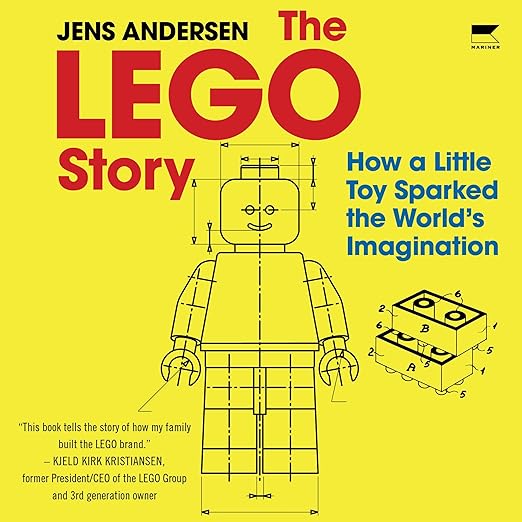
Quick Take
- Narration: Pete Cross delivers a clean, engaged performance that gives the material an appropriate fairytale register without sentimentalizing the harder business chapters.
- Themes: Family legacy and generational stewardship, the philosophy of play, reinvention under crisis
- Mood: Warm and richly detailed, with darker undercurrents in the near-bankruptcy chapters
- Verdict: A more substantial corporate biography than the subject matter might suggest, anchored by unprecedented archive access and honest reckoning with the company’s mistakes.
I was not expecting to spend an entire Saturday with this one. The Lego Story caught me off guard in the way the best business biographies do, not by being a business biography at all, but by being a family story that happens to have a balance sheet. Jens Andersen, a Danish journalist and author, was given access to Lego’s private archives and extensive conversations with Kjeld Kirk Kristiansen, grandson of founder Ole Kirk Christiansen and the man who ran the company through its most volatile decades. That access shows on every page.
I started listening while doing something else and gradually stopped doing everything else. The early chapters on Ole Kirk Christiansen, the carpenter who started making wooden toys in a small Danish workshop in the 1930s, have a quality that one reviewer accurately described as fairytale-like. They are also, quietly, devastating, since we know from the outside that this small carpentry business will nearly collapse at least once before it becomes the world’s largest producer of play materials. Andersen holds that knowledge in reserve, letting the rise feel genuine before the fall arrives.
Our Take on The Lego Story
The book covers ninety years of corporate history across five generations of family ownership, and it does so without the plodding chronological march that kills most corporate histories. Andersen organizes around themes and turning points: the shift from wood to plastic, the invention of the stud-and-tube brick system that made the pieces interoperable, the catastrophic over-expansion of the 1990s and early 2000s that nearly destroyed the company, and the recovery under Jorgen Vig Knudstorp. Each phase illuminates something about the central philosophical argument of the book, which is that Lego’s survival has depended on its founder’s belief that play is not frivolous but essential to human development.
That philosophy, sometimes dismissed as marketing language, turns out to have real organizational consequences. When Lego expanded recklessly into theme parks, video games, and wildly diversified product lines that strayed from the core brick concept, the company nearly went bankrupt. The near-death experience of the early 2000s is the most gripping section of the book. Andersen does not moralize, but the structural argument is clear: the companies that survived were the ones that remembered what they were for.
Why Listen to The Lego Story
The archive access is the book’s decisive advantage over every previous account of Lego’s history. Never-before-seen photographs from the family’s private collection are available in the accompanying supplemental PDF, which is worth downloading before you begin. The oral history quality of the Kristiansen conversations gives the family chapters an intimacy that institutional histories rarely achieve. You understand why Ole Kirk named the company Lego, a contraction of the Danish leg godt meaning play well, and why that name functioned as a kind of internal compass for decisions that otherwise might have felt arbitrary.
Pete Cross’s narration suits the material well. He has a warmth that matches the book’s register without becoming cloying during the business crisis chapters. At nearly twelve hours, the runtime is substantial, and Cross maintains consistent energy throughout. The supplemental PDF includes photographs that are genuinely worth pausing to examine, particularly the images from the early workshop years.
What to Watch For in The Lego Story
One reviewer noted, gently, that Andersen handles the company’s failures with considerable softness. The sexist management culture that characterized certain periods of Lego’s history is mentioned briefly enough that readers can fill in the omitted details themselves. This is a book written with the cooperation of the founding family, and that cooperation comes with certain editorial constraints. Andersen is not sycophantic, exactly, but he is clearly protective of the brand he spent years embedded in. Listeners expecting unflinching corporate journalism will find the book warmer than that.
What they will also find, and what surprised me, is the depth of Andersen’s engagement with the cultural history of childhood and play. The book situates Lego’s rise alongside shifts in how Western societies understood what children needed, from structured instruction to open-ended creativity. That context makes the company’s commercial decisions feel like symptoms of larger cultural arguments rather than mere business choices.
Who Should Listen to The Lego Story
Anyone who grew up with Lego, which is to say roughly any adult under sixty in the developed world, will find this book personally resonant. Beyond nostalgia, it holds up as a genuinely thoughtful case study in brand stewardship, generational transition, and the dangers of losing sight of a core product philosophy. It works as a business school text and as a cultural history and as a biography of an unusual family. Listeners who want the unvarnished corporate investigative account may wish to supplement it with other sources, but as an authorized history with rare access, The Lego Story is the fullest account of this company currently available on audio.
Frequently Asked Questions
Does this book cover the near-bankruptcy crisis of the early 2000s, or does it focus mainly on the founding decades?
The crisis is covered in significant depth and represents one of the book’s most compelling sections. Andersen traces the over-expansion under Kjeld Kirk Kristiansen and the recovery under Jorgen Vig Knudstorp, including the strategic return to the core brick concept.
Is the supplemental PDF that accompanies the audiobook worth downloading?
Yes. It contains photographs from the family’s private archive, including images from the early workshop years in Denmark that are not available elsewhere. Pausing to look at them during the early chapters enhances the listening experience considerably.
Does Jens Andersen have any critical distance from Lego, or is this essentially an authorized company history?
It is authorized in the sense that Andersen had full archive access and extensive cooperation from the founding family. He is gentler with the company’s failures, including its management culture issues, than an independent journalist might be. The book is honest about the near-bankruptcy but protective of the brand overall.
How much business detail does this cover versus cultural and family history?
The balance shifts by section. The founding chapters are primarily family and cultural history. The middle sections cover product innovation and international expansion with more business specificity. The crisis and recovery chapters are the most analytically business-focused. Overall the family story carries more weight than the financial mechanics.