Quick Take
- Narration: Cameron Goodall handles FitzSimons’s muscular prose with energy, though the dramatic emphasis occasionally overreaches in the quieter biographical passages.
- Themes: Individual heroism within institutional failure, Gallipoli and the Western Front as character-forming experiences, the construction of national legends
- Mood: Patriotic and propulsive, with a partisan undercurrent that some will embrace and others flag
- Verdict: A vivid portrait of an extraordinary soldier that carries the genuine strengths and documented limitations of FitzSimons’s approach to military history.
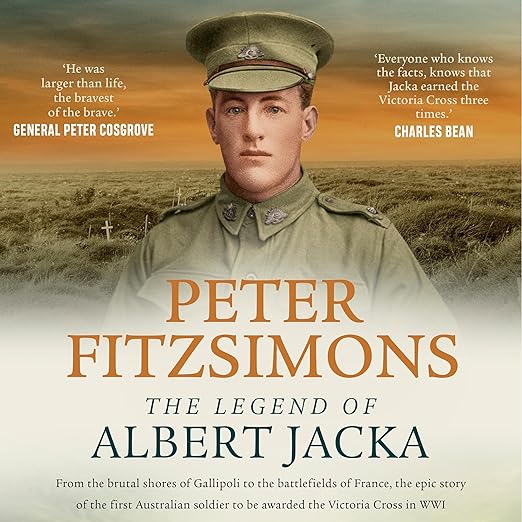
Peter FitzSimons has written more Australian military history than almost anyone alive, and The Legend of Albert Jacka sits firmly within his project of recovering figures who have faded from public consciousness without, in his view, sufficient commemoration. Albert Jacka is the ideal subject for that project: the first Australian soldier to win the Victoria Cross in World War I, a man who fought at Gallipoli, at Pozières, at Bullecourt, and at Villers-Bretonneux, accumulating citations for actions that the historical record describes as genuinely extraordinary. The story FitzSimons tells is not an invention. The question is what kind of telling it receives.
I listened through a series of late-night sessions, which suited the book’s pace. Cameron Goodall’s narration is energetic and committed, which serves the battle sequences well. FitzSimons writes combat with kinetic immediacy, and Goodall matches that energy. When the prose slows for the interwar sections and the human costs of Jacka’s service, Goodall adjusts accordingly. The performance is professional throughout.
What Jacka Did at Gallipoli on 20 May 1915
The Victoria Cross action is the book’s foundational event, and FitzSimons reconstructs it with maximum vividness. The Turks had launched a full-scale frontal attack. Jacka’s comrades lay dead or dying around him. He held off the assault alone, and the Turks retreated. Military historian Charles Bean, writing about a subsequent action at Pozières, called it the most dramatic and effective act of individual audacity in the history of the AIF. FitzSimons quotes Bean at length, and Goodall delivers the quotation with appropriate weight.
The Victoria Cross at Gallipoli was followed by a Military Cross at Pozières for an action that Charles Bean, the official Australian war historian, called the most dramatic and effective act of individual audacity in the history of the AIF. Jacka was then wounded and gassed at Villers-Bretonneux. He carried the war home in his body as well as his memory, and FitzSimons traces that aftermath with the seriousness it deserves.
What makes Jacka a more interesting subject than a standard hero biography is the gap between his battlefield performance and his postwar trajectory. He survived the war gassed and wounded, returned to Australia, struggled in business, and died relatively young. FitzSimons handles this trajectory with genuine care. The legend-building that gave the book its title was a posthumous process, and the distance between the living man and the national icon is quietly present throughout the narrative.
FitzSimons’s Register and Its Known Limitations
One reviewer’s criticism is worth acknowledging seriously. The reviewer described FitzSimons as having a chip on both shoulders when it comes to the British, and characterized the tone as pantomime, Aussies cheering versus British villains. Another reviewer described the writing style as almost schoolboy-like. These are real limitations that recur across FitzSimons’s military history work. He writes popular history in the mode of narrative advocacy, not academic history. If you come expecting the even-handedness of a John Keegan or the structural analysis of a Geoffrey Blainey, you will be disappointed.
The reviewer who gave five stars called it a passionately written inspirational biography of an Australian war hero and described it as important and enjoyable for anyone interested in Australian military history. Both responses are honest reactions to the same book. FitzSimons delivers vivid advocacy and, at times, argumentative imbalance. Which of those dominates your experience depends on what you bring to it.
The Full Arc: Gallipoli to France
One of the book’s structural strengths is its coverage of Jacka’s full arc across multiple theaters. Too much Gallipoli writing treats the campaign as self-contained, but Jacka’s story is continuous, from the Anzac Cove landing through the Western Front battles that consumed so many survivors of 1915. FitzSimons situates the Western Front sections within the larger argument about what the AIF contributed to the Allied cause, and that framing gives the later chapters a context that purely campaign-focused accounts miss.
Who Should Listen and Who Should Skip
The Legend of Albert Jacka is for listeners who want a vivid, emotionally engaged narrative of one extraordinary soldier’s service, and who are comfortable with the patriotic register FitzSimons brings. Australian listeners, and particularly those with family connections to World War I service, will find it resonant. International listeners unfamiliar with Jacka will learn a great deal about a figure who deserves wider recognition.
Listeners who want analytical balance, or who find FitzSimons’s tendency to frame the British as antagonists to Australian achievement consistently irritating, should be aware of that before committing to sixteen hours. The reviews reflect this split: the three-star review is a signal, not an outlier. The 149 ratings and 4.4 average suggest that FitzSimons’s core audience finds the book delivers what they come for, and on the evidence of the military biography itself, they are not wrong. Jacka’s story is genuinely extraordinary, and FitzSimons does not invent the tension between Australian troops and British command; it was documented at the time and is well-established in the historiography. The question is one of emphasis and register, not fabrication. Goodall’s sixteen-hour performance holds the energy well, and the book earns its length through the breadth of campaign coverage rather than through repetition.
Frequently Asked Questions
What did Albert Jacka do to earn the Victoria Cross at Gallipoli?
On 20 May 1915, during a Turkish assault at Gallipoli, Jacka single-handedly held off the attack after his comrades had been killed or wounded around him, forcing the Turks to retreat. It was the first Victoria Cross awarded to an Australian soldier in World War I.
Is FitzSimons’s approach to British commanders in this book notably critical?
Yes, and this is a consistent feature of FitzSimons’s military history writing. He writes from a strongly pro-Australian perspective that often frames British command decisions as failures that Australian troops had to overcome. Listeners should be aware of this framing before starting.
Does the book cover Jacka’s life after the war?
Yes. FitzSimons follows Jacka through his difficult postwar years, his business struggles, and his relatively early death. The gap between the wartime legend and the postwar man is one of the more thoughtful aspects of the narrative.
How does Cameron Goodall’s narration handle the battle sequences versus the biographical sections?
Goodall is strongest in the combat sequences, where FitzSimons’s energetic prose is well-served by Goodall’s pace and commitment. Some listeners may find the dramatic register occasionally overextended in the quieter biographical and reflective passages.