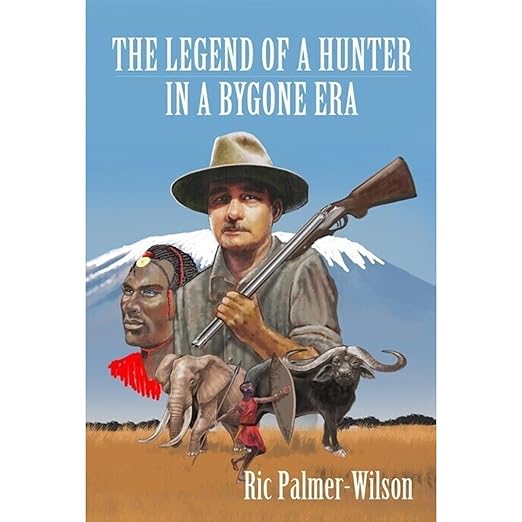
Clary Palmer-Wilson was fourteen years old in 1921 when he left home for the untamed bushlands of East Africa to become a hunter. The chronicle of his life across those wilds, compiled by Ric Palmer-Wilson in The legend of a hunter in a bygone era, opens a window onto a world so thoroughly gone that it functions almost as speculative history, except that every incident in it actually happened. This audiobook, narrated by Virtual Voice across eighteen hours and twenty minutes, presents a collection of episodes that reviewer Patricia Steiner described as reminiscent of a swashbuckler's character where life and death adventures were part of everyday living and survival was mostly a form of luck. Reviewer Dr. R. A. Cordes put it plainly: had he not read this book, he would have remained ignorant of what it was like to be born in an African age when leopards regularly wandered into town at night and a child could enter the world of big game hunting at the age of thirteen.
Hunting the Crown Prince, Matter-of-Factly Told
The book's structure is episodic rather than conventionally biographical. Ric Palmer-Wilson, in reconstructing his subject's life, organizes the material around individual incidents and periods rather than a continuous chronological narrative. Clary Palmer-Wilson's attempts at farming, gold mining during the Lupa gold rush, and running a garage sit alongside accounts of his hunting exploits, each enterprise reflecting the economic precariousness of a life in the East African bush between the wars and after. The hunting accounts carry an authenticity that distinguishes them from safari adventure fiction. The man-eaters of Mtwara, the near-fatal poisoning by tribesmen, the encounter described as hunting the Crown Prince, the unknowing consumption of human tissue during a meal with tribesmen: these incidents are documented with the matter-of-fact detail of a man for whom such events were simply part of what happened. They are extraordinary to a modern reader precisely because Palmer-Wilson does not treat them as extraordinary.
Reviewer Richard H. Loftin described Clary Palmer-Wilson as living an enviable life more akin to fantasy in our sterile modern world and compared him to the last of the American Mountain Men, facing death on a regular basis in ways that contemporary readers can barely imagine. That comparison is useful. This is a book about a type of person and a type of existence that no longer have any viable context, and the sadness of that awareness runs beneath the adventure in every chapter. The Lupa gold rush sequence is particularly striking, showing Palmer-Wilson trying to operate like every other prospector while being drawn back constantly to the bush by an orientation toward the natural world that no economic opportunity could fully override.
Handles Fact Acceptably, Misses the Human Warmth
The audiobook's eighteen-hour runtime reflects the breadth of material Palmer-Wilson assembled. This is not a slim memoir but a comprehensive account of a long life lived in extreme circumstances, and the episodic format means that listeners can engage with individual sections without losing the thread of the whole. The incident-driven structure also means that the audiobook rewards listeners who follow one episode at a time rather than trying to process eighteen hours in compressed sessions. Virtual Voice narration handles the factual, descriptive content of the material acceptably, and for a book built from incident and external detail rather than psychological interiority, that adequacy is less limiting than it would be for a more literary memoir. The sheer accumulation of genuinely extraordinary events carries the narrative forward even when the narration cannot provide the human warmth a personal story like this deserves.
Listeners who enjoy colonial-era African adventure writing in the tradition of Peter Capstick or J.A. Hunter will find Clary's story occupying a similar register with the additional weight of documented personal history rather than third-hand account. The world Palmer-Wilson inhabited, where a fourteen-year-old could plausibly make a living as a hunter in the East African bush, is as remote from contemporary experience as the medieval period, and the book makes that distance vivid rather than merely stating it.
Flattened Personality and Humor Behind the Words
The colonial context of the narrative requires a thoughtful listener. This is a book about white hunting life in East Africa across a period of profound exploitation and violence against African populations, and the perspective is necessarily that of a participant in the colonial system whose relationship to that system is assumed rather than examined. The hunting content is extensive and explicit. Those who are uncomfortable with big-game hunting as subject matter will find much of the book difficult to engage with, as it is not peripheral to the narrative but central to it. Virtual Voice narration is the production's clearest limitation. The storytelling voice that gives personal adventure memoirs their energy, the sense of a specific person's personality and humor behind the words, is flattened by AI narration in ways that eighteen hours makes noticeable. A human narrator with real vocal character would serve this material significantly better.
Eighteen Hours of Virtual Voice, or Skip It
Listeners drawn to the Peter Capstick tradition of East African hunting memoir, who want a book-length immersion in a world that has completely disappeared, and who can engage with the colonial context critically will find this audiobook rewarding. History readers interested in interwar East Africa, the Lupa gold rush, and the practical daily realities of the hunting era beyond romanticized accounts will encounter unusually specific documentation here. The strong reviewer ratings across a substantial sample suggest the content has found a dedicated audience who values the material despite the production's limitations. Skip this if hunting content troubles you, if Virtual Voice narration across eighteen hours is not a format you find listenable, or if you want a conventionally structured biography rather than an episodic adventure chronicle built from incident rather than arc.
- Narration: Virtual Voice narration delivers the episodic adventure content adequately but cannot replicate the storytelling personality that a book built from lived memory requires for full effect.
- Themes: Colonial Africa's last wilderness era, survival and adaptation, the hunter as a vanishing type
- Mood: Adventurous and retrospective, with the quality of stories told around a fire by someone who actually lived them
- Verdict: Ric Palmer-Wilson's account of an extraordinary life in the East African bush is genuinely remarkable material that the Virtual Voice narration cannot fully honor.