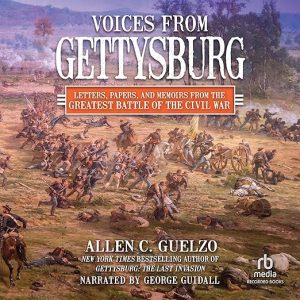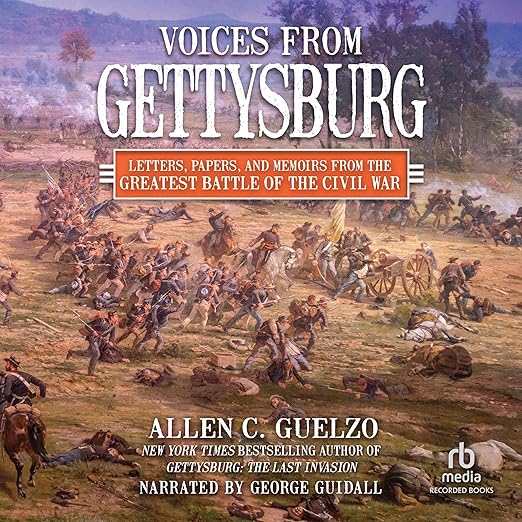
Voices from Gettysburg takes a structural approach to Civil War history that cuts past the usual bird's-eye analysis. Allen C. Guelzo, a New York Times bestselling historian and among the most respected Civil War scholars working today, assembled a documentary anthology built from original letters, never-before-published papers, memoirs, and dispatches. This audiobook, narrated by George Guidall across twelve hours, presents these documents in chronological sequence, moving through the three days of battle from July 1 to July 3, 1863, in the words of the people who experienced them. Reviewer Jeffrey N. McCollum described how Guelzo weaves a narrative through the voices of soldiers from senior officers to conscripts, Lincoln in his correspondence, Longstreet arguing against Pickett's Charge, townsfolk, reporters, and politicians, with the result being something that transcends standard battle history.
The anthology structure has a specific effect on the listener's relationship to the battle. Rather than receiving an authoritative account of what happened and why, you receive fragments of experience that accumulate into something more emotionally present than analysis can achieve. A Union staff officer's diary entry from the evening of July 1st. A Confederate artilleryman's letter home written before Pickett's Charge. A Northern woman's account of the town of Gettysburg during the Confederate occupation. A drummer boy's description of what he heard and could not see from his position. A fearful college student hiding as the armies moved through the surrounding countryside. These voices are unreliable in the way that all firsthand accounts are unreliable. They contradict each other on details of timing and position. They are shaped by their authors' interests and fears and the particular angle of sight they occupied. That friction is part of the point, and Guelzo's editorial judgment in selecting and sequencing these documents means the friction illuminates rather than confuses.
Guelzo provides connective framing that situates each document in the larger tactical and political context. The book includes maps, a detailed order of battle, and a comprehensive unit list that help listeners track the geographic and organizational logic of what they are hearing. At twelve hours, the production gives the material enough space to breathe. The opening moves at Brandy Station and Winchester, Virginia are covered before the battle proper begins, which gives the Gettysburg encounter its appropriate historical context rather than treating it as an isolated event that sprang from nowhere on July 1st.
Guidall Reads Primary Sources Like a Skilled Presenter
George Guidall is among the most experienced audiobook narrators in American publishing, with credits spanning decades and thousands of titles. His voice for this project is precisely calibrated: deep and steady, capable of carrying both formal military correspondence and the more personal register of a frightened college student's diary entry. He does not perform these documents as actors perform characters. He reads them as a skilled presenter reads primary sources, with enough engagement to honor the material and enough restraint to let the words do their own work. Reviewer Grand Army Boy called it a great addition to the history of the battle as experienced by people who were there, and Guidall's narration is a large part of why that description holds across twelve hours.
For listeners who already know the broad outlines of Gettysburg, the documentary approach adds texture that no narrative account can supply. Reviewer Little Richie, describing himself as an amateur historian who had read several books and visited the battlefield multiple times, found that Voices from Gettysburg helped fill in loose ends and connect the battle to its circumstances in ways that conventional histories had not. That is precisely what primary source material does that secondary analysis cannot: it restores the contingency and confusion that post-hoc accounts inevitably organize away.
From Artillery Barrage to a Civilian's Cellar
The anthology format places demands on the listener that a conventional narrative history does not. There is no single protagonist to follow, no through-line of personal development. The experience is cumulative and sometimes jarring. A detailed account of an artillery barrage is followed immediately by a civilian's account of hiding in a cellar, and the tonal shifts can be abrupt. Listeners who want a clear story of Gettysburg with causes, decisions, and consequences sequenced into a coherent single argument will find this format less satisfying than a traditional military history. The book also presupposes some familiarity with the Civil War's broader context. The references to Lincoln's frustrations with General Meade, to Longstreet's disagreements with Lee before the final charge, and to the strategic implications of the Confederate retreat will carry more meaning for listeners who already know why those details matter than for those encountering the campaign for the first time.
Deeper Than Conventional Accounts Allow
Civil War enthusiasts who have read the standard histories and want to get closer to the human texture of the battle will find this audiobook genuinely enriching. Listeners interested in primary source documentation as a form of historical writing, rather than analysis or narrative, will also respond to what Guelzo has assembled here. Amateur historians who have visited the battlefield and want to hear the voices behind the monuments and markers will find this a deeply satisfying companion that makes those sites more present. Skip this if you are new to Civil War history and want a clear explanatory account of what happened and why, or if you find the absence of a single narrative perspective disorienting over twelve hours. This is a book for people who already love the subject and want to go deeper than conventional accounts allow.
- Narrator: George Guidall's deep, measured voice lends gravity to the primary source material without editorializing, which is exactly the right approach for a documentary anthology.
- Subjects: Civil War's turning point, the experience of battle from every rank, Lincoln's political pressures
- Tone: Sober and immersive, with the cumulative weight of many individual voices
- Bottom line: Guelzo's primary source anthology gives Gettysburg back to the people who were there, and Guidall's narration makes every voice feel distinct and present.
Does the Voices from Gettysburg audiobook require prior knowledge of the Civil War?
Some familiarity with the Civil War's context helps significantly. Guelzo provides connective framing between documents, but references to Lincoln's correspondence with Meade, the significance of specific commanders, and the strategic stakes will carry more meaning for listeners who already have some background.
Is this audiobook a narrative history or a documentary anthology?
It is a documentary anthology. Guelzo assembles original letters, unpublished papers, diary entries, and memoirs and presents them in chronological order with framing context. There is no single narrator protagonist or conventional military narrative arc.
How does George Guidall handle the variety of voices and document types in this audiobook?
Guidall reads the documents with measured authority rather than performing them as distinct character voices. His consistent register works well for primary source material because it honors the documents without theatricalizing them. The variety comes from the material itself rather than from vocal performance differences.
Does the Voices from Gettysburg audiobook cover events before and after the three-day battle?
Yes. The book covers the opening moves at Brandy Station and Winchester before the battle begins, provides context for the march toward Gettysburg, and follows through Pickett's Charge, the Confederate retreat, and Lincoln's Gettysburg Address. The three-day battle sits within a broader chronological frame.