Quick Take
- Narration: Anderson Lincoln reads with calm conviction, which is the right register for Neville Goddard’s teaching style.
- Themes: consciousness and manifestation, the power of assumption and imagination, faith as a practical tool
- Mood: Quiet and contemplative, designed for focused listening rather than passive background audio
- Verdict: A concentrated nine-minute distillation of Neville Goddard’s core philosophy that functions as an accessible entry point rather than a comprehensive study.
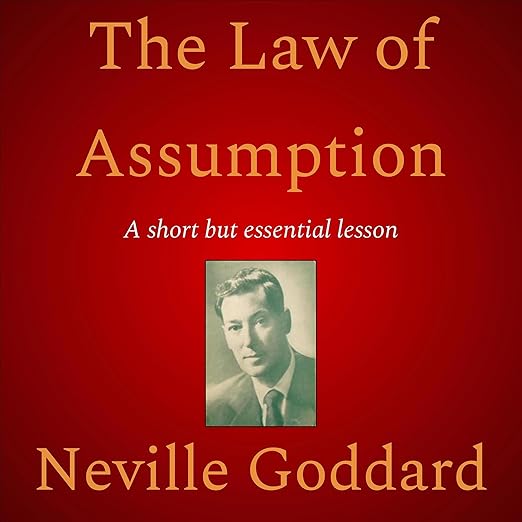
Nine minutes is not very long. I want to say that upfront, because The Law of Assumption is not an audiobook in the conventional sense. It is a brief recording, produced under the banner of a publisher called The Universe Unveiled, that packages a single lesson drawn from the teachings of Neville Goddard, one of the 20th century’s most influential and singular metaphysical thinkers. I listened to it on a slow Tuesday afternoon, partly out of curiosity about the 4.6 rating it carries from over five hundred listeners, which is an unusually high engagement number for something this short. That kind of sustained attention points to material people return to rather than simply consume once.
Neville Goddard worked and wrote in the mid-20th century, developing a philosophy rooted in the idea that consciousness is the only reality, and that what you assume to be true about yourself and the world shapes your actual experience of it. The Law of Assumption is his central principle: assume the feeling of your wish fulfilled, and reality will rearrange itself to conform to that assumption. It’s a teaching that sits somewhere between New Thought philosophy, mystical Christianity, and practical psychology, and it has experienced an extraordinary revival in the digital age through YouTube lectures, TikTok manifestation communities, and renewed popular interest in related figures like Bob Proctor, whom several reviewers mention as their entry point into Goddard’s work.
What Nine Minutes Can and Cannot Do
The recording does what it promises in the synopsis: it delivers a single lesson with focus and clarity. Anderson Lincoln narrates with measured calm, giving Goddard’s ideas the contemplative space they require. Goddard’s language is not modern, and Lincoln doesn’t try to modernize it. He reads with respect for the source material, allowing the slightly formal cadence to communicate the seriousness with which Goddard held these ideas. That tonal fidelity is important: Goddard’s philosophy depends on a certain quality of earnestness, and narration that approached it with ironic distance or casual delivery would undermine the material entirely.
What nine minutes cannot do is serve as a comprehensive introduction to Goddard’s philosophy. It is a fragment, a single teaching extracted from a much larger body of work. Listeners who find it resonant should follow up with Goddard’s longer published lectures, particularly books like Feeling Is the Secret or The Power of Awareness, which are widely available in audio form and develop these ideas with considerably more depth and practical application across multiple life situations.
Who Finds This Useful and Why
The reviewer testimony here is striking in its specificity. One listener described applying the technique to a job application, being rejected, then using the method of imagining themselves already accepted, and receiving an unexpected follow-up call opening a process for their situation. Another traces their path from Bob Proctor’s work to Goddard, noting that this recording provided clear, actionable processes in plain and simple language. A third emphasizes that Goddard himself acknowledged he had not mastered his own techniques, a candor that several readers found refreshing rather than undermining. What emerges from these accounts is a portrait of listeners using this brief recording as a meditative anchor they return to repeatedly, rather than a single comprehensive resource that answers all questions once and is set aside.
The Honest Limitations of This Recording
At nine minutes, the lack of context around Goddard’s broader framework means that first-time listeners may leave with questions the recording doesn’t have space to answer. The synopsis describes it as an experience of life-changing power, which is the kind of promotional language that tends to oversell short products. The teaching itself is genuine Goddard, but the packaging is thin. Listeners who already have some familiarity with New Thought philosophy or Goddard’s work will extract considerably more value than those coming in without any frame of reference. As a standalone listen, it functions as an introduction and a prompt, not a destination. For committed skeptics of manifestation philosophy, nine minutes at no cost is a low-risk way to encounter the ideas. For those already embedded in this tradition, it functions as focused reinforcement of the core principle rather than new information.
Where This Sits in the Goddard Catalogue
Neville Goddard published extensively across his lifetime, and the audio landscape for his work ranges from original recordings of his actual lectures, available freely online despite varying quality, to contemporary narrated adaptations like this one. This recording occupies a specific position: it is clear, well-produced, and accessible, but it’s a thumbnail of a much larger intellectual and spiritual project. Listeners who start here and want to go deeper will find Goddard’s original lectures, particularly those from the 1950s and 1960s, offer something this recording cannot replicate: the full architecture of his thinking, built argument by argument across hours rather than delivered in a single concentrated burst. The nine-minute format is a genuine limitation, but as a free audiobook introduction to one of the most influential alternative spiritual thinkers of the 20th century, it earns its high rating honestly. For listeners who are simply curious about where the contemporary manifestation conversation traces its intellectual roots, this recording offers one clean, accessible point of entry. Goddard’s influence on modern self-help, spirituality, and consciousness-focused communities is considerable, and understanding his central teaching in the form he articulated it is more valuable than encountering it filtered through secondary interpreters. Goddard’s particular synthesis of scripture, metaphysics, and practical instruction has no close analogue in mainstream self-help, and encountering it in even this brief audio form offers something genuinely distinct from what most manifestation content provides.
Frequently Asked Questions
Is this a recording of Neville Goddard himself speaking, or is it a narrator reading his work?
This is a narrated adaptation, not a recording of Goddard himself. Anderson Lincoln reads the material on behalf of the publisher The Universe Unveiled. Recordings of Goddard’s actual lectures are available separately online and are considered essential by dedicated students of his work.
At only nine minutes, is this worth the time, or is it better to find free resources on Neville Goddard?
Given that it is currently listed at no cost on Audible, the time investment is minimal. As a free audiobook it is a reasonable way to hear one concentrated Goddard teaching in audio form, though YouTube hosts many of his original lectures freely and at much greater length.
What is the Law of Assumption, and how does it differ from the Law of Attraction?
Goddard’s Law of Assumption holds that what you assume to be true shapes your reality through the mechanism of consciousness itself. The Law of Attraction, popularized by The Secret, focuses on thoughts drawing corresponding experiences. Goddard’s version is more specifically rooted in the felt sense of assumption rather than thought frequency.
Where should I go after this recording if I want to explore Goddard’s work more deeply?
Goddard’s own books, particularly Feeling Is the Secret, The Power of Awareness, and At Your Command, are the essential texts and are available in various audio formats. His original lecture recordings, while older in audio quality, are considered by many students to be the most direct source.