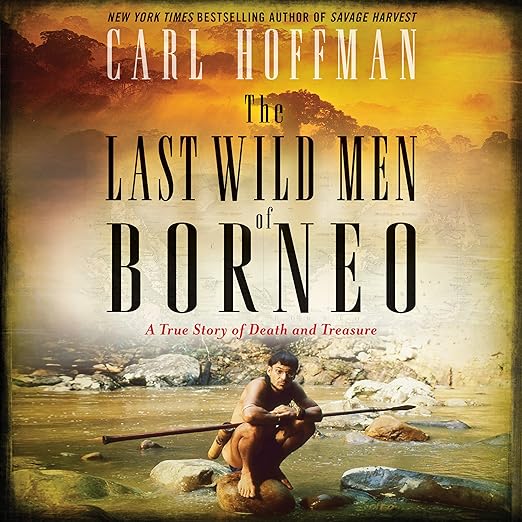
Quick Take
- Narration: Joe Barrett brings a journalist’s tempo to Carl Hoffman’s prose – measured, respectful of the landscape, and capable of the tonal shifts that distinguish the Penan sequences from Hoffman’s more analytical passages.
- Themes: The ethics of outsider engagement with indigenous cultures, environmental activism and its costs, the line between preservation and extraction
- Mood: Quietly unsettling and deeply immersive, like travel writing that refuses to let you stay comfortable
- Verdict: One of the most morally complex and genuinely compelling adventure narratives in recent travel writing – Hoffman handles difficult questions about Western engagement with indigenous cultures with unusual intellectual honesty.
I read Carl Hoffman’s Savage Harvest a few years ago, his account of the search to understand Michael Rockefeller’s death in New Guinea, and it left me with the particular kind of restlessness that good narrative nonfiction produces: the sense that a place and a set of questions have been made real in a way that won’t easily leave. The Last Wild Men of Borneo produces the same effect, and it does it through a structure that’s more ambitious – two parallel biographical portraits that converge around a set of questions neither biography alone could raise.
Bruno Manser, the Swiss traveler who joined the Penan tribe in 1984 and lived among them for years before becoming an environmental activist and eventually disappearing in 2000, is one of the twentieth century’s more genuinely strange figures. Michael Palmieri, the Californian who evaded the Vietnam War and built a career as one of the world’s most successful tribal art collectors, acquiring Dayak artifacts for museums and private collectors, is in many ways Bruno’s photographic negative. Hoffman’s insight is that these two men, who never traveled together and had very different relationships to Borneo, are in a sense pursuing the same sacred fire – and that pursuing it raises the same uncomfortable questions regardless of the form it takes.
Our Take on The Last Wild Men of Borneo
The moral complexity here is the book’s most valuable quality, and it’s handled with a rigor that Hoffman’s best work consistently delivers. Reviewer Anaid made an observation that cuts to the heart of the book’s tensions: both Bruno and Palmieri are white men from the West inserting themselves into a place they didn’t belong, shaped by romantic ideas about the untamed and paradisaical. Bruno’s activism is genuinely heroic – he led the Penan against commercial logging, escaped captivity under gunfire twice, and became an international environmental figure. Palmieri’s artifact collection supplied sacred works to prestigious museums. But the question of who benefits from this engagement, and what it costs the Penan and Dayak communities, doesn’t resolve neatly in either case.
Hoffman is not polemical about this. He grants both men their complexity and their genuine passion without whitewashing the extractive dimension of what they both, in different ways, were doing. This is harder than it sounds – it’s easier to celebrate Bruno as an uncomplicated hero or dismiss Palmieri as a buccaneer than to hold both men in the same ethical frame simultaneously. Hoffman does the harder thing, which is why the book lingers.
Why Listen to The Last Wild Men of Borneo
Joe Barrett’s narration is an asset here. Hoffman’s prose is literary without being decorative – he writes with a journalist’s precision but with novelistic attention to the human texture of places and encounters. Barrett reads it at the pace the material demands: unhurried through the descriptive passages about the Bornean jungle, more urgent during the sections about Bruno’s escape from captivity or his psychological deterioration under strain. At nine hours and eighteen minutes, the book never feels padded, but it also never rushes past the moments that require sitting with.
Reviewer R. E. W., who has read multiple Hoffman books in sequence, finds each one better than the last. The trajectory from Lunatic Express through Savage Harvest to The Last Wild Men of Borneo is a writer developing a sharper sense of the questions he wants to ask about Western engagement with the world beyond its borders – and this book is where those questions become most explicit.
What to Watch For in The Last Wild Men of Borneo
Reviewer William Higgins flagged that the book could have been condensed without losing its overall relevance, and this is a fair criticism. Hoffman’s portraits of both men are thorough, and there are passages – particularly in the Palmieri sections – where the biographical detail accumulates past the point where it’s illuminating the central questions. Reviewer Anaid observed that the link between the two men feels somewhat forced, and I have sympathy for that reading: the structural conceit works better as a frame for the ethical questions than as a claim about the men’s actual relationship to each other.
The Borneo setting itself is extraordinary, and Hoffman’s access – traveling with Penan guides through paths Bruno walked, going up rivers with Palmieri to remote villages – gives the book a ground-level specificity that armchair travel writing can’t replicate. The land itself is a presence in the narrative, which is appropriate given that it is, ultimately, what both men were responding to.
Who Should Listen to The Last Wild Men of Borneo
Readers of narrative nonfiction who want their adventure writing to carry genuine intellectual weight will find this book one of the more rewarding listens in recent travel writing. It’s also essential for anyone interested in the ethics of conservation, tribal art collection, or Western engagement with indigenous cultures – these are the book’s real subjects, and it handles them without flinching. Listeners who want pure adventure without ethical friction may find Hoffman’s questioning mode frustrating. Those who want both the jungle and the questions that come with it will not be disappointed.
Frequently Asked Questions
Did Bruno Manser’s disappearance ever get resolved – does the book provide any answers?
Hoffman investigates the disappearance thoroughly and draws on exclusive access to Manser’s letters, journals, and interviews with his family and colleagues. The book provides the most comprehensive account of what is known, but Bruno’s fate remains officially unresolved – he was declared dead in 2005. Hoffman’s investigation produces informed conclusions rather than definitive answers.
Is previous knowledge of Borneo or the Penan people necessary to follow the narrative?
No. Hoffman is writing for readers who don’t know the region, and he provides the historical and cultural context needed to follow both biographical threads. The book works as an introduction to Borneo, the Penan, and the Dayak as much as it works as a portrait of its two central figures.
How does Joe Barrett’s narration handle the switches between Bruno’s and Palmieri’s stories?
Barrett’s measured, journalistic delivery suits the material’s complexity. He doesn’t dramatize the contrast between the two men but lets the prose make that argument – which is the right approach for a book where Hoffman is deliberately resisting easy moral categorization.
Is The Last Wild Men of Borneo part of a series of Carl Hoffman travel books, or does it stand completely alone?
It stands completely alone as a work of narrative nonfiction, though Hoffman has written multiple other books in the same investigative travel vein, including Lunatic Express and Savage Harvest. Readers who enjoy this one would likely find those equally compelling, and reviewer R.E.W. specifically recommends reading them in sequence.