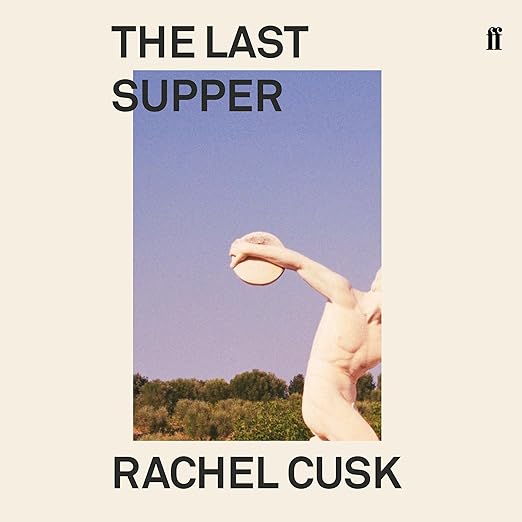
Quick Take
- Narration: Antonia Beamish matches Cusk’s measured, introspective prose with a reading style that is precise and controlled, perhaps slightly cool for listeners who prefer warmer narration, but entirely appropriate for the material.
- Themes: The foreigner’s eye in Italy, art as a lens for self-examination, the difficulties and rewards of family travel
- Mood: Reflective and observational, with passages of real beauty interrupted by Cusk’s characteristic unease with comfort
- Verdict: A distinctly Cuskian travel memoir, not escapist, not romantic, and entirely honest about the exhaustion and occasional transcendence of going somewhere unfamiliar with children in tow.
I came to The Last Supper already a reader of Rachel Cusk’s Outline trilogy, which means I arrived with calibrated expectations. Cusk does not write easy books. She writes books in which the narrator is always slightly exposed, in which beauty and difficulty coexist in the same paragraph, and in which the reader is asked to do more interpretive work than most travel writing requires. I listened to Antonia Beamish’s narration across several evenings that week, usually after dinner, which turned out to be exactly the right context for a book that is largely about observation and unease rather than arrival.
The premise is simple: Cusk, her husband, and their two young daughters spend a summer in Italy. What follows is not a travel guide or an expat fantasy. Cusk is a rigorous, sometimes demanding writer who is interested in what travel reveals about the traveler rather than the destination. The Italy she writes about is real in its light and architecture and food, but it is also a mirror. Every encounter with beauty becomes an opportunity for self-examination. Every friction, and there are frictions, with the climate, with the locals, with the logistics of traveling with small children, becomes material for her characteristically sharp and humane analysis.
Our Take on The Last Supper
What makes this book work, when it does, is the quality of Cusk’s prose. One reviewer called it “limpid and uncontrived,” and that is precise. She does not perform admiration for Italy; she reports it, with the careful specificity of someone who is genuinely looking rather than confirming expectations. The sections on Raphael and Italian Renaissance art are among the strongest in the book, genuinely illuminating rather than decorative, the kind of art writing that makes you want to look at the actual paintings with different attention.
Cusk’s perspective on Italy is not romantic, and that is what makes it interesting. She has no interest in the frothy expat-in-Italy genre that one reviewer describes as full of “flirty Marcellos on Vespas.” Instead she writes about the exhaustion of being a foreigner, the particular social texture of Italian daily life, and the specific difficulty of being a British intellectual in a culture that has very different ideas about aesthetics, leisure, and the relationship between beauty and function. Her observations on the English in Italy are particularly acute, she has both the insider knowledge of a foreigner living closely and the critical distance of someone who is not trying to belong.
Why Listen to The Last Supper
Antonia Beamish is well-cast here. Her narration is controlled and precise, which matches the register of Cusk’s prose without competing with it. Beamish does not editorialize the text through performance; she delivers it with the seriousness it deserves. At just under eight hours, the runtime is comfortable and the listen has a natural rhythm to it, Cusk writes in a mode that rewards a certain kind of relaxed attention rather than urgent forward momentum.
The comparison to Cusk’s later autofiction trilogy is worth making: The Last Supper is an earlier work, written in a more recognizably conventional first-person memoir mode than the Outline books. Listeners who found the Outline trilogy frustratingly oblique may actually prefer this, since it is more direct about its subject matter and its author’s experience within it. But the signature Cusk qualities are present: the self-scrutiny, the interest in other people as a form of indirect self-examination, the refusal to smooth things over.
What to Watch For in The Last Supper
This is not a book for every reader, and it is worth being specific about why. Some reviewers found Cusk’s critical eye relentless, “too critical of everyone and everything” is how one listener put it. That is a fair characterization of what Cusk does, though whether it is a fault depends entirely on what you want from travel writing. If you want affirmation of Italy’s pleasures, this is not that book. If you want a rigorous, intellectually honest account of what it actually feels like to be somewhere unfamiliar with a family, this is exactly that book.
The book’s emotional center, the relationship between the family’s dislocation from their ordinary life and the discoveries that dislocation makes possible, is present throughout but rarely stated directly. Cusk is not a writer who summarizes her own insights for you. You carry that weight as the reader, which is where the demanding quality of her work lives.
Who Should Listen to The Last Supper
Existing Cusk readers will find this valuable as part of the larger body of work, and as a precursor to the formal experiments of her later autofiction. Readers who enjoy literary travel writing in the tradition of writers like Patrick Leigh Fermor or Mary McCarthy, writers for whom place is always a vehicle for thinking rather than an end in itself, will be well-suited to this. If you have come to travel memoirs primarily for wanderlust and practical recommendation, Cusk will frustrate you. But for the right reader, The Last Supper is a serious and beautifully written account of a real experience, rigorously examined.
Frequently Asked Questions
How does The Last Supper compare to Rachel Cusk’s Outline trilogy for listeners who know her later work?
It is an earlier, more conventional first-person memoir than the Outline books. The autofiction technique is not yet in play, making it more directly accessible, Cusk is explicitly writing about her own family’s Italian summer rather than filtering experience through unnamed interlocutors. Fans of the trilogy will recognize her voice immediately, but this is a more traditional form.
Is this a romantic or celebratory book about Italy, or something more complicated?
Decidedly the latter. Cusk has no interest in the idealized expat-in-Italy narrative. Her account is honest about friction, difficulty, and the specific discomforts of being a foreigner with children, balanced by genuine encounters with beauty, particularly in the sections on Raphael and Italian art.
How does Antonia Beamish’s narration handle Cusk’s introspective, sometimes demanding prose style?
Beamish is well-matched to the material, controlled, precise, and serious without being cold. She delivers Cusk’s writing without editorializing through performance, which is exactly right for prose that asks the listener to do interpretive work rather than be guided through it.
Does the book include practical observations about the specific places in Italy they visited, or is it entirely interior?
There is genuine specificity about location and place, Cusk writes with real geographical and cultural knowledge, and the art passages in particular are grounded in specific works and settings. But the purpose of those observations is always reflective rather than recommendatory; this is not a guide to Italy but a mind engaging with it.