A Compact Book From a Man Who Valued Time
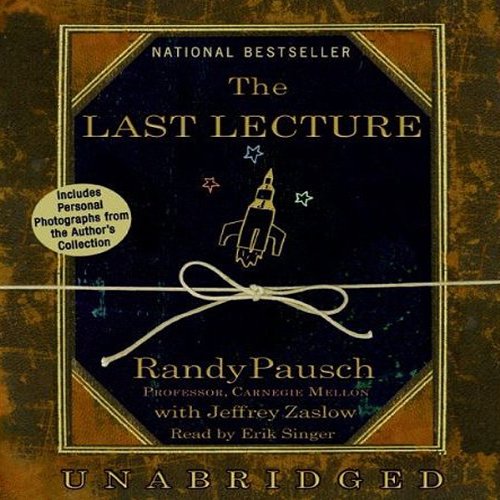
Randy Pausch gave his last lecture at Carnegie Mellon in September 2007, roughly two months after learning his pancreatic cancer was terminal. The lecture was titled 'Really Achieving Your Childhood Dreams,' and it was, as Pausch notes clearly, not about dying. This audiobook, narrated by Eric Singer, delivers the companion book that extended the lecture's ideas into written form, and it is worth sitting with what that means before pressing play. At four hours and thirty-six minutes, The Last Lecture is a compact book, and its compactness is part of its honesty: a man who genuinely believed that time is the most valuable currency you have did not pad his final contribution to unnecessary length. The audiobook format gives this honesty particular weight, you feel the brevity as a choice, not a limitation.
Pausch's argument is distributed across his life story rather than constructed as a formal philosophical treatise. He was a computer science professor with a genuine gift for collaborative teaching, a deep Disney fascination that shaped his sense of what imagination could build, and a childhood filled with specific dreams, playing in the NFL, becoming Captain Kirk, experiencing zero gravity, that he pursued with a seriousness that most adults quietly abandon. The lecture and book track which of those dreams he achieved, which he achieved by proxy through enabling others, and what the process of pursuing them taught him about the difference between obstacles and walls, about what it means to enable other people's dreams, and about what a legacy actually looks like from the inside. The answer, it turns out, is less grand than the word suggests and more specific than most people imagine.
Singer's Restraint Is Harder Than It Looks
Eric Singer brings a measured warmth to the narration that serves the material well. This is not a book that benefits from a demonstrative or emotionally heightened performance, Pausch's own voice in the original lecture was notable for its steadiness, its humor, and its refusal to perform grief. Singer preserves that quality. He does not tell you how to feel about a man talking about his own death; he delivers the material clearly and trusts the content to do its work. In a genre where narrators often over-signal the emotional beats, Singer's restraint is the right call and a harder one to execute well than it might appear.
One reviewer noted that their son had this book assigned as high school summer reading and that the parent found themselves unexpectedly overwhelmed in ways a teenager might not yet have the life experience to fully absorb. That dynamic is real and telling: the book operates differently depending on where you are in your own life. Pausch's advice about obstacles, about enabling others, about seizing time hits differently at forty than it does at seventeen, and the audiobook format, more intimate than reading, more personal in its delivery, amplifies that differential effect significantly. Listening alone in a car or on a commute gives the content a privacy that changes how it lands.
A Father's Record for Children Who Grow Up Without Him
Some readers approach The Last Lecture expecting a deep, structured philosophy of living and find instead a set of anecdotes, life lessons, and personal convictions from a specific kind of high-achieving person in a specific field. Pausch was a computer science professor, a virtual reality pioneer, and a man with a particular set of values that not every reader will share fully. Critics who find the book too ego-driven are engaging with a real aspect of its character, he is writing from a life in which confidence, achievement, and forward motion were core values, and the book reflects that without extensive self-interrogation of those values' limits. If the TED Talk version of intellectual life does not resonate with you, the book may not either.
The book is also explicitly about a father leaving a record for children who will grow up without him. That frame gives the content a particular emotional weight that can be difficult to sit with even when the material itself is being addressed with humor and lightness. Singer handles the more tender sections with appropriate quietness, never pushing toward sentimentality but not retreating from the genuine feeling of the passages either. The advice and the grief are simultaneously present throughout, and the best passages in the audiobook are the ones where Pausch allows both to coexist without forcing a resolution.
What You'd Say If This Were Your Last Chance
This audiobook will resonate most with listeners who have reached a point in life where time scarcity feels genuinely real, parents, people facing illness personally or in their families, professionals in the second half of a career who are assessing what they have built and what they have left to do. The core question Pausch poses, what would you say if this were your last chance to say it, is genuinely useful regardless of how you answer it, and the specific form his answers take is concrete enough to prompt real reflection rather than abstract aspiration.
Listeners expecting a comprehensive life philosophy or systematic wisdom will find the book more anecdotal and personal than that. The Last Lecture is exactly what it claims to be: one man's account of what he learned and who he loved, delivered with humor and without performance of suffering. That specificity is its strength, and Eric Singer's narration honors it across every one of the four-and-a-half hours.