Quick Take
- Narration: Paul Maitrejean brings a storyteller’s cadence to Wally Johnson’s oral history, honoring the campfire origin of the material.
- Themes: a vanishing Africa, survival and professional obsession, colonial twilight and its aftermath
- Mood: Rugged and elegiac, the texture of stories told by firelight about a world that no longer exists
- Verdict: An essential document for readers of African history and hunting literature, though its context requires honest engagement with what the ivory trade meant ecologically.
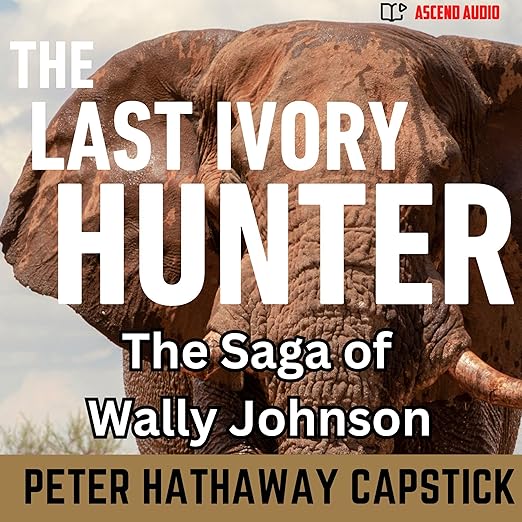
There’s a particular quality of atmosphere in books that document people and practices at the precise moment of their disappearance. The Last Ivory Hunter is one of those books. Peter Hathaway Capstick spent hours around a campfire on the banks of the Mupamadazi River with Wally Johnson, a man who spent fifty years hunting elephant ivory in Mozambique and survived things that killed most of the men in his profession. By the time those conversations happened, Johnson was among the last people alive who could tell this story from the inside. Capstick understood the value of what he was recording and treated it accordingly, with patience and a writer’s ear for what makes a story stay.
Capstick is one of the most recognized writers in the African hunting memoir genre, and he brings to this project the combination of narrative craft and atmospheric precision that distinguishes his best work. This is not a book Capstick wrote in the conventional sense. It is a book he shaped and framed, transcribing and organizing Johnson’s own account into something with the structural coherence of a narrative without losing the oral quality of stories told aloud by someone who lived them. The campfire origin of the material is never entirely forgotten, and that is the book’s central strength and its defining texture throughout the eight hours of audio.
Wally Johnson’s Africa
The world Johnson describes is already largely gone by the time Capstick records it. Mozambique’s ivory hunting culture operated across decades of colonial administration, independence movements, and civil conflict, and Johnson survived all of it. The specific episodes Capstick documents, the Gaboon viper bite, the buffalo gorings, the moment Johnson bluffed down two hundred armed poachers almost single-handedly, and the rocket attacks from communist revolutionaries during Mozambique’s political collapse in 1975, are not embellished adventure stories in the conventional sense. They are testimony, grounded in specific geography, specific fauna, and the specific political reality of mid-20th century Mozambique.
Several reviewers use the word incredible in describing the content, and while the events are extreme by any modern measure, Johnson’s account carries the authority of someone who regarded his own survival as workmanlike rather than remarkable. One reviewer captures this perfectly by comparing the experience to sitting around a campfire at elk camp listening to stories from an older generation about days they considered ordinary. That normalizing of the extraordinary is one of the things that oral history at this level does that written memoir rarely achieves quite so naturally.
Paul Maitrejean and the Voice of the Bush
Maitrejean’s narration is well matched to the material. He reads with a storytelling quality rather than a broadcast quality, which respects the oral origins of the source. The African settings, the mopane fires, the bush camps, the river banks, require a voice that can suggest physical space without overperforming it, and Maitrejean manages that balance throughout. When the book shifts from adventure to historical documentation, covering the political collapse of Mozambique and the eventual seizure of Johnson’s property and possessions by what the text calls freedom fighters, Maitrejean modulates accordingly. The elegiac closing sections, describing Johnson in his sixties still working in Botswana after most of his contemporaries are dead, land with genuine weight in audio form.
One reviewer from Italy notes that the political context of the Mozambican civil war, the communist revolutionary period, and the interference of outside powers rings true to what their generation experienced as contemporaneous European news. The specificity of Maitrejean’s delivery honors that historical precision rather than smoothing it into adventure-story distance or softening the political complexity of what Johnson lived through.
What the Book Requires of Its Readers
The ivory trade is ecologically catastrophic by any contemporary measure. Elephant populations across sub-Saharan Africa were devastated by commercial hunting across the same decades Johnson operated, and any honest engagement with this book has to acknowledge that context. Capstick writes from within a tradition that treated the African bush as a place where men measured themselves against nature, and that tradition carries assumptions that modern conservation ethics have substantially overturned. One reviewer notes that the negative reviews tend to come from applying a contemporary perspective to historical practices, which is a useful framing without being a complete defense. Reading the book as historical document, as testimony from inside a vanished world, is the appropriate mode. It requires the same kind of critical engagement you’d bring to any historical account of practices that were accepted within their time and are not acceptable now.
The Listeners This Book Is For
Readers of Capstick’s earlier work will find this entirely consistent with his established voice and subject matter. Listeners interested in African history, colonial and post-colonial Mozambique, and the human dimensions of practices now prohibited will find it a rich and specific document. Hunters and outdoors readers who appreciate memoir in the tradition of oral history will feel at home immediately. Anyone who needs historical figures to conform to contemporary ethical standards will find the material genuinely difficult to read uncritically. The book is honest about what it is: rugged testimony to an Africa that is now a distant dream. That honesty is both its limitation and its value as a historical record of a world that no longer exists and can no longer speak for itself. Capstick did the world a genuine service by writing these stories down before they vanished entirely, and Paul Maitrejean honors that service in audio.
Frequently Asked Questions
Is The Last Ivory Hunter suitable for listeners who are uncomfortable with hunting content?
No. The book centers on the life of a commercial ivory hunter and includes detailed accounts of elephant hunting, animal deaths, and the professional culture of ivory trading. Listeners who find hunting content distressing should look elsewhere.
How accurate is Wally Johnson’s account as a historical document of Mozambique?
Johnson’s account of the political events surrounding Mozambican independence and the communist revolutionary period in 1975 is corroborated by historical record. One reviewer with direct knowledge of the Italian political context notes the events match contemporaneous news coverage closely. Capstick’s framing is sympathetic to Johnson, which shapes what the book foregrounds.
Is this a Capstick-written book or is it primarily Wally Johnson’s voice?
It is a collaboration. Johnson’s oral testimony provides the raw material, which Capstick shaped into narrative form. The result blends Capstick’s prose style with Johnson’s account. Readers who have enjoyed Capstick’s Death in the Long Grass or Safari: The Last Adventure will recognize the authorial hand throughout.
How does Paul Maitrejean’s narration compare to other African adventure audiobooks?
Maitrejean brings a quiet, authoritative quality to the material that suits its oral history origins. He doesn’t dramatize excessively, which is the right call for a book whose authority comes from documented testimony rather than narrative construction.