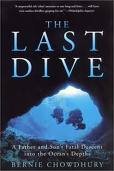
Chowdhury wrote The Last Dive from the inside of a world that claims lives, and the audiobook narrated by L.J. Ganser carries the weight of that insider knowledge across its sixteen hours and forty-two minutes. Bernie Chowdhury was himself a technical diver who understood the specific gravitational pull of deep wreck diving, which makes this account of Chris and Chrissy Rouse, a father and son who died in a catastrophic decompression incident on a German submarine wreck off the New Jersey coast, something considerably more than a standard adventure narrative. This is a book about why people return to dangerous things even when the cost is legible and real.
A Closer Look at The Last Dive
Chowdhury's authority on the subject comes from lived experience, which means his account of the Rouse family's progression through the technical diving world has a precision that secondhand reporting cannot replicate. He knew Chris and Chrissy Rouse personally, trained alongside divers who ran the same routes, and understood the social world of the wreck-diving community that formed around the New Jersey coast's extraordinary concentration of sunken ships. That context shapes every choice in the narrative. Chowdhury does not frame the Rouses' story as a cautionary tale about recklessness, which would be the simpler and less honest version of events. He frames it as an account of two people who loved the water completely and understood, at some level, the bargain they were making.
L.J. Ganser's narration handles this material with the appropriate register: measured, serious, and without the performative grief that would undercut the book's analytical rigor. Ganser is a narrator with long experience in nonfiction audio, and his pacing reflects the book's dual structure, alternating between the history of deep wreck diving as a practice and the specific biographical arc of the Rouses. The result is a sixteen-hour listen that does not feel padded. Chowdhury earns the length by building the context necessary for the final dives to carry their full meaning.
What Makes The Last Dive Worth Hearing
The book's central appeal, across whatever format you encounter it in, is the intimacy of Chowdhury's access. This is not a journalist's account reconstructed from interviews after the fact. It is written by someone who shared a culture with the people he is writing about, and that access produces a portrait of compulsion that is genuinely rare in adventure nonfiction. The father-son relationship between Chris and Chrissy Rouse is rendered with specific detail: how they pushed each other technically, where their ambitions converged, how the diving community responded to their rapid advancement through ever more demanding wreck sites. The audiobook format allows Ganser to sustain the mounting tension of the later chapters without the pace-breaking that can happen in print when readers pause between sessions.
Listeners drawn to Robert Kurson's Shadow Divers, which covers some of the same New Jersey wreck-diving world and community, will find Chowdhury's account a natural companion volume. Where Kurson's book is more propulsive and thriller-adjacent in its construction, The Last Dive is more elegiac and more willing to sit with the psychological dimensions of why people accept extreme risk as part of their daily identity. The audiobook gives both writers' different approaches to the same underwater geography a useful comparative context.
Things to Know Before Starting The Last Dive
The book's scope extends well beyond the Rouses' fatal dive. Chowdhury provides substantial historical context on the development of technical diving as a discipline, including the equipment innovations, the community figures, and the documented fatalities that defined the practice's limits before the Rouses entered it. That background is necessary for the final chapters to carry weight, but listeners who come specifically for the account of the fatal dive should know they are getting a full survey of a world rather than a tightly focused single incident. The historical sections are not filler; they are the argument. But they require patience from listeners oriented toward action over context.
Ganser maintains consistency across the full sixteen-plus hours, which matters in a book this long. He does not flatten the Rouses into symbols or the diving community into a backdrop. His handling of the technical diving terminology, which is specific and occasionally dense, keeps the precision without making the narration inaccessible to listeners who have never worn a tank.
Who Bernie Chowdhury Is Writing For
Readers with an interest in extreme sport psychology, deep-sea and wreck-diving culture, or the specific geography of the Atlantic coast's underwater history will find this audiobook unusually detailed and honest. Listeners who already know Robert Kurson's Shadow Divers or have an appetite for serious adventure nonfiction will find Chowdhury's account a grounding counterweight to more thriller-forward treatments of this world. Skip it if you want a quick adrenaline-focused listen; sixteen hours of careful, grief-inflected reporting is a different commitment than a dramatic reconstruction. The Last Dive is for people willing to sit with what happens when passion and poor margins for error overlap in the dark.
Ganser's narration specifically rewards the kind of listener who wants to understand the technical diving world rather than simply observe it from outside. The terminology that accumulates across the early chapters, the decompression schedules, the mixed gas configurations, the wreck-penetration protocols, is given enough context by both Chowdhury's writing and Ganser's delivery that it becomes legible rather than alienating. By the time the Rouses' final dive begins, the listener understands not just what went wrong but exactly how much had to go right for the dive to have been possible at all. That technical texture is what gives the audiobook's final hours their particular weight.
Quick Take
- Performance: L.J. Ganser brings the controlled tension this material demands across sixteen-plus hours, sustaining dread without melodrama.
- What it covers: Deep wreck diving obsession, father-son bonds under pressure, the psychology of extreme risk.
- Feel: Tense, elegiac, and unflinching.
- Our call: A portrait of compulsion at depth, written by someone who understood the water and the grief from the inside.