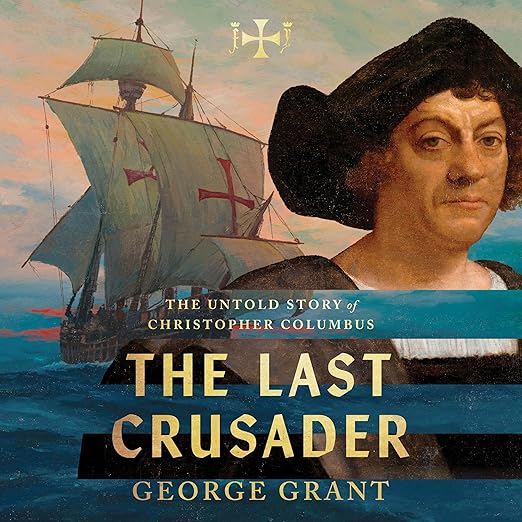
At a Glance
- Voice: Joffre Swait delivers a performance that suits the book's confident, revisionist tone; the narration is clear and measured, appropriate for a historical argument rather than a dramatic recreation.
- Big ideas: Christian historical motivation, revisionist biography, faith and discovery
- Atmosphere: Declarative and conviction-driven, written to correct rather than complicate
- Worth it?: A compact argument for a particular reading of Columbus that listeners should approach knowing it presents one interpretive tradition rather than current historical consensus.
Christopher Columbus sailed in 1492, and that much is not in dispute. What George Grant argues in The Last Crusader, narrated by Joffre Swait across four hours and one minute, is that the animating purpose behind that voyage has been systematically misrepresented. Grant opens with a direct claim: you have been lied to about Christopher Columbus. This audiobook is his case for a different account, one that centers Columbus's Christian religious motivation, specifically his aspiration to fund a new Crusade to free the Holy Land, as the defining principle of a life that history has variously lionized and condemned.
Grant's argument is that the conventional post-colonial critique of Columbus, which focuses on the destruction and exploitation that followed European contact with the Americas, has displaced a prior truth about the man's own stated motivations. Columbus did want to open trade routes to the Indies, and he did aspire to the titles and privileges of discovery, but Grant insists that Christian zeal for what he calls the Great Commission was the animating principle beneath both of those objectives. The Crusader framework is not Grant's invention; it is documented in Columbus's own writings and correspondence, and several serious historians have engaged with this dimension of Columbus's self-understanding.
This is where the book's honesty and its limitations intersect. Grant is writing from within a specific interpretive tradition, one that takes Columbus's religious statements at face value and gives them explanatory priority over other motivating factors. Listeners who approach The Last Crusader expecting a balanced account that weighs this tradition against the substantial body of scholarship on Columbus's colonizing violence will not find that balance here. Grant is making an argument for one understanding of Columbus, and he makes it clearly and with conviction. A reviewer who studied Columbus in the context of a local Columbus Day debate found the historical background valuable and genuinely illuminating; another praised it as presenting the truth concerning Columbus. Both responses reflect readers who found Grant's account enlarging rather than reductive, which is legitimate. What it is not is a view without contestation in the broader historical literature, and that context matters for listeners deciding how to weigh what they hear.
Swait's Clarity Serves a Focused Four-Hour Argument
Joffre Swait's narration is well-suited to the material. The prose is direct and argumentative rather than novelistic, and Swait delivers it with the kind of clarity that serves an author who wants the argument heard without distraction. The four-hour runtime is compact for a biography, but Grant is not attempting comprehensive biography; he is making a focused case for a reinterpretation of motivation, and the length is appropriate to that narrower aim.
For listeners who have absorbed the mainstream post-colonial account of Columbus, whether from school curricula or contemporary cultural discussions, this audiobook provides context that is routinely absent from those accounts: the specific medieval Christian theological framework within which Columbus understood his own mission, and the Crusading tradition that gave that framework its historical texture. Understanding how Columbus understood himself is genuinely useful historical knowledge regardless of how one weighs the moral account of what followed. Grant's account of the Crusader context is the primary value this audiobook delivers, and at four hours it delivers it efficiently without padding the argument beyond what the evidence supports.
A Holy Land Fundraising Angle Rarely Told This Directly
Listeners should track the distinction Grant draws between Columbus's intentions and the consequences of European contact with the Americas. The book focuses almost entirely on the former, which is its explicit scope. The consequences, dispossession, violence, and the decimation of Indigenous populations, are not Grant's subject, and their absence from the argument does not constitute a historical erasure so much as a deliberate narrowing of focus that listeners should be aware of before they begin.
The Crusading context Grant establishes is historically specific and worth following carefully, because it connects Columbus's project to a centuries-long tradition of Christian political and military aspiration that fifteenth century Europeans would have understood without explanation. The idea that a voyage of discovery was also a fundraising enterprise for a Holy Land campaign is a historical detail that mainstream accounts of Columbus rarely foreground, and hearing it articulated clearly gives it space to register that a paragraph in a survey history cannot provide.
Faith-Driven Listeners Are the Real Audience Here
Listeners interested in faith-driven historical biography and revisionist accounts of familiar figures will find Grant's argument substantive and efficiently delivered. Christians interested in the historical relationship between their tradition and the Age of Exploration will find this audiobook the most direct account available of Columbus as a religious actor. Those who encountered the Columbus Day and Indigenous Peoples Day debate and wanted more historical context for the source figure will find the audiobook a genuinely informative addition to that understanding. History readers who find survey textbook treatments of Columbus frustratingly thin will appreciate the specificity of Grant's research into the Crusading motivation, even if they ultimately weigh the evidence differently than Grant does.
Listeners seeking a full biography of Columbus that engages with contemporary historical scholarship on colonialism and its consequences will need additional reading beyond this title. Those who approach history from a secular framework and are skeptical of faith-motivation as primary historical explanation will find Grant's interpretive priorities unconvincing, though the documentary basis for Columbus's own religious statements is real regardless of how one weights them.
A Few Questions About The Last Crusader
Does Joffre Swait's narration work for historical nonfiction in this audiobook?
Swait's delivery is clear and measured, appropriate for a text that is arguing a case rather than dramatizing events. The narration serves the argumentative structure of the book without overplaying the more declarative moments.
Is the historical information in this audiobook accurate, or is it revisionist in a way that distorts the record?
Columbus's own writings do reference his Crusading aspirations and his desire to fund a recapture of the Holy Land, which is the documentary foundation Grant builds from. The revisionist dimension is Grant's interpretive emphasis rather than invention of facts, though his weighting of Columbus's religious motivation over other factors is debated among historians.