- Performance: Heather Wilds manages Moriarty's multi-character ensemble with confident differentiation, finding the precise register between comedy and emotional honesty the novel requires.
- What it covers: The mythology of family secrets, the lives women construct under social expectation, the comedy of romantic catastrophe
- Feel: Warm and wry, with a genuine mystery simmering underneath
- Our call: Not Moriarty at her most propulsive, but a rich ensemble piece that rewards listeners willing to settle into its particular rhythms.
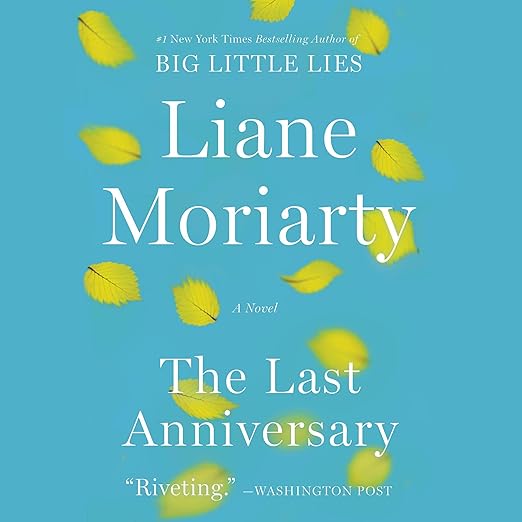
I had been on a Liane Moriarty run for about two weeks when I got to The Last Anniversary, which is technically her second novel and was reissued as her reputation built on the strength of Big Little Lies. I was halfway through my Tuesday evening when I realized I had been listening for longer than I intended, which is the quiet metric I trust most when assessing how a book is working on me.
This is a different beast from Nine Perfect Strangers or Big Little Lies. It is slower and warmer, more interested in the texture of domestic life than in the mechanics of revelation. The mystery at its center, the unsolved disappearance of the Munro Baby on Scribbly Gum Island decades earlier, is treated less as a plot driver and more as the organizing mythology around which a family has built its entire identity. When Sophie Honeywell inherits the house of her ex-boyfriend Thomas Gordon's aunt Connie, she becomes an outsider looking in at a world that has arranged itself entirely around a secret.
Where This One Lands
Moriarty works well with large casts, and she puts that skill to full use here. The Scribbly Gum Island community is populated with women at various stages of reckoning with the lives they have built: Grace, whose beautiful-on-the-surface marriage conceals something she is planning to escape; Margie, whose frumpy housewife exterior hides a private arrangement with a stranger; and Aunt Rose, who has spent decades making herself small and is beginning to wonder why. Sophie herself is the narrative anchor, but the book is genuinely polyphonic in a way that serves Moriarty's interest in the gap between how women's lives look from the outside and what they actually contain.
One reviewer noted that the story occasionally switches perspective to foreshadow important revelations, and this structural device, handled clumsily, can feel manipulative. Moriarty handles it with enough subtlety that it mostly functions as texture rather than mechanism. The shifts broaden the novel's emotional range rather than merely teasing upcoming plot points.
The Best Parts of The Last Anniversary
The Last Anniversary is funny in a way that Moriarty's darker books are not, and it is worth thinking about what the comedy is for. Moriarty uses humor here to create intimacy between the reader and characters who are, when you look at them closely, doing quite desperate things. Grace's barely suppressed rage at her domestic situation is played partly for comedy and partly for something more uncomfortable. Sophie's romantic catastrophizing is genuinely entertaining and also a form of avoidance that the book treats seriously. The humor and the emotional honesty are not in tension in this novel; they are working together, which is a harder trick to pull off than either alone.
Heather Wilds finds this dual register consistently throughout the twelve-plus hour narration. She does not play the comedy as farce or the drama as soap opera, and the result is a sustained tonal consistency that the novel needs. A less assured narrator could tip this material into mockery of its characters, which would undermine everything Moriarty is trying to do with women's interiority.
What Gives Us Pause
Multiple reviewers noted that the book starts at a more mellow pace than Moriarty's later work, and one came close to abandoning it before finding her footing. That is honest and worth acknowledging. The first act of The Last Anniversary is patient in a way that requires trust in the author. The Connie and Rose flashback sections that establish the Munro Baby mystery are essential to the payoff but feel distant from Sophie's contemporary storyline in the early chapters. The payoff is real: the final sections of the book are among the best Moriarty has written, and the revelation of what the Munro Baby mystery actually concealed is handled with genuine restraint and emotional intelligence. But getting there requires a different kind of engagement than her later, more plot-driven work demands.
At nearly thirteen hours, this is a substantial commitment, and listeners who prefer their audiobooks to maintain constant forward momentum may find the middle sections testing. Those who can settle into the rhythm of the island and the family will find themselves deeply invested by the time the book's quieter revelations arrive. The final sequence is worth the patience it asks for.
Should You Listen to The Last Anniversary?
Readers who came to Moriarty through Big Little Lies or Nine Perfect Strangers and want more of the same intense narrative engine will need to recalibrate their expectations. The Last Anniversary is the work of a writer more interested in the emotional architecture of ordinary lives than in the machinery of a thriller. It rewards listening that is comfortable with ambiguity and patient with characters who take time to reveal themselves. For that reader, it is one of the more quietly satisfying things Moriarty has produced, and a reminder that she has always been more interested in people than in plot.