Quick Take
- Narration: Nick Podehl is one of the definitive LitRPG narrators, and his performance on the Chaos Seeds series set a benchmark the genre has been trying to match since.
- Themes: Competence fantasy, the ethics of agency in systems that reward ruthlessness, building something worth protecting from nothing
- Mood: Propulsive and escalating, with the specific pleasure of watching a capable protagonist learn rules and immediately push against them
- Verdict: The foundational LitRPG audiobook for English-language readers, not the most sophisticated novel in the genre, but the one that established what the genre could do in audio.
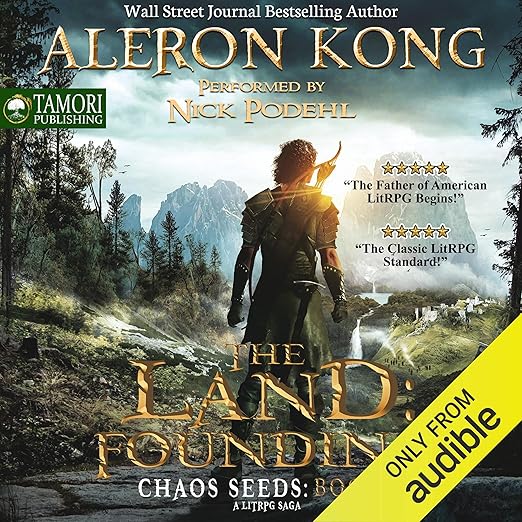
I want to be careful about how I frame what The Land: Founding actually is, because the category it belongs to is still misunderstood by readers approaching from traditional fantasy. LitRPG is not fantasy with game mechanics bolted on. At its best, it is a fundamentally different structural project: a novel whose protagonist’s growth is measured in explicit systems, whose world operates according to rules the reader can track alongside the character, and whose pleasures are partly the pleasures of watching someone optimize within constraints. The Land: Founding is the novel that made English-language LitRPG commercially viable, and Nick Podehl’s narration of it became a reference point for the entire genre in audio.
I came to this one having read its reputation carefully. Audible’s 2018 Customer Favorite, seven-book series, the synopsis describing comparisons to Ready Player One and Game of Thrones. The Ready Player One comparison is about accessible portal-fantasy mechanics; the Game of Thrones comparison is about political and faction-level complexity. Neither is quite accurate, but both gesture toward real qualities the novel possesses.
What Richter Actually Has to Do
Richter is tricked into a world of banished gods, demons, goblins, sprites and magic, and the novel’s first act is essentially an extended tutorial sequence: Richter learning what his abilities are, what the world’s systems reward, and where the early threats are positioned. The Chaos Seeds series premise is that Richter is not just surviving in this world, he is attempting to build a kingdom, which means the novel’s escalating plot involves faction management, resource acquisition, territorial defense, and the specific decision-making of someone trying to build something durable rather than simply survive.
Reviewer Christian Peterson identifies the novel as incredibly addicting and specifically praises the way it balances real-world reference humor with the game-world mechanics. That balance is one of Aleron Kong’s genuine achievements: Richter’s reactions to the world’s systems are calibrated to feel like a real person’s surprise and delight rather than a character conveniently discovering powers at the right narrative moment.
Nick Podehl and the Stat Screen Problem
One of LitRPG’s inherent audio challenges is the stat screen: moments where the prose presents explicit numerical game feedback, level-up notifications, skill descriptions, and system messages. On the page, these can be formatted visually. In audio, they must be narrated, and a bad narrator turns them into tedious recitations. Podehl found the solution that the genre subsequently adopted as standard: he differentiates these system messages with a slightly different register, cooler and more detached, that signals to the listener that this is game-interface information rather than narrative prose. It is a small technique with enormous impact on the listening experience.
Reviewer BelartTheIlliterateReviewer notes the words cool, clever, fun, bloody, descriptive, detailed, sometimes corny, and badass as descriptors. That list is accurate and also captures the tonal range Podehl is asked to navigate. He handles all of it with practiced ease.
What the Series Promises and Whether This Book Keeps It
Reviewer J.R. Bryan gives four stars while noting irritation with what they perceive as an obvious pen name, which is worth flagging because it is unrelated to the quality of the actual work. Pen names are common in genre fiction, and this one has not prevented the series from building a substantial readership. The more practically relevant caveat is that the synopsis positions this as book one of a seven-book series, and the novel functions explicitly as a foundation. This is not a self-contained story with a complete arc: it establishes the world, introduces the kingdom-building premise, and ends with the stage set rather than the first act resolved. Listeners expecting a full narrative payoff from this volume alone should know that they are signing up for a series investment from the first chapter.
Who Should Listen, Who Should Skip
Listen if you are curious about LitRPG and want to start with the title that proved the subgenre could work as audio entertainment. Listen if competence fantasy, kingdom-building premises, and explicit game-system mechanics in a fantasy setting appeal to you as pleasures. Nick Podehl’s narration alone is worth the runtime for fans of the genre.
Skip if you need your fantasy novels to be complete narratives rather than series installments. Skip if game mechanics in prose fiction feel like an intrusion rather than a feature: the LitRPG premise is not a light touch here, and the novel does not apologize for its genre conventions. Also skip if you want literary sophistication: The Land: Founding is an entertainment, executed with considerable craft, but its ambitions are not in the direction of the literary.
Frequently Asked Questions
Does The Land: Founding work as a standalone, or do I need to commit to all seven books?
It reads as an opening volume rather than a complete story. The kingdom-building premise is established and the world is introduced, but the narrative arc does not reach a traditional conclusion within this book. Readers who want a self-contained experience should know upfront that this is the beginning of a long series investment.
How does Nick Podehl handle the LitRPG-specific elements like stat screens and system notifications?
Podehl developed a distinct vocal register for system messages that differentiates them from narrative prose without making them feel like interruptions. This technique, which became influential in LitRPG audio production, makes the game-interface elements feel like part of the experience rather than a technical limitation. It is one of the reasons this recording became a benchmark for the subgenre.
Is this book appropriate for readers who have never encountered LitRPG before, or does it assume genre familiarity?
Kong designed The Land: Founding to be accessible to readers who know MMORPGs or fantasy video games but have not read LitRPG fiction specifically. The novel explains its systems through Richter’s discovery process, which also serves as the reader’s tutorial. Prior genre experience enhances the pleasure but is not required.
The synopsis compares this to Ready Player One and Game of Thrones, are those comparisons accurate?
Partially. The Ready Player One comparison points to the portal-fantasy mechanics and the protagonist’s gamer-oriented approach to his new world. The Game of Thrones comparison gestures at the eventual faction politics and kingdom-scale stakes, which become more prominent in later volumes. Book one is closer to an origin story than either comparison suggests, but the trajectory toward those larger scales is established from early on.