Quick Take
- Narration: Leon McCarron narrates his own book, and the intimacy this creates is the audiobook’s defining quality, you are walking with the person who walked, and the difference is palpable.
- Themes: Human connection across political borders, the gap between media narratives and lived experience, the spiritual dimensions of walking
- Mood: Contemplative and quietly urgent, with moments of profound warmth
- Verdict: A rare travel book that uses the physical journey as a structure for something deeper, McCarron’s self-narration makes the audio format the ideal way to experience this particular story.
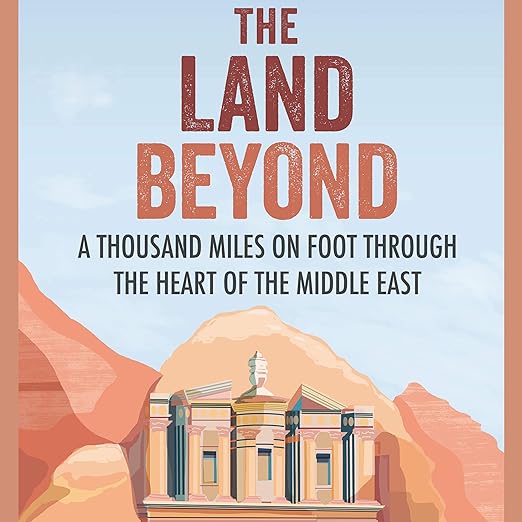
I started The Land Beyond on a quiet Tuesday evening, and by the time I went to bed I had listened to two hours and was still reluctant to stop. There is something specific that happens when a writer narrates their own travel memoir: the distance between the words and the experience collapses. Leon McCarron walked a thousand miles through the West Bank, Jordan, and the Sinai, mostly alone, and when he reads his own account of that journey, the vocal quality carries something no hired narrator could replicate, a kind of earned stillness.
This is not adventure writing in the adrenaline-driven sense. McCarron is not seeking danger. He is seeking contact with people, places, and a history that Western media has thoroughly flattened into geopolitical abstractions.
Our Take on The Land Beyond
McCarron sets out from Jerusalem following wild hiking trails that trace ancient trading and pilgrimage routes through some of the most contested terrain in the world. He spends time in the West Bank with families navigating daily life under political conditions that make ordinary existence complicated in ways outsiders rarely understand. He visits Hellenic ruins in Jordan, treks through the legendary Wadi Rum, and ends his journey in the vast Sinai desert, in the company of Bedouin tribes and haunted by layers of Biblical history that feel genuinely present in that landscape.
The book’s central argument, that these places are about people, not politics, sounds simple and is not. McCarron earns that conclusion through specificity. The vignettes he constructs from individual encounters are the book’s real architecture. One reviewer called these small portraits unforgettable in their simplicity, wisdom, and perspective, and that description matches the experience of listening. McCarron does not deliver sweeping statements about the Middle East. He delivers people.
Why Listen to The Land Beyond
The self-narrated audiobook is not always the best version of a travel memoir. Some writers lack the vocal range or the technical control to sustain eight-plus hours of audio performance. McCarron is an exception. His voice is measured, warm, and slightly worn in the way that extended solo travel produces, it sounds like the voice of someone who has spent months in their own head, developing a specific relationship with silence. That quality cannot be faked, and it cannot be hired.
One reviewer described the book as offering a perspective that greatly differs from mainstream media coverage of the region, and that function is genuinely valuable. McCarron is Irish, traveling in 2015, and his position as an outsider who is also not American or British gives him a different kind of access to the communities he encounters. He is honest about the limits of his understanding without being paralyzed by them.
What to Watch For in The Land Beyond
This is a contemplative book, and the pacing reflects that. McCarron’s journey was slow by design, you cover about 15 miles per day walking, and the book captures the rhythm of that pace. Listeners seeking dramatic incident or narrative tension of the thriller variety will find the book persistently sidesteps those conventions in favor of something quieter. That is not a weakness; it is a choice. But it is a choice that defines the entire experience.
The political context of the West Bank is treated with care but not at great length. McCarron does not position himself as a political commentator, and he is explicit about the limits of a visitor’s understanding. Listeners hoping for a rigorous analysis of the Israeli-Palestinian conflict will find something more humanizing and less explanatory than that. A reviewer with evident knowledge of the region found the balance thoughtful and fair.
Who Should Listen to The Land Beyond
Listeners who have enjoyed Bruce Chatwin’s In Patagonia or Rory Stewart’s The Places In Between will recognize the spiritual ancestor of McCarron’s approach, the long walk as a way of knowing, undertaken alone, reported with literary care. Those interested in the Middle East as a human geography rather than a political conflict will find this especially valuable. Self-narrated memoir fans who appreciate the intimacy of listening to a writer read their own words will find this one of the better examples of that format. At 4.4 stars, the audience is small but consistent in their praise.
Frequently Asked Questions
Does Leon McCarron address the Israeli-Palestinian conflict directly in this book?
He engages it through individual human encounters rather than political analysis. McCarron is clear about the limits of his understanding as a visitor, and reviewers appreciate his refusal to reduce complex political realities to simple conclusions. The book is more humanizing portrait than geopolitical argument.
Is the self-narrated format a strength or a limitation for this audiobook?
For this particular book, it is a clear strength. Reviewers consistently cite the intimacy of McCarron reading his own words about his own journey as central to the experience. His voice carries an earned quality that professional narrators cannot replicate when working with another person’s travel memoir.
What kind of physical conditions does McCarron encounter on the walk, is this a survival story?
This is not a survival narrative. The physical challenges are real and present, desert heat, difficult terrain, solitude, but the book’s focus is on the people and landscapes McCarron encounters rather than on dramatic danger. The Wadi Rum and Sinai sections are the most physically demanding by description.
When was the journey in The Land Beyond undertaken, and is it still relevant to current conditions?
McCarron walked through the region in 2015, which one reviewer notes was during a period of significant instability as ISIS was expanding in neighboring areas. The book’s portraits of people and places remain relevant, though specific political conditions have continued to evolve since then.