Quick Take
- Narration: Peter Ganim reads with appropriate gravity and care, handling the academic density well without making the material feel inaccessible.
- Themes: Textual history of Islamic scripture, the Koran’s role in Muslim civilization, diversity of interpretive traditions
- Mood: Scholarly and measured, the academic equivalent of a long, considered conversation
- Verdict: A rigorous short introduction to the Koran as a historical and cultural object, best for listeners approaching from an academic or comparative religion angle rather than a devotional one.
I spent a semester in university sitting in on a comparative religion seminar where my professor, a small fierce woman who had spent years in Cairo, kept returning to the same question: what do we mean when we say we know a sacred text? The question felt abstract at the time. Reading Michael Cook’s contribution to the Oxford Very Short Introductions series years later, I found myself thinking about that seminar again. Cook is asking something similar, and his answer is characteristically careful: knowing the Koran requires knowing how it was transmitted, interpreted, and wielded across fifteen centuries of Muslim civilization.
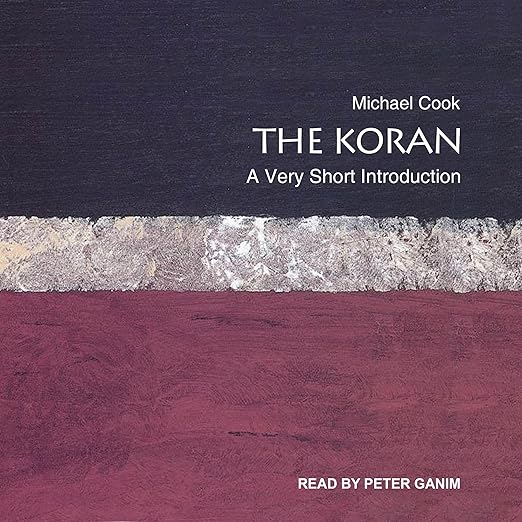
This is not a devotional text. It is not a translation of the Koran itself. It is a scholarly introduction to the Koran as a cultural and religious artifact, narrated by Peter Ganim in an Audible edition produced by Tantor Media. Cook, a professor of Near Eastern studies at Princeton, brings rigorous academic credentials and a genuine clarity of expression that is sometimes absent from this kind of concise scholarly writing. At just over five hours, this is a genuinely dense listen compressed into an accessible format.
Our Take on The Koran
Cook organizes the book around what the Koran is and what it has done in the world. He covers the processes by which the text took shape, the mechanisms of its dissemination, the diversity of interpretive traditions it has generated, and its relationship to other sacred texts of the Abrahamic traditions. This is not a survey of Islamic theology. Reviewers who came expecting an account of what Muslims believe were occasionally surprised to find a book that is more concerned with how those beliefs have been textually authorized and contested over centuries.
One reviewer described it as ‘a history of the Koran as a book’ rather than an introduction to the tenets of Islam, and that is exactly right. If you want to understand why Muslims respond to the defiling of a physical Koran with such intensity, or why the question of translation carries profound theological weight in Islam when it does not carry equivalent weight in Christianity, this book provides the historical and textual context that makes those reactions intelligible. Another reviewer noted that it ‘helped me surface confusions I didn’t even know I had,’ which is one of the best things a short introduction can do.
Why Listen to The Koran
Peter Ganim’s narration is a genuine asset here. The material is dense with names, dates, and academic distinctions, and a narrator who cannot maintain pace and clarity through that density will lose listeners quickly. Ganim reads with appropriate weight and care, treating the subject seriously without making the listening experience feel like a lecture you are failing to keep up with. The audiobook format suits this title because the material rewards focused attention, and the shorter chapter structure of the Very Short Introductions series creates natural pauses for reflection.
Comparative religion scholars and students will find Cook’s framing especially useful. His comparisons between the Koran and other sacred texts, particularly his discussion of how the Koran occupies a different structural role in Islam than the Bible does in Christianity, are among the most illuminating passages in the book. The observation that the Koran is, for Muslims, the direct word of God transmitted through a human vessel rather than a text written by divinely inspired humans changes how every question about translation, interpretation, and textual authority must be framed, and Cook uses that distinction well throughout.
What to Watch For in The Koran
The limitations of the Very Short Introduction format are real here. Cook is covering territory that has produced whole libraries, and the compression shows. One reviewer noted that the relationship between the Koran and the Hadith, a crucial structural element of Islamic practice and law, receives almost no attention. Another flagged that the book does not fully deliver on its promise to account for the Koran’s significance to Muslims themselves, focusing more on historical and scholarly processes than on lived religious experience.
The writing occasionally assumes background knowledge that casual listeners may not have. Reviewers with some prior knowledge of Islam and its history found the book rewarding and dense with useful information. Listeners coming in completely cold may need to pause frequently to situate what they are hearing, particularly in the sections dealing with early Islamic history and the textual traditions that shaped Koranic scholarship. This is a companion to, not a replacement for, a more introductory overview of Islam as a religion.
Who Should Listen to The Koran
This one suits listeners approaching from a scholarly or comparative religion angle: students of religious studies, history enthusiasts curious about early Islamic civilization, or anyone who wants to understand why the Koran’s cultural authority functions the way it does. Listeners seeking a devotional introduction to Islam or an accessible overview of what Muslims believe will find this a less obvious fit. And anyone wanting to read the Koran itself should look at a translation designed for that purpose rather than this analytical framing of it as a historical text.
Frequently Asked Questions
Is this audiobook a recording of the Koran itself, or is it about the Koran?
This is Michael Cook’s academic short introduction about the Koran as a historical and cultural text, not a recitation or translation of the Koran itself. The book examines how the Koran took shape, how it has been interpreted, and what role it plays in Muslim civilization.
Does Cook approach the Koran from a Muslim perspective or a secular academic one?
Cook writes as an academic scholar of Near Eastern studies. The approach is analytical and comparative rather than devotional or confessional. He treats the Koran as a subject of serious scholarly inquiry, drawing comparisons with other sacred texts and situating it within the history of Islamic civilization.
How much prior knowledge of Islam does a listener need to follow this audiobook?
Some background is helpful. Listeners who are familiar with the basic outlines of Islamic history and practice will get more from this book than those coming in completely fresh. The text occasionally references concepts and historical periods without defining them, which can create gaps for listeners with no prior exposure.
Does Peter Ganim’s narration handle the Arabic names and terms accurately?
Reviewers have not flagged pronunciation issues, and Ganim’s performance is generally praised for its care and clarity. The narration handles the academic density of Cook’s writing without losing pace, which is the more significant challenge in this kind of scholarly audio.