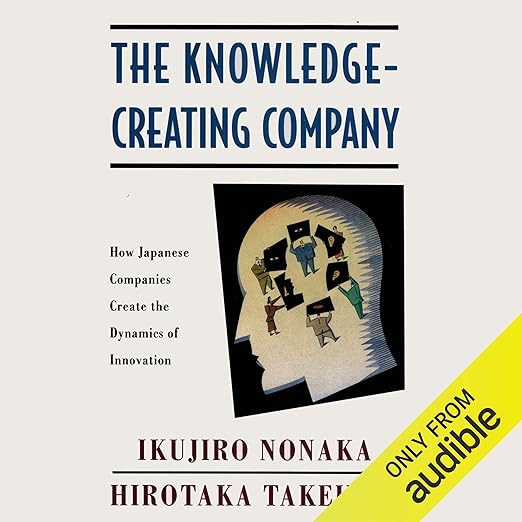
Quick Take
- Narration: William Michael Redman handles dense academic material with clear diction and steady tempo – functional and reliable, though the text’s complexity demands active listening regardless of narrator.
- Themes: Tacit vs. explicit knowledge, organizational learning, Japanese management philosophy
- Mood: Dense and intellectually demanding, rewarding for patient listeners with a management or organizational theory interest
- Verdict: A foundational management text that holds up decades after its writing – the tacit-explicit knowledge distinction remains one of the more useful frameworks in organizational thinking, and the Honda and Matsushita case studies are still vivid.
I first encountered the tacit-explicit knowledge distinction in a graduate seminar on organizational behavior, where The Knowledge-Creating Company kept appearing in footnotes. I finally listened to the full audiobook during a stretch of long evening walks, working through it in segments over about two weeks. It is not a book that rewards half-attention – the conceptual framework builds on itself, and Nonaka and Takeuchi are not writers who simplify for the sake of accessibility. But for listeners who give it the focus it asks for, there is a coherence here that most business audiobooks never approach.
The context matters for appreciating the book properly. This was published in 1995, drawing on research that began a decade earlier, during the period when Japanese manufacturing and product development methods were being studied with something approaching reverence by Western business schools. Nonaka and Takeuchi had the unusual position of being Japanese academics writing for a primarily Western management audience, explaining their own companies’ practices from the inside.
Our Take on The Knowledge-Creating Company
The central argument is elegantly simple even if its implications are not. Western management theory, the authors contend, overinvests in explicit knowledge – the kind that can be written down, systematized, and transferred through training manuals. Japanese companies, particularly the ones they study in detail, have developed a more sophisticated understanding of tacit knowledge: the embodied, experiential, largely inarticulable know-how that lives in people rather than documents. The path to competitive advantage, they argue, lies in the organizational capacity to convert tacit knowledge into explicit knowledge and then embed the result back into the culture where it generates new tacit knowledge. The Matsushita Home Bakery example – where a software programmer apprentices with a master baker to understand kneading in a way that can then be engineered into a machine – remains one of the most concrete illustrations of an abstract idea I have encountered in business literature. It is the kind of case study that stays with you.
Why Listen to The Knowledge-Creating Company
William Michael Redman reads with clarity and authority – the kind of narrator who does not get in the way of dense material. The range of case studies across Honda, Canon, NEC, and 3M means the argument never becomes too abstract for too long; there is always a concrete organizational story to anchor the theory. The management concept the authors call middle-up-down – a rejection of both pure top-down and pure bottom-up management in favor of middle managers as knowledge-synthesizing bridges – has aged particularly well in an era when flat organizations and distributed work have made traditional hierarchies feel both inadequate and quietly persistent. The audiobook gives you access to the full text in a format that rewards the meditative pace of long walks or commutes.
What to Watch For in The Knowledge-Creating Company
This is a product of its time in ways that matter. The Japan-as-model framing carries the optimism of the late 1980s and early 1990s, before the lost decade complicated the narrative of Japanese corporate superiority. Listeners should hold the cultural claims with some historical awareness. The theoretical scaffolding also draws heavily on Western philosophy – Plato, Polanyi, Hegel – in ways that can feel more elaborate than necessary. And at eleven hours and fourteen minutes, the audiobook asks a genuine commitment from listeners who may find some of the middle sections denser than the payoff justifies.
One practical note for listeners planning to use this audiobook professionally: the SECI model that Nonaka and Takeuchi present – Socialization, Externalization, Combination, Internalization – is dense enough in audio that first-time listeners may want to look up a visual representation of the framework before or during listening. The model is central to everything the book argues, and having it mapped spatially makes the audio presentation considerably easier to track. This is a minor point but it genuinely improves the experience.
Who Should Listen to The Knowledge-Creating Company
Essential listening for anyone working in knowledge management, organizational design, or innovation strategy who has not yet engaged with the primary source. Also valuable for managers curious about why certain kinds of expertise resist documentation and training – the tacit knowledge framework has direct practical application. Less useful for listeners seeking immediately actionable frameworks or quick business lessons; this is a theoretical text that rewards slow digestion rather than rapid extraction.
Frequently Asked Questions
Is The Knowledge-Creating Company still relevant, given that it was written in the mid-1990s?
The core framework – the distinction between tacit and explicit knowledge and the SECI model of knowledge conversion – remains one of the more durable ideas in organizational theory. The Japan-specific claims require some historical adjustment, but the underlying concepts are applied regularly in knowledge management and innovation research today.
Do I need a management or business background to get value from this audiobook?
A general interest in how organizations work is sufficient. The theoretical sections reference Western philosophy and organizational theory, but Nonaka and Takeuchi ground everything in concrete case studies that make the concepts accessible without specialist vocabulary.
How does the Matsushita bread-maker case study illustrate the book’s core argument?
It is the clearest single example in the book. A software programmer could not engineer a bread-kneading mechanism from a manual, so she apprenticed with a master baker and developed a felt understanding of the motion. That tacit knowledge was then translated into explicit engineering specifications – the cycle of tacit-to-explicit-to-tacit knowledge the authors argue Japanese companies run on.
How does William Michael Redman handle the more philosophically dense sections of the text?
Redman is a reliable narrator for academic material – clear diction, steady pacing, no vocal tics. The density comes from the text itself rather than the narration. Active listening is essential regardless of narrator quality.