In Brief
- Narration: Tim Alberta narrates his own reporting, lending firsthand authority a hired narrator simply could not match.
- Themes: evangelical politics, religious identity, institutional reckoning
- Mood: Sobering and investigative
- Verdict: A rigorously reported, genuinely important listen that earns its length even where it also earns the word slog.
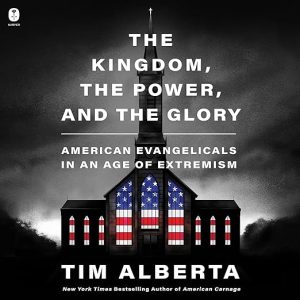
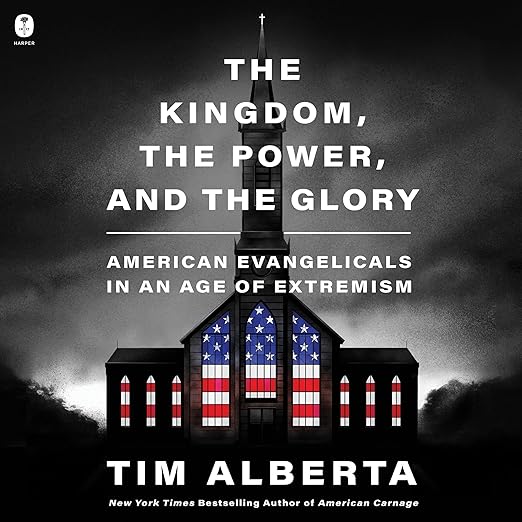
Barack Obama named this one of his favorite books of the year, and this audiobook spends eighteen hours and sixteen minutes explaining exactly why American evangelical Christianity earned that level of outside attention. The Kingdom, the Power, and the Glory is Tim Alberta's account of a movement he knows from the inside, as a practicing Christian and the son of an evangelical pastor, tracing how a faith built around loving one's enemies gave way, in his telling, to a blood-and-soil nationalism that treats political victory as a religious mandate. The book became an instant New York Times bestseller and drew praise from the Washington Post and the Los Angeles Times alongside Obama's endorsement. Alberta reported the book over several years of travel, interviews, and direct access most outside journalists covering this world never receive.
Alberta Narrates Reporting That Cost Him Personally
Tim Alberta narrates his own reporting, and self-narration by a journalist reading years of firsthand interviews, church visits, and personal history carries a specific kind of authority a hired narrator could not replicate. William's review, from a non-Christian reader, describes the book as a rare and valuable opportunity to understand what is happening politically within a community he does not belong to, crediting Alberta's wide travel and direct conversations with pastors for making that access possible. A journalist narrating his own investigative work in his own voice lets that reporting register as genuinely lived rather than performed.
RP's review, itself the account of someone inside a small group community of faith, calls the book 'wonderfully written' and credits Alberta, a pastor's son, with real insight into how Christians drift from the center of their own faith into politics or feel-good substitutes. The New York Times called it 'brave and absorbing.' The Washington Post went further, calling Alberta 'not just a thorough and responsible reporter but a vibrant writer, capable of rendering a farcical scene in vivid hues.' Both descriptions line up with RP's sense of a book written from lived experience rather than outside analysis.
Alberta's own family history adds a layer no outside journalist could replicate: writing critically about a movement his own father served as a pastor within means every observation carries personal risk, not just professional distance, and that stakes-raising detail is part of what multiple outlets single out as the book's distinguishing quality.
Sanctuaries to Conventions, Access Few Reporters Get
Alberta's access is the book's real asset: reporting from half-empty sanctuaries and standing-room-only convention halls alike, he interviews televangelists, small-town preachers, celebrity revivalists, and everyday churchgoers to trace how Donald Trump's presidency and the COVID-19 pandemic accelerated trends Alberta argues were already building for decades. The Los Angeles Times called it 'an astonishingly clear-eyed look at a murky movement.' That clear-eyed quality is exactly what William's review credits for making the material legible to a reader outside the faith entirely.
One Question Holds Eighteen Hours Together
Kem White's review calls it 'an extremely compelling book that is very well-written.' That judgment holds even though White also found parts of it slow going, which speaks to Alberta's ability to sustain interest across a genuinely long, reported narrative rather than a quick polemic. The central question Alberta poses late in the book, what the movement's purpose even is if it has stopped glorifying God, gives the whole eighteen hours a throughline stronger than a simple survey of scandals and infighting.
The synopsis's own framing question, whether the movement has 'ceased to glorify God' if its actual behavior contradicts its stated purpose, gives Alberta's reporting a moral throughline that keeps eighteen hours of scandal, infighting, and political maneuvering from reading as simple gossip. Every specific pastor or church Alberta profiles ultimately connects back to that same central question rather than existing as an isolated anecdote.
William's review adds a specific credential worth noting: coming to the book as a non-Christian reader specifically curious about American political dynamics, he found Alberta's reporting legible without requiring prior religious literacy, which suggests the book explains its own internal church-world vocabulary rather than assuming it.
Compelling Company, Even When It Slows
Eighteen hours and sixteen minutes is a serious commitment, and Kem White's review is candid about the cost: 'extremely compelling' company throughout, but, in White's own words, 'I did find the book to be a bit of a slog.' The length itself is cited as the reason it took a while to get through. That honest, mixed reaction from an admiring reader is worth taking seriously before committing to the full runtime in one push rather than a chapter-by-chapter approach.
This is reported journalism from inside a specific religious and political tradition, written by a practicing Christian critical of his own community's political drift, and readers looking for either a purely secular political analysis or a defense of the evangelical movement as currently practiced will find Alberta's actual position is more complicated than either camp. RP's review notes the book explains how some believers misuse their faith experiences politically, a framing that will read as fair to some listeners and pointed to others.
This is long-form journalism, not a quick primer, and Alberta's method, traveling to specific churches and conventions rather than working primarily from remove, means the eighteen hours include a great deal of scene-setting and individual profile alongside the larger argument. Listeners who prefer a tightly compressed thesis-driven book should know this operates on reported-narrative time instead.
Works for Insiders and Outsiders Alike
Journalists, pastors, and anyone who grew up inside evangelical church culture will find Alberta's insider access genuinely rare, and William's review confirms the book works just as well for readers entirely outside that world who want to understand American evangelical politics without a partisan filter. Readers of serious long-form political journalism who don't mind an eighteen-hour investment for a bestseller-caliber deep dive are a strong match here. Book clubs tackling contemporary political and religious nonfiction together would also find plenty to discuss across eighteen hours of material.
Four ratings currently sit on this specific audio edition, a strikingly small number next to the wall of press coverage and an instant bestseller tag, which likely says more about how recently this title has been rated than about its reception; still, listeners who lean on a large rating pool for reassurance will find little of it on the audiobook side specifically. Anyone wanting a defense of evangelical political engagement rather than a critical inside account should know Alberta's own faith and criticism are both central to this project throughout.
Before You Listen
Does Tim Alberta narrate his own audiobook?
Yes, and his self-narration lends real authority to reporting built on firsthand interviews and his own history as an evangelical pastor's son.
Is The Kingdom, the Power, and the Glory audiobook critical of evangelical Christianity?
It's critical of the movement's political direction specifically, written from inside the faith by a practicing Christian rather than as outside secular criticism.
How long is The Kingdom, the Power, and the Glory audiobook?
Eighteen hours and sixteen minutes, and even an admiring reviewer described parts of that length as 'a bit of a slog.'
Is this audiobook only for readers already familiar with evangelical politics?
No, one reviewer specifically describes it as valuable for non-Christian readers wanting to understand the movement's political influence for the first time.