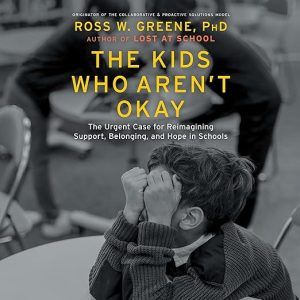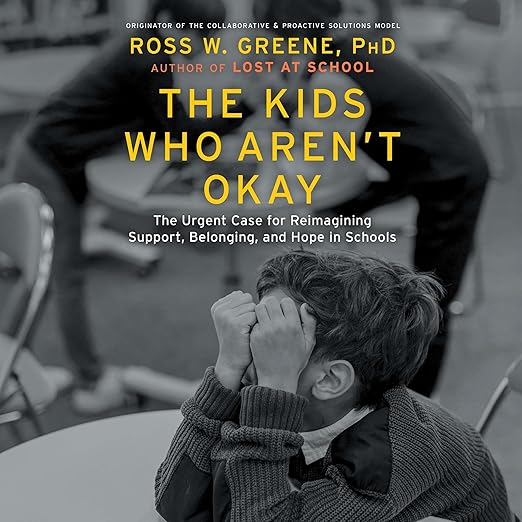
Ross W. Greene has spent more than two decades arguing that kids who behave badly are not choosing to behave badly. They lack the skills to do otherwise. That central idea powered his landmark book Lost at School, and it powers this audiobook too. The Kids Who Aren't Okay arrives at a moment when its title reads less like a rhetorical provocation and more like a plain statement of fact. Greene narrates his own work, and from the first minutes you understand why: this is a man who has sat across from furious, frightened, shut-down children and their exhausted teachers for thirty years, and the weight of that experience comes through in every sentence.
Greene Turns Alarming Statistics Into a Real Argument
What separates this from the crowded shelf of education-reform titles is Greene's insistence on specificity. He opens with statistics that are hard to sit with: record rates of anxiety, depression, chronic absenteeism, and suicidality among school-aged children, alongside equally troubling data on teacher burnout and departures from the profession. He does not present these as background scenery. They are the argument. Schools are not failing because of bad actors; they are failing because prevailing systems were designed to manage behavior rather than solve the underlying problems that produce it. Greene's Collaborative and Proactive Solutions model, which has been implemented in psychiatric units, juvenile detention facilities, and thousands of classrooms, offers a concrete alternative: identify the lagging skills and unsolved problems driving a child's behavior, then solve those problems collaboratively with the child rather than imposing consequences and hoping the behavior disappears.
Reviewer Stacey Curnow described the book as 'sobering, deeply hopeful, and incredibly helpful,' and that three-part characterization is accurate. The sobering part comes first and it earns its length. Greene does not let listeners slide past the scale of the crisis. But he refuses to leave them there.
Case Vignettes Give Greene's Concepts Real Texture
The audiobook format suits this material unusually well. Greene is not a performer, but he is a precise communicator, and hearing him work through case vignettes gives the concepts a texture that the page sometimes flattens. The fourth-grader who melts down every time the schedule changes. The middle schooler whose absences are coded as defiance rather than anxiety. He reads with the pace of someone who genuinely does not want the listener to miss anything. At just over eight hours, the book moves from diagnostic framing to practical implementation without feeling rushed, and the case studies he draws on are from real educators who have used his model, so the examples feel earned rather than illustrative.
One reviewer with direct classroom experience noted that Greene 'expands on his proven Collaborative and Proactive Solutions model with sobering statistics and firsthand accounts, highlighting the urgent need for a more empathetic' approach, and that expansion is precisely what distinguishes this from his earlier work. He has updated his framework to account for the specific conditions of the post-pandemic classroom, where the gap between what schools demand and what many children can currently provide has widened considerably. The book builds on Lost at School but is fully accessible to listeners who have not read it. Greene reintroduces the CPS framework clearly enough that new listeners can follow, and longtime readers will find enough material that has been rethought and refined to justify a full relisten.
Greene Targets School Systems, Beyond Individual Teachers
Listeners already familiar with Lost at School will find the core philosophy intact but the framing sharpened. Greene is more explicit here about the structural changes required, not just individual teacher behavior, but institutional practices, scheduling decisions, and the metrics by which schools measure success. If you are hoping for a book that reassures you that the current system is basically sound and just needs some tweaking at the edges, this is not that book. Greene argues that behavior modification, zero-tolerance policies, and punitive discipline do not work and that the data has said so for a long time. That argument will land differently depending on the listener's professional role, and teachers who have invested in traditional discipline models may find parts of the book uncomfortable.
The language stays accessible throughout. Greene writes for practitioners, not academics, and while he references the evidence base for his model, he does not bury the listener in citations. The vignettes and case studies carry the weight of the argument. One reviewer noted the book 'communicates a complex and emotionally charged subject into an easily read book that is filled with helpful information,' and that readability translates cleanly to audio. Greene's voice, calm and methodical, suits extended listening without monotony.
Readers of Lost at School Get a Real Update
Teachers, school administrators, and counselors dealing with students whose behavior patterns are not improving under current interventions will get the most out of this. Parents of children who struggle in school, children whose difficulties are being managed rather than understood, will also find genuine utility here. Greene's framework extends beyond the classroom, and the sections on collaborative problem-solving apply equally to home settings. If you are new to Greene's work, this stands alone; if you have read Lost at School, consider this a necessary update rather than a repetition. Listeners who need their education books delivered as simple tip lists may find the systemic argument harder to engage with, but those willing to sit with a real diagnosis of a real crisis will come away with both clarity and a practical path forward.
Before You Press Play
- Performance: Ross W. Greene narrates his own work with the deliberate calm of a psychologist who has sat with difficult truths for decades; his delivery is unhurried and authoritative without being clinical.
- What it covers: Children's mental health crisis, collaborative vs. punitive discipline, educator well-being
- Feel: Sober but ultimately hopeful, practical and urgent
- Our call: Essential listening for educators, school counselors, and parents of struggling kids who want a research-grounded alternative to behavior modification.
Does this audiobook require familiarity with Greene's earlier book Lost at School?
No. The Kids Who Aren't Okay stands on its own. Greene reintroduces his Collaborative and Proactive Solutions model clearly enough that new listeners can follow without prior context, though readers of Lost at School will recognize the foundation and find this a meaningful expansion.
Is this audiobook relevant for parents, or is it aimed primarily at educators?
Both. While Greene's examples are often classroom-based, the core framework of identifying lagging skills and solving problems collaboratively rather than imposing consequences applies directly to parenting. Several sections address caregivers explicitly alongside educators.
Does Ross W. Greene narrating his own audiobook affect the listening experience?
Positively, on balance. His delivery is calm and measured rather than performance-oriented, which suits the material. The case vignettes benefit from his familiarity with the real situations they're drawn from, and there's an authenticity to hearing the model's originator explain its applications.
How practical is this audiobook for someone who wants to implement changes at their school?
Quite practical. Greene includes specific steps, real educator stories from schools that have adopted his model, and a clear framework for shifting from reactive to proactive interventions. It is more a roadmap than a philosophical treatise, though it provides both.