Quick Take
- Narration: Will Stauff delivers the 1910 text without editorial framing, the appropriate approach for a primary source document being evaluated as historical artifact rather than as argument.
- Themes: Historical race pseudoscience, American racial ideology in the early 20th century, the intersection of antisemitism and anti-Black racism
- Mood: Clinical and historically disturbing
- Verdict: A 1910 pamphlet of racial pseudoscience with scholarly value as a primary source document, not a text to be engaged with as intellectual content on its own terms.
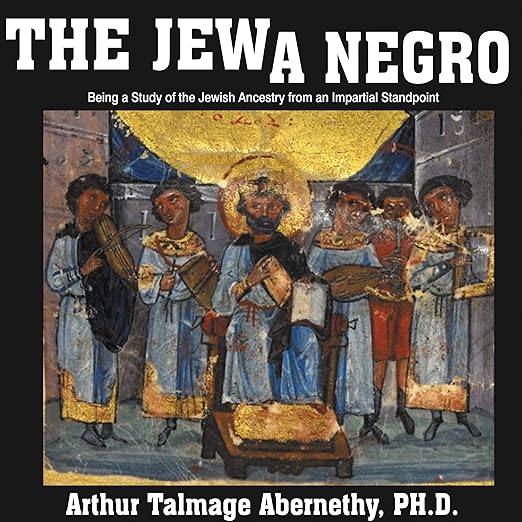
It is necessary to be precise about what this audiobook is and what it is not, because the two things are quite different. The Jew a Negro is a 1910 pamphlet by Arthur Talmage Abernethy, a Methodist minister and professor in North Carolina. It argues, through a combination of biblical interpretation, selective anthropology, and racial pseudoscience, that Jewish people share essential racial characteristics with African Americans. It is a document of American racial ideology at its most contorted, simultaneously antisemitic and anti-Black, reaching for a kind of degradation by association that reveals the anxious hierarchies of its era.
At two hours and thirty-four minutes, the audio version makes the text accessible in a single sitting. The question is what kind of sitting that should be.
The Historical Context That Makes This Worth Studying
Abernethy was not a marginal figure in the simple sense. He was elected to the American Association for the Advancement of Science, served as poet laureate of North Carolina, and ran as a Democratic candidate for Congress. The 2006 scholarly volumes cited in the synopsis, Jewish Roots in Southern Soil and The Price of Whiteness, take this text seriously as a document in the history of how racial categories in America were constructed and contested. Abernethy’s argument was unusual in some ways: he applied racial thinking to Jews at a time when most such rhetoric focused on the Black-white binary. But it operated entirely within the mainstream assumptions of his era about the reality and hierarchy of race.
This is the text’s scholarly value: it demonstrates, with uncomfortable clarity, the intellectual architecture of American racial ideology in the early twentieth century. The assumptions underpinning Abernethy’s argument, that race is a biological reality, that racial mixture has predictable outcomes, that visible characteristics reveal essential nature, were not his idiosyncratic ideas. They were the shared vocabulary of his era, including its scientific establishment.
The Narrator’s Approach and Its Appropriateness
Will Stauff reads the text without editorial framing, no scholarly introduction, no apparatus contextualizing what listeners are hearing. For a primary source document of this kind, this is the appropriate approach, though it creates an obligation for listeners to supply their own frame. The audio version is best understood as a research tool, or as a way to encounter the language and logic of early twentieth-century racial pseudoscience directly rather than mediated through quotation.
The rating of 4.5 from nearly 900 reviews is striking and warrants acknowledgment. The available reviewer comments are brief and opaque, offering little insight into the nature of the engagement driving those numbers. Any honest review of this title has to note that the audience for a 1910 racial pseudoscience pamphlet is heterogeneous in ways that star ratings do not capture.
What This Text Is and Is Not
This text makes no valid arguments about the biology, ancestry, or characteristics of any people. Its claims about Jewish and African racial similarity were pseudoscience when Abernethy wrote them and remain pseudoscience now. What the text does is demonstrate, in its own words, a specific moment in the history of American racial ideology, how race was thought about, what authorities were invoked, what analogies were drawn. That is its scholarly function, and it is the only legitimate framework for engaging with it.
Researchers in American history, ethnic studies, Jewish American history, or the history of race science will find this a useful primary source. General listeners approaching it as intellectual content rather than historical artifact will find it a deeply distressing document with no redemptive intellectual substance of its own.
Who Should Listen, Who Should Skip
Listen if you are conducting research on early twentieth-century American racial ideology, the history of antisemitism in the American South, or the pseudoscientific foundations of racial thinking. This is a legitimate primary source in those contexts.
Skip if you are not approaching this as a document of a discredited ideology. The audio format without scholarly framing requires listeners to supply that context entirely themselves, which is a meaningful burden.
Frequently Asked Questions
Is The Jew a Negro presented with any scholarly introduction or contextual framing in the audio version?
Based on available information, the audio version presents the 1910 text directly without a scholarly introduction or editorial apparatus. Listeners approaching it as a historical document rather than as argument need to supply their own contextual frame.
Why do scholars study this text if it is pseudoscience?
Multiple academic books published in 2006 cite Abernethy’s text as a document in the history of how racial categories in America were constructed. Its value is as evidence of mainstream racial ideology in 1910, the assumptions, language, and logic Abernethy mobilized were widely shared in his era, which is precisely what makes the text historically significant.
What does the high star rating on this audiobook reflect?
The rating and the available reviews do not offer enough context to determine the nature of the engagement driving them. The audience for a 1910 racial pseudoscience pamphlet is likely heterogeneous in ways that aggregate star ratings cannot distinguish.
Is this text appropriate for classroom use in history courses?
It is a legitimate primary source for courses on American racial ideology, the history of antisemitism, or early twentieth-century pseudoscience. However, the audio version’s lack of scholarly framing means instructors would need to provide substantial contextual material alongside it.