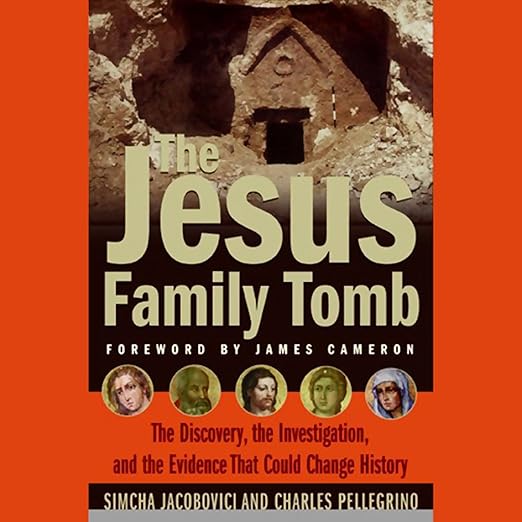
Quick Take
- Narration: Michael Ciulla delivers a clear, engaged performance that handles the book’s shifting tones, from detective story to DNA science to theological speculation, with consistent authority.
- Themes: Archaeological evidence vs. faith, historical reconstruction, the politics of uncomfortable discoveries
- Mood: Charged and contentious, this is not a calm listen regardless of where you stand on its claims
- Verdict: A fascinating document of how a discovery gets handled, contested, and suppressed, regardless of whether you accept its central argument.
The Jesus Family Tomb is the kind of audiobook I approach with a particular kind of alertness, not the skepticism I reserve for pure pseudoscience, but the more careful attention I give to claims that sit at the edge of what evidence can actually support. Simcha Jacobovici’s case is better argued than its critics often allow, and considerably more contested than its supporters acknowledge. What makes it worth listening to, nearly two decades after its release, is that the questions it raises haven’t gone away.
The 1980 discovery of a tomb in Talpiot, Jerusalem, containing ossuaries labeled with names from the Jesus family, including one reading “Yeshua bar Yosef” (Jesus son of Joseph), is a matter of archaeological record. What Jacobovici and co-author Charles Pellegrino do with that record is where the controversy begins. I finished the first two hours while pacing my apartment at eleven at night, which is either a testament to the material’s grip or my inability to sit down during anything involving contested history. Probably both.
Our Take on The Jesus Family Tomb
The book is structured as a detective narrative, and that framing is both its greatest strength and its most significant liability. Jacobovici is transparent about his intentions and methods, which is more than can be said for many popular archaeology books. He lays out the statistical argument, that the cluster of names found in the Talpiot tomb represents an improbable coincidence, and he engages seriously with the DNA analysis performed on residue from two of the ossuaries. The DNA results are genuinely interesting: they suggest the individuals in two of the ossuaries were not maternally related, which is consistent with Jacobovici’s reading of one as Jesus and one as Mary Magdalene, but consistent with many other readings as well.
One of the more substantive reviews among those provided describes the archaeological story as “fascinating and enjoyable” while flagging the analysis as sometimes surprisingly thin. That’s an accurate summary. The discovery portion is gripping. The inferential leaps that follow occasionally outpace the evidence beneath them.
Why Listen to The Jesus Family Tomb
Michael Ciulla’s narration sustains the detective-story energy without tipping into tabloid excitement. He reads the scientific sections with the same measured attention he brings to the narrative passages, which is exactly right, the book needs listeners to follow the methodology arguments carefully, and Ciulla doesn’t let those sections feel like obligatory hedging. The nine-hour runtime is well-paced for the material.
The audiobook’s most durable value is less about whether Jacobovici’s central claim is correct and more about the sociology of the discovery. The initial excavation in 1980 was documented and then essentially shelved. The ossuaries were catalogued and the bones were removed and reburied, meaning the most direct DNA evidence is permanently unavailable. Jacobovici documents this sequence of events in ways that are simultaneously understandable in context and genuinely troubling in implication. Neither Jewish nor Christian authorities had institutional incentives to amplify what the tomb might mean, and the result was a finding that sat in obscurity for decades.
What to Watch For in The Jesus Family Tomb
The statistical argument, that the name cluster is too unusual to be coincidental, is the book’s load-bearing claim, and it has been challenged by onomasticians who argue that the names in the tomb were among the most common of the period. Jacobovici acknowledges the counterargument but doesn’t give it the weight some scholars believe it deserves. Listeners who want a balanced academic treatment of the evidence should supplement this audiobook with the peer-reviewed responses it generated, some of which are available freely.
The framing as a “gripping real-life detective story” also shapes what the book chooses to foreground and what it elides. This is advocacy writing as much as it is reportage, and the best way to engage with it is to hold that clearly in mind while listening.
Who Should Listen to The Jesus Family Tomb
Excellent for listeners interested in archaeology, biblical history, or the politics of religious evidence. Those with a background in the historical Jesus debates will find the book’s empirical claims more legible and also more contestable. Listeners who need certainty, either confirmation of traditional beliefs or confident debunking, will be frustrated. The book is most rewarding for those comfortable sitting inside a genuinely unresolved question.
Frequently Asked Questions
Is The Jesus Family Tomb accepted by mainstream archaeologists and historians?
No, the central claim remains highly contested. Many scholars of early Christianity and ancient onomastics dispute the statistical argument, arguing that the names found in the Talpiot tomb were among the most common of the period. The DNA evidence is real but circumstantial. The book presents a compelling case, not a settled one.
Does the audiobook require religious belief to engage with, or is it primarily an empirical argument?
Primarily empirical. Jacobovici argues from statistical probability, DNA analysis, and archaeological context rather than from theological premises. Reviewers include both a reverend who found the evidence conclusive and secular readers who found it interesting but insufficient, the book is accessible across a wide range of starting positions.
Why were the bones from the Talpiot tomb reburied, and what are the implications of that for the investigation?
The bones were removed and reburied according to Jewish religious law governing human remains. This happened before the tomb’s full significance was recognized, meaning the most direct physical evidence for DNA analysis is permanently unavailable. Jacobovici documents this in the book and it represents the most significant limitation on what can ever be definitively established.
How does Michael Ciulla’s narration handle the shift between the narrative detective sections and the more technical DNA and statistical analysis?
Smoothly. Ciulla maintains the same engaged, clear delivery across both modes, which prevents the scientific sections from feeling like obligatory interruptions to the story. Listeners who worry about technical passages in audiobooks will find this a non-issue here.