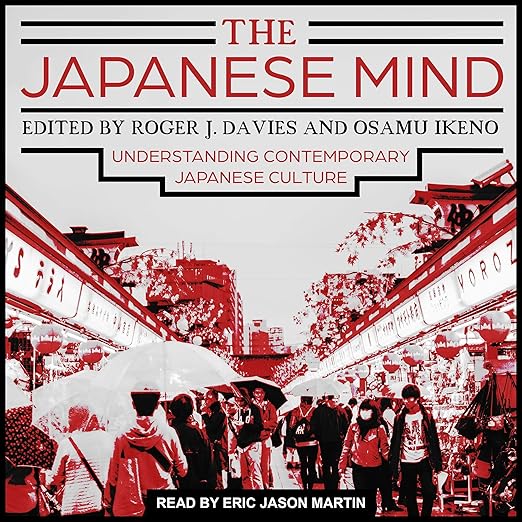
Quick Take
- Narration: Eric Jason Martin reads Davies’s essay-style chapters cleanly and at a measured pace that suits the reference-book format; the delivery is academic without being dry.
- Themes: Cultural code-switching, the gap between surface behavior and interior logic, the mechanics of cross-cultural professional interaction
- Mood: Scholarly but accessible, structured for dipping in rather than marathon listening
- Verdict: A reliable primer on Japanese cultural concepts that rewards travelers and business professionals, though it skims the surface of each topic and some sections show their age.
I picked up The Japanese Mind on the recommendation of a colleague who had spent three months in Tokyo and came back unable to explain why every professional interaction had felt slightly misaligned with his expectations. He said reading it felt like finally finding the instruction manual. I listened to it over the course of several evenings before a trip of my own, and I came away with a similar feeling: useful, clarifying, occasionally reductive, but a genuinely good starting point for understanding what is actually happening in a Japanese social context when you cannot quite read the room.
Roger Davies’s book began as a collection of essays written by students in an applied linguistics and TEFL program at a Japanese university, which explains a quality several reviewers have noted: the chapters have a consistent structure that can feel formulaic but is also genuinely easy to navigate. Each section introduces a concept, traces its historical and social roots, and discusses how it manifests in modern Japanese behavior. At 8 hours and 48 minutes narrated by Eric Jason Martin, it moves efficiently through a substantial amount of cultural territory.
The Vocabulary This Book Gives You
The most durable thing this audiobook provides is a set of precise terms for cultural dynamics that most Westerners experience in Japan but cannot name or predict. Concepts like amae, the expectation of dependence on others’ benevolence; haragei, the form of implicit communication sometimes described as belly art; and chinmoku, the strategic use of silence in professional and social contexts, are explained with enough historical and behavioral context that they become genuinely useful interpretive tools rather than academic curiosities. Reviewer Romulus described reading it before a month in Japan and finding that it transformed the quality of every interaction because it shifted his approach to match what the Japanese people he met actually needed from an encounter.
That is the book’s real value: it converts invisible social friction into legible behavior. Once you understand that kenkyo, the performance of modesty, is a social expectation rather than a personality trait, you stop misreading it as insincerity. Once you grasp giri, social obligation, you stop interpreting obligatory behaviors as personally warm or cold. The framework shifts your interpretive baseline rather than giving you a set of tactical maneuvers, which is the right kind of cultural education. Reviewer Stephen Armstrong’s description of the book as adding to the understanding of current cultural traits, their historical origins, their meaning to both Japanese and first-visit foreigners, and the countervailing Western forces eroding traditional ideals, captures the scope well.
What the Format Cannot Deliver
The honest caveat is embedded in the book’s design. As reviewer Traveler2015 noted, this is explicitly not intended as an in-depth study. Each chapter is an introduction, and some chapters repeat concepts that others have already covered from a slightly different angle. In audio format, without the ability to flip back to a specific chapter on demand, that redundancy becomes more noticeable. Martin’s narration is precise and professional, but the material was clearly designed for a reference shelf rather than sequential listening from beginning to end.
The book was assembled from student essays and carries some of the constraints of that origin. The analysis of women’s roles in Japanese society, for instance, reads as noticeably dated compared to more recent cultural scholarship. The discussion of personal space and child-rearing reflects research that is now several decades old, and Japanese society has shifted in significant ways since Davies assembled these chapters. Anyone spending substantial professional or personal time in Japan will quickly outgrow this book and need more granular, updated sources to supplement it.
Eric Jason Martin handles the academic tone well, finding a consistent register that conveys scholarly seriousness without becoming soporific. He does not try to inject energy the text does not contain, which is the correct approach for this kind of reference material. The production is clean and the pacing is appropriate for the essay format.
Who Gets the Most from This Audiobook
First-time visitors preparing for Japan, professionals about to begin working with Japanese counterparts, and students of Japanese language who want behavioral and cultural context to accompany their linguistic training will find this genuinely useful. Reviewers consistently confirm that it works as preparation: it does not guarantee smooth cultural navigation, but it removes the most common sources of avoidable confusion. Reviewer Charles100 in the United Kingdom called it perfect for someone visiting Japan for the first time or being transferred there for work, which is probably the most accurate summary of its ideal audience.
Those looking for contemporary social analysis, feminist or critical perspectives on Japanese culture, or deep dives into any of the specific concepts the book introduces will need to treat this as a starting point and look elsewhere for follow-up reading. It is a primer in the best and most limiting sense of that word. For what it sets out to do, it does it reliably and clearly, and the audio format makes the chapter-by-chapter structure easily navigable for busy listeners who want to prepare efficiently before a trip or professional assignment.
The Listening Experience Across 8 Hours
Eric Jason Martin’s narration is worth discussing in more detail because it shapes how accessible the material is in audio format. Martin reads with a careful, unhurried academic register that treats each concept with the same measured attention, whether the chapter is on gift-giving customs or on the philosophical concept of ma, negative space and its role in Japanese aesthetics and communication. That consistency is the right approach for a reference text, though it does mean that some chapters feel more energetically identical than a more interpretive narrator might allow. The trade-off is clarity over color, which is the correct choice for this kind of material.
One practical advantage of the audio format for this specific book is that the chapter-by-chapter structure, each addressing a distinct cultural concept, allows the listener to treat the audiobook as background preparation during commutes or travel without losing continuity between sessions. The concepts are discrete enough that picking up mid-chapter after a break does not create confusion. That accessibility is part of why this works well for pre-travel listening specifically.
Frequently Asked Questions
Is The Japanese Mind still relevant, or has Japanese culture shifted enough to make it outdated?
The core cultural concepts, including amae, giri, sempai-kohai, and haragei, remain broadly applicable and are regularly cited in contemporary cross-cultural literature. Some sections, particularly around gender roles and family structure, reflect an earlier moment and should be supplemented with more recent sources for anyone spending significant time in contemporary Japan.
Is this audiobook useful if you are visiting Japan as a tourist rather than for business?
Yes, and reviewers who used it specifically for tourism report strong results. Understanding concepts like gift-giving protocol, the use of silence in social interaction, and the distinction between public and private behavior matters as much in tourist contexts as in professional ones. Reviewer Romulus used it for a month-long tourist trip and found it transformed his interactions.
Does Eric Jason Martin’s narration make the reference-book structure easy to follow in audio format?
Martin reads clearly and at a measured pace that helps the more conceptually dense sections land. The chapter-by-chapter structure translates reasonably well to audio, though the lack of a visual index means you cannot jump to specific concepts the way you would with the print edition. Sequential listening works, though the book rewards revisiting individual chapters as specific situations arise.
How does this compare to Ruth Benedict’s The Chrysanthemum and the Sword for understanding Japanese culture?
Davies is more practically oriented and more accessible than Benedict’s classic anthropological study, which is denser and more theoretical in its approach. For immediate pre-travel or professional preparation, Davies works better. For deeper cultural understanding and historical analysis, Benedict and more recent academic writing offer more substance, though Benedict’s work is now very dated in its own way.