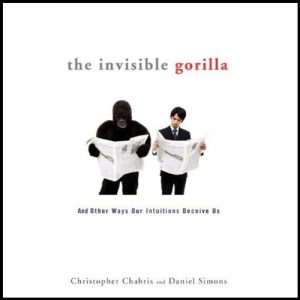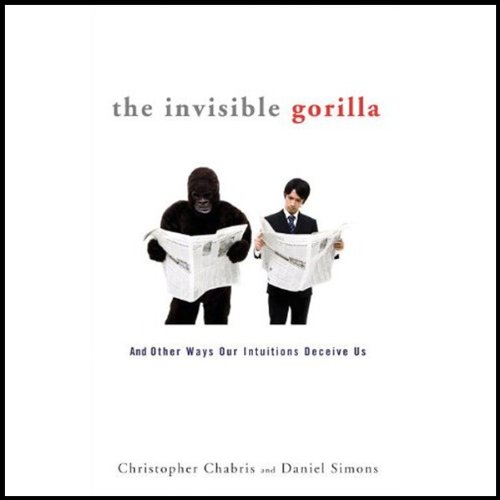
I picked up The Invisible Gorilla on the recommendation of a colleague who described it as the book that had most changed how she thought about her own thinking. That is a high bar to set for any popular psychology title, and I found the reality to be something more modest but still genuinely worth the nine hours: a well-structured examination of the ways human intuition routinely misleads us, built around a famous experiment and expanded into a broader taxonomy of cognitive failure.
Christopher Chabris and Daniel Simons are best known for the selective attention test, in which participants watching a basketball video fail to notice a person in a gorilla suit walking through the scene because they are focused on counting passes. The experiment has become one of psychology's most cited demonstrations of inattentional blindness, and this book uses it as the launching point for exploring a wider range of situations in which our confidence in our own perception, memory, and reasoning significantly outstrips our actual reliability.
The book is organized around six key illusions: the illusions of attention, memory, confidence, knowledge, cause, and potential. Each section draws on real-world case studies, medical errors, courtroom testimony failures, financial decisions, and educational interventions, as well as experimental evidence to demonstrate how each illusion operates. The strongest sections are the ones most directly connected to the original experiment and its implications: the chapters on attention and memory are where Chabris and Simons are most confident in their material and most convincing in their examples.
Reviewer Jon Richfield described the book as succeeding both as a satisfying read and as a public service, noting that it handles an intriguing field without being superficial. That is an accurate summary of what the book achieves at its best. The authors write with genuine respect for both the science and the reader, avoiding the trap of popular psychology that mistakes accessibility for oversimplification.
Why Listen to The Invisible Gorilla
Dan Woren is a reliable narrator for this kind of explanatory nonfiction: clear, measured, and unobtrusive enough that the material takes precedence over the performance. The case studies in particular benefit from audio delivery; a live account of a police officer failing to notice a brutal assault happening outside his field of attention while in pursuit of a suspect lands differently when heard than when read, because the listening itself enacts the problem the book is describing. You are attending to Woren's voice and narrative, and the peripheral material that was also present in that story may have slipped past your notice too.
Reviewer Andrés, reading in a second language, called the book enlightening and captivating, noting specifically the account of how easily perception is deceived by illusory reality. That cross-language accessibility is worth noting: the prose is clear enough to work even when the reader does not have full native fluency, which says something about the quality of the explanatory writing.
What to Watch For in The Invisible Gorilla
One reviewer raised a legitimate criticism that deserves acknowledgment: some of the specific claims the authors use to debunk others have since faced complications of their own as the science has continued to develop. Chabris and Simons were writing in 2010, and the replication crisis in psychology has since cast a broader shadow over some of the findings they cite as settled. This does not undermine the central arguments about cognitive illusion, which are well-established, but it is worth knowing that any popular psychology book written before 2015 is working with a literature that has since been partially revised. The broader claims in The Invisible Gorilla hold up better than some of the peripheral examples.
The anonymous reviewer who found the writing too slow and the content under-edited raises a point that also has some validity. The later sections of the book, particularly the discussions of cause and potential, cover ground less compellingly than the opening chapters, and some of the case studies run longer than the argument requires.
Who Should Listen to The Invisible Gorilla
A good fit for listeners who enjoyed Thinking, Fast and Slow or similar popular cognitive science titles and want something more tightly focused on attentional and perceptual failure specifically. Also worthwhile for professionals in fields where overconfidence in perception has real consequences: law enforcement, medicine, finance. Skip it if you are looking for deeply current science or if you have already read extensively in the cognitive bias literature and want something that will challenge you rather than consolidate ground you have already covered.
Key Details
- Voice: Dan Woren delivers the psychology and storytelling with professional clarity, keeping the science accessible without oversimplifying the nuance.
- Big ideas: cognitive illusions, the gap between perceived and actual mental capacity, everyday decision-making under faulty assumptions
- Atmosphere: Engaged and occasionally humbling, the kind of listening that makes you second-guess your own certainty
- Worth it?: A solid popular psychology audiobook that works best when it sticks to its strongest case studies, though it occasionally meanders in its mid-sections.
How does The Invisible Gorilla compare to Daniel Kahneman's Thinking, Fast and Slow as a listen?
The Invisible Gorilla is more tightly focused and considerably shorter than Kahneman's book. It covers adjacent territory around cognitive bias and intuition failure, but from a narrower, more experimentally grounded perspective. Kahneman's book is more comprehensive; Chabris and Simons go deeper into specific attentional and perceptual phenomena.
Has the science in The Invisible Gorilla held up since it was published in 2010?
The core findings around inattentional blindness and change blindness are well-replicated and robust. Some of the peripheral claims and case studies the authors use to illustrate broader points draw on research that has faced more scrutiny in the post-replication-crisis era. The central argument is sound; some supporting details require updating.
Is Dan Woren's narration a good match for the material?
Yes. He reads explanatory nonfiction with appropriate clarity and pacing, keeping the scientific content accessible without flattening its nuance. The narration is competent and unobtrusive rather than particularly distinctive.