Quick Take
- Narration: Brian Arens delivers the structured, chapter-by-chapter content with clarity and a business register that keeps the material accessible without oversimplifying the analytical depth.
- Themes: Fundamental business analysis, disciplined equity research process, mistake avoidance in investing
- Mood: Methodical and serious, best approached as a working reference rather than a straight listen-through
- Verdict: One of the most thorough treatments of equity research process available in audio form, essential for fundamental investors, but incomplete for those who also need valuation framework guidance.
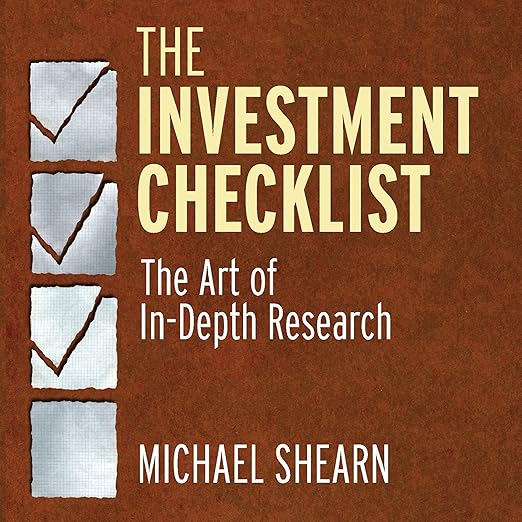
I picked this one up after a conversation with a reader who described it as the book he wished he had discovered twenty years earlier rather than after his first serious investment mistake. That kind of endorsement, specific, retrospective, grounded in loss rather than aspiration, tends to mean something. I listened to The Investment Checklist over a couple of weeks of early-morning sessions, treating it less like a linear narrative and more like a structured reference I was building familiarity with over time. That mode of engagement, it turns out, is exactly what the book rewards.
Michael Shearn’s central premise is simple and quietly powerful: most investment mistakes happen not from bad luck but from insufficient understanding of what you are actually buying. The solution is not more intuition or faster pattern-matching but a more disciplined research process, one structured by systematic questions that force you to confront what you do not know before you commit capital. The checklist form has been popularized in adjacent fields, most notably through Atul Gawande’s work on surgical safety, but Shearn applies it to equity research with a specificity and rigor that is specific to the discipline.
Our Take on The Investment Checklist
What makes this book genuinely valuable rather than just competently organized is the depth of the questioning it models. Shearn moves from generating and evaluating investment ideas through assessing business quality, management teams, competitive dynamics, and risk identification. One reviewer who spent years as a mutual fund analyst and returned to individual stock picking after retirement described it as the best book on individual company analysis he had encountered across three decades of the field. That is not a casual assessment.
The real-world examples are a strength. Shearn illustrates each section with actual cases showing how investment managers and CEOs apply the principles, which keeps the checklists from feeling purely theoretical. You are not just reading a schema; you are seeing the schema tested against the messiness of actual businesses and actual decisions. One reviewer who works in a structured investment process appreciated specifically that the format is exhaustive without being unworkable, you can engage with it at the level of completeness your situation requires.
Why Listen to The Investment Checklist
Brian Arens’s narration handles the structured, chapter-organized content with professional clarity. This is not a book that is trying to be emotionally compelling or narratively driven, it is a methodological guide, and Arens treats it as such without making the delivery dry or dismissive. The pacing is deliberate, which suits material where you occasionally need to replay a section to absorb what a particular checklist item is actually asking you to think through.
The supplementary PDF containing all the checklists found in the book is available for download alongside the audio edition, which is the right approach for this kind of reference material. The actual checklist forms are the core practical tool the book produces, and having them in a format you can work from separately, annotating them, filling them in against an actual investment idea, transforms the audiobook from a passive learning experience into something you can use as a working framework. Listeners who commit to downloading and using that supplementary material will get significantly more from the audio version than those who simply listen through.
What to Watch For in The Investment Checklist
The most consistent critique in the reviews is substantive and worth engaging with honestly: Shearn covers the strategic and competitive analysis of a business in considerable depth but offers limited guidance on translating that analysis into a valuation framework. One reviewer with academic and professional investment background noted explicitly that a discussion linking the quality assessment to valuation methodology would have made the book more complete. This is accurate. Shearn tells you how to understand what a business is and how well it is run; he is less systematic about telling you what to pay for it.
For investors who already have a valuation discipline, who know how to construct a discounted cash flow analysis, how to think about multiples in context, how to translate a business quality assessment into a price, the checklist fills a genuine gap in most analytical processes. For those who are still developing the full spectrum of analytical skills, this book works best in conjunction with a valuation-focused text rather than as a standalone investment education.
Who Should Listen to The Investment Checklist
Fundamental investors who believe in understanding businesses before buying them will find this essential. Analysts building or refining their research process, portfolio managers looking for a more systematic pre-investment discipline, and individual investors who have experienced the cost of making decisions without fully understanding what they owned are the natural audience. Those looking primarily for valuation shortcuts, technical analysis guidance, or portfolio construction frameworks will need to supplement this with other reading. Download the PDF checklist companion and use it actively with real investment ideas, that is the mode of engagement where the book’s value fully materializes.
Frequently Asked Questions
Is The Investment Checklist useful for individual investors, or is it primarily aimed at professional analysts?
Both groups benefit, but in different ways. Professional analysts will find a structured framework that complements and challenges their existing process. Individual investors who have experienced investment losses from incomplete analysis will find the systematic questioning approach genuinely transformative. The most important factor is a commitment to fundamental, business-focused investing, the checklist method is not useful to those who prefer technical or macro-driven approaches.
The book is described as not covering valuation in depth, does that make it incomplete as a standalone investment guide?
It is a genuine limitation that reviewers consistently flag. Shearn builds deep rigor around understanding a business qualitatively and strategically, but the bridge from that understanding to a specific valuation methodology is largely left to the reader. The book works best in combination with a valuation-focused resource rather than as a complete investment education on its own.
How essential is the supplementary PDF checklist to getting value from the audiobook?
Very. The checklist forms are the core practical tool the book generates, and engaging with them actively against real investment ideas is where the methodology becomes genuinely useful rather than theoretical. Download the PDF and treat it as a working document alongside the audio listening.
Does Brian Arens’s narration keep the methodological content engaging over 13 hours, or does it become dry?
Arens delivers clearly and with appropriate pacing for the structured content. The book is not designed to be narratively compelling, it is a disciplined reference work, and Arens does not try to impose energy the material isn’t calling for. The real-world examples Shearn includes throughout help prevent the analytical framework from becoming monotonous, and Arens handles those case studies with enough variation to maintain attention.