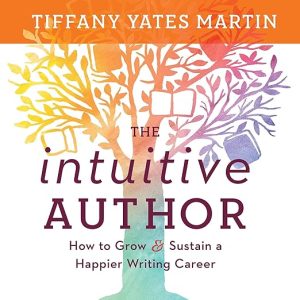
Ten hours is a long time to spend with a career book editor talking you through impostor syndrome, but Tiffany Yates Martin earns most of it in The Intuitive Author. Martin, founder of FoxPrint Editorial and already the author of Intuitive Editing, narrates her own survival manual for working and aspiring authors, covering rejection, criticism, burnout, and the unglamorous business mechanics that sit underneath any writing career. Is this audiobook another writing-craft title retreading the same five pieces of advice everyone already knows? Reviewers who have read stacks of comparable books insist it genuinely is not, and the reasoning behind that claim is worth unpacking.
Martin's Case-Study Approach to Impostor Syndrome
Martin narrates with the unhurried clarity of someone who has spent decades explaining editorial notes to anxious writers without losing their trust, which turns out to be exactly the right register for this material. She is warm without turning saccharine about rejection and criticism, and she is specific rather than vague when she describes what impostor syndrome actually does to a working writer's daily habits. Because she edits for a living rather than simply writing about writing from the outside, her advice carries the texture of someone who has watched hundreds of authors, not just herself, cycle through the same specific anxieties, which gives the audiobook a case-study quality that purely personal writing memoirs tend to lack.
The book covers an unusually wide range of publishing paths, traditional, indie, small-press, hybrid, and Martin resists the temptation to rank them, treating the choice as a legitimate strategic decision rather than a referendum on a writer's seriousness. That even-handedness extends to genre versus literary fiction and to nonfiction and memoir writers, all of whom get direct acknowledgment rather than an assumption that the audience is exclusively novelists. Structurally, the audiobook moves through discrete, nameable challenges, rejection, comparison, motivation, balancing creativity and commerce, rather than a single continuous argument, so it holds up well as something to dip into out of sequence when a specific problem is actively bothering you.
Martin's sense of humor surfaces regularly throughout, and it is a specific, wry, self-deprecating kind rather than broad comic relief tacked onto serious material. She is as willing to poke fun at her own early-career mistakes and rejections as she is to gently needle common author neuroses, the tendency to compare a rough draft to other people's finished, published books, the urge to check sales rankings obsessively, which keeps ten hours of career advice from ever tipping into a lecture. That balance of genuine expertise and self-aware humor is harder to pull off in audio than it sounds, since timing has to carry jokes that a page can let breathe visually with white space, and Martin's narration handles that timing well.
Breaking the Repetition Other Craft Books Repeat
At 4.8 across 44 ratings, this sits near the top of the writing-craft category, and the reviews back up why: one listener, self-identified as Amazonaholic, specifically calls out how repetitive most writing how-to books have become, sharing slightly different flavors of the same very similar concepts, and credits Martin with genuinely breaking that pattern. Another reviewer, Anne, frames the book as useful well beyond fiction writers specifically, extending the operating-instructions framing to any creatively minded person navigating obstacles to their own work. A third, a self-described novelist deep in the querying trenches, calls Martin an invaluable resource after working through a dozen comparable craft books in recent years, which is a meaningfully high bar for a genre this crowded.
Part of what separates this from adjacent titles is Martin's decades of hands-on editorial experience with bestselling and award-winning authors, which she draws on throughout rather than relying purely on her own writing journey the way many craft-book authors do. The result reads less like personal memoir dressed up as advice and more like an editor finally writing down the patterns she has watched play out across thousands of manuscripts and just as many anxious phone calls. For listeners who already own Intuitive Editing, this functions as a companion volume addressing the psychological and business side of the career that the earlier book, focused more narrowly on craft and revision, did not really cover.
Martin also draws a clear, useful line between what a writer can actually control and what they cannot, submission timelines, market trends, an agent's mood on a given day, and where energy is better spent focusing on craft and habit instead. That distinction recurs throughout in slightly different forms, and it lands as genuinely actionable rather than as the kind of vague reassurance career books often default to, since Martin ties it back to specific, nameable moments in a working author's year: contract negotiations, launch week, the long months of silence after a manuscript goes out on submission.
Ten Hours Aimed at Career, Not Craft
At a full ten hours, this is a genuine commitment, and the audiobook is explicitly aimed at working and aspiring authors rather than general listeners with a casual interest in books; anyone without active skin in a writing career specifically will find long stretches speaking past them rather than to them. The content also leans toward inner-game and career-strategy territory, impostor syndrome, rejection, business mechanics, rather than line-level craft instruction, so listeners hoping for grammar or prose-technique guidance specifically should look toward a different title in Martin's catalog, or elsewhere entirely.
The advice, while grounded in decades of editorial experience, is necessarily general in places, since it has to apply across fiction, nonfiction, and memoir, and across traditional, indie, and hybrid publishing paths simultaneously. Listeners in a very specific situation, querying literary agents this month, deep into a self-publishing launch, may find themselves wanting more targeted, tactical detail than a book this broad in scope was ever designed to provide in any single chapter.
No Active Project Means This Won't Land
Working and aspiring authors of any genre or category, especially those currently stuck on the psychological side of the craft rather than the mechanical one, are the clear intended audience, and the audiobook delivers for them specifically. Writers who have already burned through the more famous craft titles and found them repetitive, the exact complaint Amazonaholic raises in their review, are likely to find this a genuinely fresh angle rather than another lap around advice they have already read a dozen times under different covers.
No active writing project or career ambition in play means this one will likely feel like a mismatch, regardless of how well-crafted the material is, since so much of its value depends on recognizing your own specific anxieties in Martin's descriptions of impostor syndrome and creative burnout. If you are not currently wrestling with rejection, comparison, or the business side of a writing career, that same ten-hour runtime becomes a long stretch to spend on problems you are not actually having, and your time is likely better spent elsewhere in the catalog until that changes.
Before You Listen
Does Tiffany Yates Martin narrate her own audiobook?
Yes, and her editorial background comes through clearly in the narration, warm but specific, closer to a trusted editor's notes than a generic motivational voice.
Is this audiobook useful for nonfiction and memoir writers, or just novelists?
Both. Martin explicitly addresses fiction, nonfiction, and memoir writers throughout rather than assuming an audience of novelists exclusively.
How does this audiobook compare to Martin's earlier book Intuitive Editing?
It functions as a companion volume, shifting focus from line-level craft and revision toward the psychological and business side of sustaining a writing career.