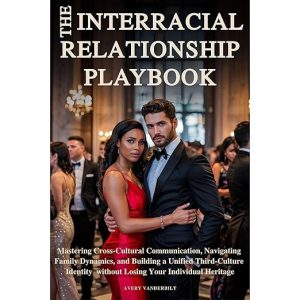
At a Glance
- Read by: Virtual Voice AI narration; functional but emotionally flat for a book that deals in intimate, high-stakes relationship territory.
- At its heart: Multicultural identity, communication across cultural divides, systemic bias in domestic life
- Vibe: Direct and instructional, occasionally clinical, with moments of genuine recognition
- Short version: A strategically framed guide with real insight for interracial couples, though the AI narration keeps it at arm's length from its full emotional potential.
I came across The Interracial Relationship Playbook on a Tuesday evening when I was deep in a review backlog, expecting something generic. Avery Vanderbilt’s framing stopped me almost immediately. The book opens by telling you that you and your partner are not just two people in love but two “Cultural Operating Systems attempting to sync in a world that wasn’t built for your union.” It is a blunt, almost provocative lens, and it works better than I expected.
The audiobook runs just under four hours, narrated by a Virtual Voice AI. That is the first honest thing to say: the emotional material here deserves a human voice. Vanderbilt is writing about the pain of microaggressions, holiday negotiations with overbearing in-laws, and the specific exhaustion of representing your entire relationship to the world on social media. These are not neutral subjects. The AI narration delivers them competently but without texture, which flattens some of the more vulnerable passages.
Named Strategies Carry More Than the Narration
What Vanderbilt does well is refuse to be vague. Each chapter builds toward a named strategy, the Cultural OS Audit, the Sword and Shield Strategy, the Digital Threshold Ritual, and these frameworks give couples a shared vocabulary for conversations that are often hard to even start. One reviewer described the experience as “serially telling the challenging parts of my love story back to me,” and that kind of recognition is exactly what the book is reaching for. Another listener noted that some things are so ingrained in our upbringing that we would not even know they exist until something names them, which is the real value here.
The Script Library of more than fifty word-for-word responses for racist strangers, intrusive coworkers, and well-meaning family members is a genuinely practical inclusion. It gives couples language they can rehearse and adapt, rather than leaving them to improvise in charged moments. The Legacy Blueprint chapter, focused on raising multiracial children with a stable dual-heritage identity, is the most emotionally resonant section of the book and the one that would have benefited most from human narration.
Twelve Case Studies Ground the Framework
This audiobook finds its audience among couples who have been together long enough to recognize the patterns Vanderbilt describes but have not yet had the language to address them systematically. The twelve anonymized case studies, drawn from real forum conversations and diagnosed through what Vanderbilt calls the Avery Bridge Lab Reports, give the abstract frameworks grounding in actual situations. The chapter on medical environments, specifically what the book calls Medical Monoracialism, covers territory that very few relationship guides acknowledge at all.
The synthesis of neurobiology and sociolinguistics is not always seamlessly executed, and at times the book leans into the register of a brand rather than a conversation, with phrases like “build your sovereignty” that feel more like marketing copy than clinical insight. But the underlying ideas are sound, and the structural organization is clear enough that readers can return to specific sections as circumstances require.
Western Assumptions Limit the OS Metaphor
The tone occasionally tips into the prescriptive in ways that may not land for couples from all cultural backgrounds. The model assumes a fairly Western, English-language context for most of its scenarios, and the High-Context versus Low-Context communication framework, while useful, is drawn from intercultural communication research that has its own limitations when applied to individual relationships. There is also a certain earnestness to the framing that a skeptical reader may find difficult to settle into, particularly in the opening chapters where the metaphor of Cultural Operating Systems is established at length.
The AI narration remains the most significant practical limitation. For couples who intend to listen together, which seems like the ideal use case, the absence of warmth or variation in the voice will be noticeable. A future recording with a human narrator would serve this material considerably better.
Couples Already Circling the Same Friction Points
This audiobook will resonate most with couples who are already in established interracial relationships and find themselves repeatedly encountering the same friction points without a framework for resolving them. It is also worth considering for people early in a multicultural relationship who want to build shared language before conflict arises. It is less suited to listeners who prefer narrative nonfiction or who find the self-help strategy format alienating. And if AI narration is a dealbreaker for you, the physical or e-book format would likely deliver the content more effectively.