Quick Take
- Narration: Craig Wasson reads with appropriate gravity and restraint, letting the injustice speak rather than editorializing through performance.
- Themes: Wrongful conviction, small-town institutional failure, mental illness and the criminal justice system
- Mood: Bleak and methodical, with a slow-building outrage that the material earns honestly
- Verdict: Grisham’s only nonfiction work delivers a case study in systemic failure that is more disturbing for being scrupulously documented.
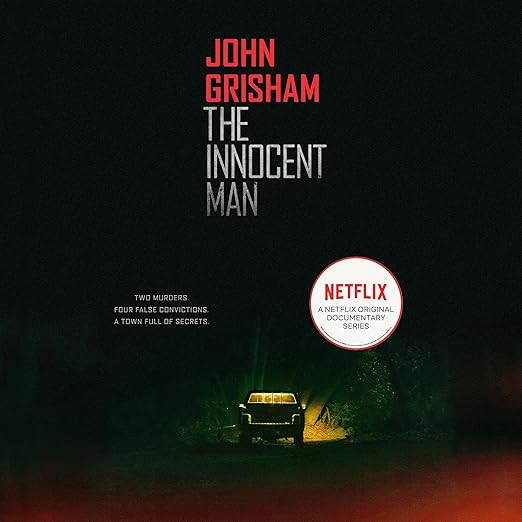
There is a specific discomfort that comes from reading a book that makes you angry and sad simultaneously and gives you no easy resolution to settle into. I finished The Innocent Man on a quiet evening and sat with it for a while before I could write about it. John Grisham is many things as a writer, but his particular gift in his fiction has always been the ability to make legal systems feel alive and dangerous. In this, his only work of nonfiction, the stakes are not imagined.
Ron Williamson was a baseball player from Ada, Oklahoma, picked in the first round of the 1971 Major League draft from the state. He left with dreams and returned six years later with a bad arm, worse habits, and the early signs of mental illness that would define the rest of his life. In 1982, a twenty-one-year-old cocktail waitress named Debra Sue Carter was raped and murdered in Ada. For five years the crime went unsolved. When police finally focused on Williamson and his friend Dennis Fritz, the case they built rested on junk science, jailhouse snitches, and a prosecutorial determination that mistook correlation for evidence. Williamson went to death row. Fritz received a life sentence.
Our Take on The Innocent Man
Grisham’s framing in the preface is direct to the point of being challenging: if you believe in American innocence until proven guilty, this book will shock you. If you believe in the death penalty, it will disturb you. If you believe the criminal justice system is fair, it will infuriate you. Those three sentences are not marketing hyperbole. They are an accurate description of what the documented facts of this case produce as a reading experience.
What Grisham does well here is the same thing he does well in his fiction: he makes people specific. Williamson is not an abstraction or a symbol of wrongful conviction. He is a particular man with particular gifts, particular failures, and a particular mental illness that the system exploited rather than addressed. The portrait is neither hagiographic nor detached. Grisham documents the drinking, the erratic behavior, the difficulty Williamson caused people around him, precisely because the injustice of what happened to him requires the full picture to register properly. He was not an easy man to know, and the book does not pretend otherwise.
Why Listen to The Innocent Man
Craig Wasson’s narration is calibrated for the gravity of the material without tipping into performative solemnity. He reads with the kind of even authority that lets the documented facts do their own work rather than telling you how to feel about them. In a book where the injustice is this thoroughly documented, a narrator who editorializes would actually undermine the impact. Wasson’s restraint is the right professional judgment.
At twelve and a half hours, the pace is measured rather than quick. This is not a complaint: Grisham takes the time to establish the Ada community, the Carter family’s grief, and the specific procedural failures at each stage of investigation and prosecution. That patience is what transforms a shocking story into a damning analysis.
What to Watch For in The Innocent Man
Not all reviewers find the writing fully satisfying as literary nonfiction. One reviewer, who initially read it thinking it was poor fiction and only realized mid-read that it was true, offered a pointed observation: Grisham’s narrative style sometimes keeps the reader at an emotional distance from the people involved. That distance is partly a function of the true crime conventions Grisham is working within, and partly a genuine stylistic limitation relative to the best literary nonfiction in this genre. The story’s power comes primarily from what happened rather than from the prose shaping it.
Listeners who have read Grisham’s legal thrillers should know this reads nothing like them in terms of pacing. The urgency that propels his fiction is replaced here by methodical documentation, which is appropriate to the subject but can feel slow to readers expecting his novelistic tempo.
Who Should Listen to The Innocent Man
Essential listening for anyone interested in wrongful conviction cases and the systemic conditions that produce them: prosecutorial overreach, jailhouse informants, junk forensic science, and the failure of mental health support systems within criminal proceedings. The Netflix documentary series on this case offers a useful visual companion for those who want both experiences.
Skip it if you are looking for the pacing of Grisham’s fiction or if you want the narrative satisfaction of a true crime story that resolves cleanly. The resolution here is deeply qualified, and the system’s failures are not attributed to individual bad actors who can be satisfyingly condemned.
Frequently Asked Questions
How does The Innocent Man compare to Bryan Stevenson’s Just Mercy for listeners interested in wrongful conviction?
They are different in focus and form. Stevenson writes from inside the advocacy work with moral clarity and personal investment. Grisham writes as a journalist documenting a specific case with novelistic precision. Just Mercy is more emotionally galvanizing; The Innocent Man is more forensically detailed about one case’s specific systemic failures.
Is Craig Wasson’s narration noticeably different from Grisham’s fiction audiobooks?
The material demands a different performance register, and Wasson delivers it. The voice is more grave and measured than you would expect from a thriller narration, which is exactly right for nonfiction of this weight. It does not try to manufacture tension artificially because the actual story is sufficiently disturbing.
Does the book address the Carter family’s experience or focus primarily on Williamson and Fritz?
Grisham is primarily focused on Williamson and Fritz, but the book does not ignore Debra Sue Carter or her family. The crime and its human cost are established with appropriate seriousness before the investigation failures become the central concern.
Was Ron Williamson exonerated before his death?
Yes. Both Williamson and Fritz were exonerated by DNA evidence in 1999, eleven years after their conviction. Williamson died in 2004. Fritz went on to write about his own experience and became an advocate for justice reform. The book covers the exoneration and its aftermath.