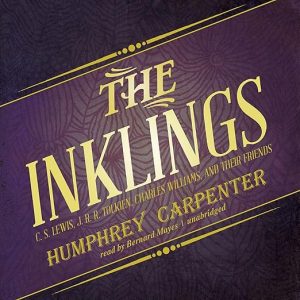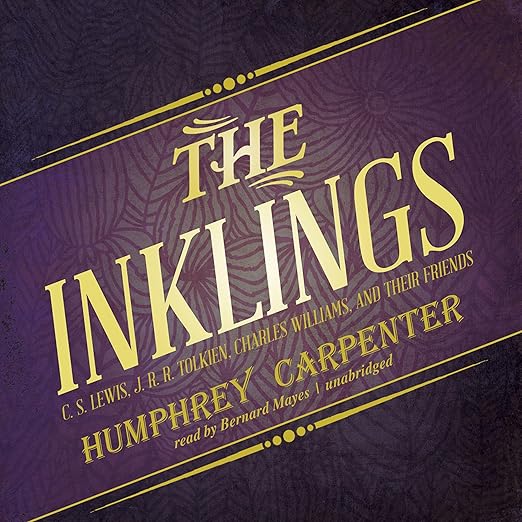
Oxford in the nineteen thirties, and a group of dons meeting in a college room to read their unfinished work aloud to one another. That is the premise of Humphrey Carpenter's book, and the detail worth pausing on is the phrase the publisher uses about what came out of those rooms: The Screwtape Letters, The Lion, the Witch, and the Wardrobe, and The Lord of the Rings all "first found an audience" there. An audience, not readers. This audiobook is about men who heard books before anybody read them.
Cleared Away Before the Value Becomes Visible
Three men sit at the center, Charles Williams, J. R. R. Tolkien and C. S. Lewis, and the circle grew outward from them. A five-star reviewer fills in the roster the publisher's copy leaves out, naming Owen Barfield, Neville Coghill and Warren Lewis among the others. Another places the gatherings on Thursday evenings in Lewis's rooms, held specifically so members could read their work to each other. The description puts those rooms at Magdalen College and calls the evenings warm and enchanting. Carpenter's account of them is the book's spine.
Carpenter's advantage over any later biographer is stated plainly in the description: he was born in Oxford and personally knew Tolkien, Hugo Dyson and several other Inklings. That is not a research credential; it is proximity, and it explains why the book reads as reconstruction rather than as archaeology. A five-star notice describes it as "a classic study of the literary fraternity" built around the three central figures, which is the standard verdict and, on the evidence of this page, a durable one.
Caricature is the sharper point that same reviewer makes about who needs this book. For anyone already familiar with the three men, it offers what that notice calls "the rare perspicacious look into the lives and careers of these three men." For anyone unfamiliar, the caricatures that grew up around Tolkien and Lewis because of their famous books have to be cleared away before the value becomes visible at all. That is a genuine observation about how celebrity distorts a writer, and Carpenter's method is the corrective.
Hearers Is the Word That Fits Best
Bernard Mayes is listed as the narrator, and the assignment carries an irony that works in the recording's favor. This is material about writers who tested their sentences by speaking them into a room, and the description says outright that their most famous books met listeners before they ever met readers. Hearing a study of that practice, rather than reading it silently, puts you closer to the original conditions than a print edition can manage, which is not a claim an audio edition usually gets to make honestly.
A four-star reviewer names the book's most striking formal choice: an imagined Inklings meeting at the end, which that notice judges well done and credits with drawing much of a fragmented book together, while also finding it something of an afterthought. Consider what that section becomes in audio. A single reader has to voice a reconstructed conversation among several men, in a scene that never happened and therefore has no original to be faithful to. It is the one passage where format and subject converge completely.
Hearers is the word one five-star reviewer reaches for when listing the people this group influenced: students, readers, hearers, each other. That word is exactly right, and it is the one a printed page cannot act on. The same review praises the excerpts of poetry running through the book, which are the passages that most obviously want a voice behind them. Poetry read aloud inside a study of men who read poetry aloud is a small structural pleasure a page simply cannot deliver.
Overbalanced Toward Lewis, by One Reader's Count
Balance is the most substantive criticism on this page, and it comes from the one reviewer who withheld a star. That reader enjoyed the biographies of the lesser-known members but found much of the Lewis and Tolkien material already familiar, and judged the whole thing overbalanced toward Lewis. The word that notice uses about the structure is fragmented. If you are coming for Tolkien specifically, know that he shares this book with a circle, and that by that reader's account the weight falls on Lewis.
Condition, not content, is the subject of one five-star review here, which reports that a secondhand copy arrived in better shape than expected and closes with a flat verdict: "Any fan of Lewis or Tolkien will gain from reading this, in any form." Two things follow. The 4.6 average across 243 ratings is a verdict on Carpenter's book as it has circulated across editions for years, rather than on this recording specifically. And those three closing words are the most format-neutral endorsement anywhere on the page.
Density is the practical caution. Carpenter is reconstructing a group across a decade, with shifting membership, overlapping friendships and a great deal of literary argument, and the book assumes you already care about at least one of the three principals. A recording supplies no family tree to consult and no way to look up who Neville Coghill was. Anyone arriving with only the films for context will find the early hours slow going, and no shortcut through them exists.
What a Recording Knows How to Do
Tolkien and Lewis readers looking for the men rather than the mythology will find this is still the standard account of how they actually worked. The value is specific: not what they wrote, but the room they wrote it into, and the friendships that decided what got kept and what got thrown away. One five-star reviewer argues that readers who already know these authors get the most from it rather than the least.
Literary-history listeners with no particular attachment to fantasy have a second route in. The Inklings were philologists, critics and scholars long before any of them were bestsellers, and Carpenter is as interested in Owen Barfield's ideas and Charles Williams's strangeness as in the two famous names. Just over twelve and a half hours is generous enough to give the minor figures real room, which is precisely what the four-star reviewer singles out for praise.
Stay away if what you want is a Tolkien biography, because this is a group portrait and the four-star complaint about balance is fair warning. Stay away too if you need narrative propulsion, since a book about weekly conversations has the shape of weekly conversations. Carpenter's closing reconstruction is what keeps me recommending it, since it turns a study of a friendship into a scene, and a scene is exactly what a recording knows how to do.
Before You Listen
Is The Inklings audiobook mostly about Tolkien?
No. It is a group portrait, with Lewis, Tolkien and Charles Williams at the center and Owen Barfield, Neville Coghill and Warren Lewis among the wider circle. The only four-star notice on the listing argues the balance actually tilts toward Lewis, so a Tolkien-first listener should calibrate expectations accordingly.
Why does an audiobook suit this subject particularly well?
Because reading aloud was the group's entire working method. They met to hear each other's drafts, and the classics that emerged from those rooms reached listeners before they reached readers. A recording therefore restores the original mode of transmission, which is a claim very few audiobooks can make about their own subject matter.