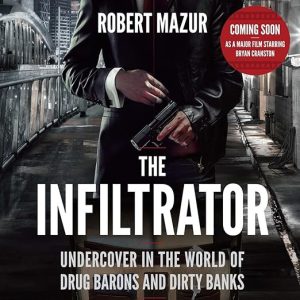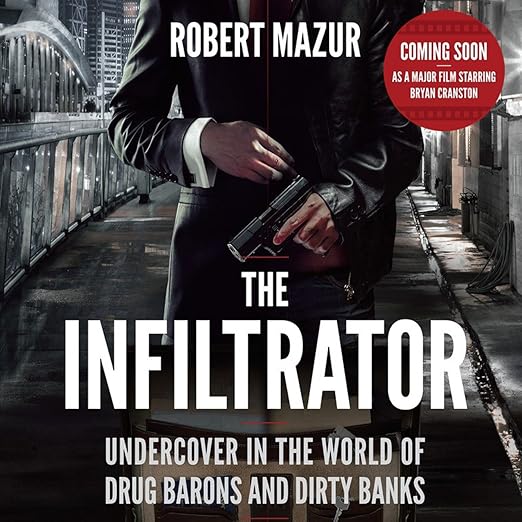
I finished The Infiltrator on a Thursday evening after an unusually long week, and I remember sitting still in the dark for a few minutes afterward, thinking about banking. That is not a response I expected from an audiobook. But Robert Mazur's account of five years spent undercover inside the financial infrastructure of the Medellín cartel does something most true crime does not: it makes you angry at the right people, and they are not who you might expect going in.
The setup is genuinely extraordinary. Mazur, a US Customs agent, builds a false identity as a money launderer and spends years infiltrating BCCI, the Bank of Credit and Commerce International, which served as the financial backbone of the cartel's operations. He works his way through layers of criminal hierarchy until he is meeting with people who report directly to Pablo Escobar. He keeps the operation running for years. And the whole thing culminates in a staged wedding ceremony used as cover for the simultaneous arrest of more than forty high-ranking criminals.
Mazur's Own Voice Tells an Undercover Story
Mazur reads his own book, and this is not a small thing. Most true crime audiobooks benefit from a narrator's craft, but they are always translating a distance between the storyteller and the events. Here, the voice belongs to the man who was in the rooms, who shook those hands, who spent years constructing a persona so convincing that the people around him never doubted it until the handcuffs went on. His delivery is controlled and deliberate, exactly the qualities an undercover agent needs, and they serve the audio format with unusual precision. When he describes meeting with the people who laundered billions for the Escobar organization, the flatness in his voice is not a performance limitation. It is something closer to the trained calm of someone who learned to show nothing.
Several reviewers have compared the reading experience to the best of Ludlum or Forsyth, which is apt because the structure really does move with thriller mechanics. But the crucial difference is that the implausible things happened. You cannot invent what Mazur actually did, and the audiobook's most powerful quality is that his voice keeps reminding you of that fact.
Accountants and Attorneys Routed the Cartel's Billions
What lifts The Infiltrator above a conventional undercover memoir is its portrait of the financial world that made the cartel's operations possible. Mazur does not spend most of his time with gunmen. He spends it with accountants, attorneys, and financial advisors in expensive suits who routed billions through complex international systems on behalf of drug lords and corrupt politicians. The people enabling this were deeply embedded in respectable institutions, and the book's real revelation is how thoroughly normal that world looked from the inside.
One reviewer put it plainly: the revealed complicity of the banks around the globe is disgusting. Another noted that the governments around the world both benefit from and protect these corrupt banks, making the drug dealers look like small-time operators by comparison. That framing is exactly what Mazur himself builds toward, and he earns it through granular, specific detail about how the laundering worked, who signed off on what, and how few of those people faced serious consequences. The emotional current running through the book is not excitement. It is a quiet, building outrage that the systems Mazur exposed are still largely intact.
Granular Detail Serves the Book's Larger Argument
At just over twelve hours, this is a substantial listen, and there are stretches, particularly in the sections covering the mechanics of wire transfers and shell company structures, where the granularity becomes demanding. One reviewer noted they would have preferred some trimming in these passages. That is a fair criticism. Mazur is thorough to a degree that occasionally slows momentum. But I found that the detail ultimately serves the book's larger argument: that what he uncovered was not an aberration but a system, and systems require that kind of careful documentation to understand fully.
The book was published in 2009 and the events it covers are from the late 1980s. Some of the specific institutions and figures have changed, but the structural critique has only grown more relevant. Listeners who came to this through the 2016 film adaptation may find the audiobook significantly more complex and less tidily resolved, which is the right response. The real story is messier and more instructive than any feature film version of it.
Compliance Professionals Will Find Essential Background Here
If you work in finance, compliance, or law enforcement, this is essential background. If you are interested in the true mechanics of how drug money moves through legitimate financial systems, Mazur provides one of the most granular and credible accounts available in the genre. If you prefer your true crime narratives driven by psychological portraits of killers rather than institutional critique, you may find the financial focus less gripping than the setup suggests. And if you are the kind of listener who picked this up as a free audiobook on a whim, expecting something with the pace of a thriller, you will get some of that, but you will also get something considerably more substantive than the cover might promise.
- Performance: Robert Mazur reads his own story, and the effect is remarkable; his measured, credible delivery makes the undercover tension feel lived-in rather than performed.
- What it covers: Financial crime, identity and deception, institutional corruption
- Feel: Tense and methodical, with the slow accumulation of a long con
- Our call: One of the best true-crime finance narratives in audio form, made essential by Mazur's own voice carrying every word.