The Short Version
- Narrator: Joe Barrett brings measured, unhurried delivery to dense technical and operational material.
- Subjects: Naval strategy and shipbuilding, WWII Pacific theater, military modernization
- Tone: Dense, analytical, reference-heavy
- Bottom line: A strong pick for Pacific War enthusiasts and IJN researchers, tougher going for listeners wanting a single narrative arc.
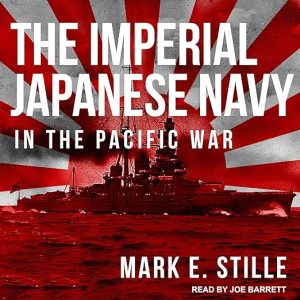
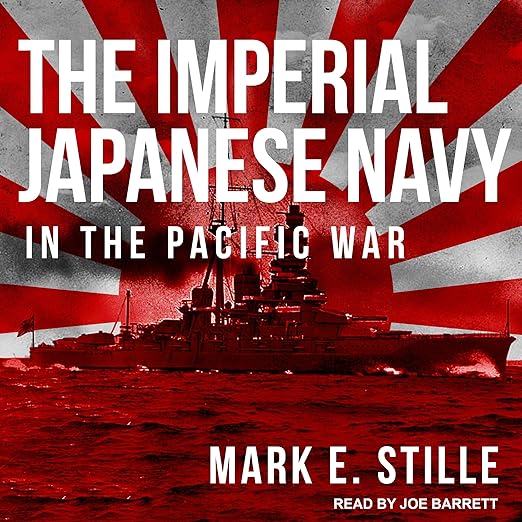
The Imperial Japanese Navy went from a fleet that only began modernizing in 1868 to the third most powerful navy on earth by the start of World War II, and this audiobook's real subject is how that happened and whether the resulting force was actually as prepared for Pacific combat as its early victories suggested. Mark Stille builds his case ship by ship, campaign by campaign, compiling and expanding material originally published across multiple Osprey military history titles into one consolidated audiobook. Whether that navy was ever genuinely prepared for the fight it eventually lost is the exact question Stille keeps circling back to across eleven hours.
Half Reference Work, Half Operational History
Stille's approach here is fundamentally analytical rather than narrative; this isn't a battle-by-battle campaign history so much as a structural examination of design principles, armament choices, and deployment decisions across the IJN's full range of ship classes. Reviewer Glenn H. addresses a real point of confusion directly, noting the title could suggest either an operational history of the IJN's wartime service or a reference work cataloging specific ships, and concludes it functions as something of a hybrid between the two, matching how the synopsis itself describes the content.
The book's origin as a compilation is worth understanding upfront rather than as a knock against it: Stille pulls together material previously spread across several individual Osprey series volumes, adds newly written material incorporating more recent research, and organizes the result into a single, more complete reference than any one of the source volumes offered alone. Reviewer Dale H. Reeck frames this specifically as an expansion of Stille's earlier Imperial Japanese Navy Aircraft Carriers, extending coverage to battleships, cruisers, and destroyers, calling the final product, after some release delays, 'excellent bang for the buck.'
The historical arc Stille traces is genuinely compelling on its own terms: a navy built essentially from scratch after 1868, tested and validated by real victories over Russia between 1904 and 1905 and China between 1894 and 1895 at the turn of the century, then pushed to its absolute limits and ultimately broken by a war against American industrial capacity it was never structurally built to sustain. That longer arc, from rapid modernization to early dominance to eventual defeat, gives even the driest technical passages a real throughline.
The book's organizing logic also rewards close listening: rather than marching chronologically through the war battle by battle, Stille repeatedly circles back to a consistent framework, examining each ship class's design philosophy, its armament and protection tradeoffs, and its actual combat record, before moving to the next. That consistency turns what could be a disorienting jumble of ship names and dates into a legitimately learnable system by the later chapters, once a listener has absorbed the recurring analytical pattern.
Osprey's publishing model itself is worth understanding for context: the publisher built its reputation on tightly scoped, heavily illustrated single-topic military history titles, typically 64 to 96 pages each, meaning this audiobook's consolidation of multiple such titles into one eleven-hour work represents a genuinely substantial act of compilation and editing, not simply narrating one existing book cover to cover.
Barrett Keeps Technical Detail Measured and Clear
Joe Barrett's narration takes on a genuinely demanding job here: dense technical material covering ship classes, armament specifications, and strategic decision-making needs a delivery that stays measured and clear without either rushing through the details or dramatizing content that should speak for itself through the facts alone. That's a real balancing act specific to military reference material, distinct from narrating a single sustained campaign narrative.
Reviewer Lorenzo D. Garcia's enthusiasm, calling this an 'incredible book' with a 'wealth of information,' reflects the audiobook's real strength as a comprehensive single-source reference rather than a dramatized war story; listeners specifically interested in naval design, strategy, and the IJN's institutional evolution get a genuinely thorough treatment here that a narrower single-battle account wouldn't provide.
The audiobook format has a specific advantage for this kind of reference-heavy content that's easy to overlook: listening allows for genuine multitasking, absorbing ship-class comparisons and strategic context during a commute or workout in a way that flipping between chapters of a dense reference book doesn't always allow, even though the tradeoff, as noted below, is losing the diagrams that would otherwise accompany the prose.
Great Illustrations That Never Make It to Audio
The original Osprey source material this audiobook draws from is well known for detailed ship diagrams, cutaway illustrations, and technical schematics, and Lorenzo D. Garcia's review specifically praises the 'GREAT illustrations' in whatever edition he encountered; none of that visual reference material transfers to audio, a real consideration for anyone specifically drawn to Osprey's catalog for its illustration quality rather than its prose.
This also isn't beginner-friendly military history; the density of ship names, class designations, and tactical terminology assumes a listener already has some working familiarity with WWII Pacific theater basics. Newcomers to naval history specifically might find a more narrative-driven single-campaign book, something built around one battle or one ship's story, an easier entry point before tackling a reference work this comprehensive.
At 4.4 stars across 544 ratings, the reception here is both strong and drawn from a meaningfully large sample, a reassuring sign specifically for a niche military-reference title; broad popularity isn't really the goal for a book this specific, but consistency across more than five hundred ratings suggests Stille delivers reliably for his actual target audience. It's worth being direct about pacing too: because the structure moves ship class by ship class rather than following a single dramatic arc, momentum builds slowly, and listeners used to narrative military history's forward-driving urgency should recalibrate expectations toward something closer to a structured, comprehensive briefing than a page-turner.
The eleven-hour runtime itself signals real depth rather than a breezy overview, and listeners should budget for a multi-session commitment rather than a single long sitting.
Wargamers and Researchers Get Real Reference Value
This audiobook is squarely built for Pacific War enthusiasts, naval history researchers, and listeners who already know they want ship-by-ship technical depth rather than a dramatized campaign narrative. It's also a strong pick for anyone who's already read Stille's Imperial Japanese Navy Aircraft Carriers and wants the expanded, full-fleet version Dale H. Reeck describes. Wargamers and naval simulation enthusiasts looking for accurate ship specifications and design context will also find real, usable reference value here beyond the historical narrative itself. Listeners building a broader WWII Pacific library alongside titles on the US Navy's own carrier and submarine campaigns will also find this a useful counterpart from the opposing side's perspective.
Skip it if you want a single, propulsive narrative arc following one campaign or one ship's crew; this is reference-dense material organized by ship class and strategic theme rather than a chronological story with a beginning, middle, and end. Listeners newer to WWII Pacific history should also consider a more general introductory title first before committing to material this specific and this technical, since the ship-class density may be more than they bargained for.