Quick Take
- Narration: David Stifel reads with academic clarity and understated authority, well-matched to Kleinman’s measured, precise prose.
- Themes: The gap between disease and illness, patient experience, humanizing medicine
- Mood: Scholarly and compassionate, with slow-building urgency
- Verdict: Essential listening for anyone in healthcare or considering it, and surprisingly moving for general readers willing to sit with its arguments.
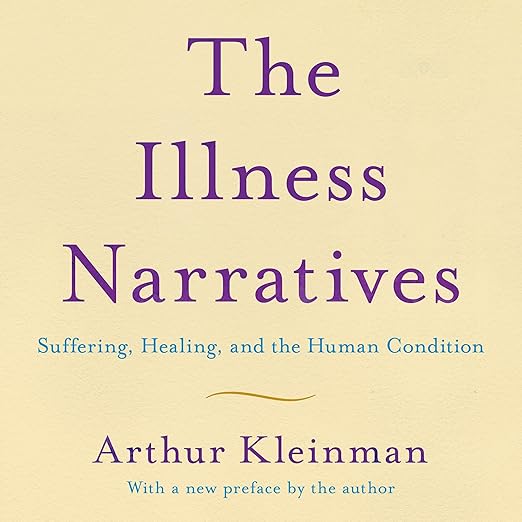
I finished the last chapter of this one on a Sunday morning and sat quietly for a few minutes before moving on to anything else. That is not something that happens often with academic medicine books. Arthur Kleinman’s The Illness Narratives was first published in 1988, predates Atul Gawande’s Being Mortal by nearly three decades, and yet it felt, listening to it now, startlingly current. The problems it names, the gap between what doctors treat and what patients experience, have not been solved. If anything they have calcified.
Kleinman, a Harvard psychiatrist and anthropologist, built this book from decades of clinical work with chronically ill patients. His argument is precise: modern medicine treats disease as a biological malfunction to be corrected, but illness is what the patient actually lives through, and those two things are not the same. Ignoring the illness in favor of the disease leaves patients worse off even when the diagnosis is technically accurate and the treatment medically sound.
Our Take on The Illness Narratives
What Kleinman does better than almost any writer in this tradition is show rather than assert. The book moves between theoretical framework and case study with a fluency that never feels manipulative. His patients are not symbols. They are people whose fear, exhaustion, and need for their suffering to be witnessed come through in careful, respectful prose. A veteran physician of thirty years who reviewed this book noted that it remains applicable precisely because Kleinman’s approach is fundamentally humanistic and humanistic approaches do not become obsolete with each new treatment protocol.
The book makes its central clinical claim, that patient narratives should be treated as core diagnostic information, not as noise to be filtered out, and then spends the second half examining what it would take to actually practice that way. Those chapters are harder and more honest than the theoretical opening. Kleinman knows that the pressures of clinical time, insurance systems, and institutional medicine make sustained narrative engagement difficult. He is not naive about this. But he refuses to let the difficulty become an excuse.
Why Listen to The Illness Narratives
David Stifel’s narration is a good match for this material. He reads Kleinman’s prose with the kind of measured authority that lets you hear it as argument rather than lecture. There are no theatrical pauses or emotional swells, which is exactly right: the book earns its emotional impact through accumulation, not through performance. At 13 hours and 2 minutes, it demands real commitment. But the format rewards sustained listening in a way that reading in disconnected sittings might not. The case studies build on each other, and hearing them in sequence reinforces Kleinman’s larger claims more effectively than sampling chapters would.
The book was originally published in 1988, but this audiobook edition from Basic Books, released in 2020, makes it newly accessible. The ideas have been cited and built upon in medical education for decades, but encountering them in audio form, especially for healthcare practitioners who do much of their learning during commutes or between shifts, feels like a valuable addition to the format.
What to Watch For in The Illness Narratives
Readers looking for a narrative arc or a single compelling protagonist will find this book structured differently than they expect. It is organized as a series of interlocking arguments, each supported by patient cases, rather than as a sustained story. Some passages in the middle section, particularly those engaging with anthropological theory, require more active concentration than the clinical chapters. If you lose the thread there, it is worth rewinding rather than pushing on, because those sections set up the conclusions that follow.
The theoretical vocabulary is accessible to a general reader but does assume you are willing to sit with ideas rather than move through them quickly. This is not a book that flatters casual attention. It rewards the kind of listening you give to a serious argument you want to actually engage with.
Who Should Listen to The Illness Narratives
Healthcare workers and medical students are the obvious primary audience, and for them it is close to required listening. But The Illness Narratives also speaks to anyone who has navigated serious illness, either their own or a family member’s, and felt that the medical system was treating something other than what they were actually experiencing. Kleinman gives language to that gap and makes a disciplined case for why closing it is not optional sentimentality but clinical necessity. If you have ever felt that a doctor saw your chart instead of you, this book will articulate why that happened and what it costs.
Frequently Asked Questions
Is The Illness Narratives accessible to general readers without a medical background?
Yes, though it requires patience with academic framing. Kleinman is a careful writer who defines his terms and grounds his theoretical arguments in specific clinical cases. Non-medical readers will follow the central argument and the patient stories without difficulty. The denser anthropological passages in the middle require more attention but are not impenetrable.
How does David Stifel’s narration hold up over 13 hours of dense academic material?
Stifel reads with consistent clarity and does not attempt to dramatize what is essentially a scholarly argument. His pace is measured and his articulation clean. For listeners who prefer their nonfiction narrated with personality and warmth, he may feel reserved. For listeners who want to focus on the ideas, he is a good vehicle for the prose.
Is the 1988 publication date a problem? Has medicine changed enough to make Kleinman’s arguments obsolete?
Multiple reviewers, including a veteran physician, have noted that the book remains fully applicable. The structural tensions Kleinman identifies between patient experience and biomedical treatment have persisted despite advances in treatment. If anything, the pressures on clinical time have increased since 1988, making his arguments more rather than less urgent.
How does this compare to Atul Gawande’s Being Mortal for listeners interested in humanizing medicine?
The Illness Narratives predates Being Mortal by nearly three decades and operates at a more theoretical level. Gawande writes primarily as a narrative journalist and memoirist; Kleinman writes as a psychiatrist and anthropologist making a clinical argument. They are complementary rather than redundant. Being Mortal is more emotionally immediate; The Illness Narratives gives you the analytical framework behind that emotional urgency.