Quick Take
- Narration: Roger Mueller gives Anderson’s memoir the gravitas of a naval officer’s account while keeping the human warmth of a story told by someone who genuinely loved his crew.
- Themes: Cold War secrecy and national ambition, naval leadership under extreme conditions, the opening of the Arctic as a strategic theater
- Mood: Tense and technically absorbing, with a quiet pride that never tips into self-congratulation
- Verdict: A naval memoir that delivers both the adventure and the geopolitical stakes of one of the Cold War’s most remarkable achievements.
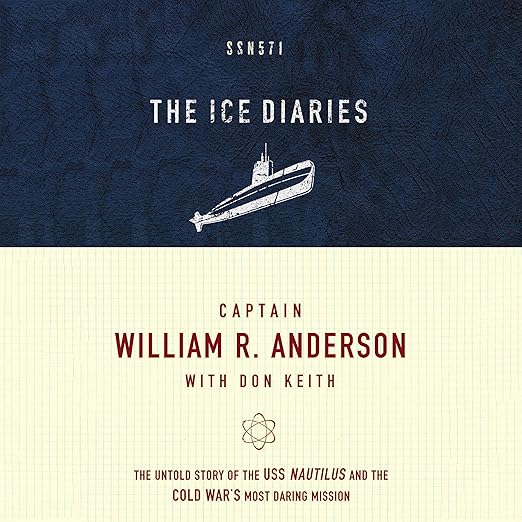
I spent most of a Sunday afternoon with this book, which felt appropriate. The story of the USS Nautilus traveling beneath the Arctic ice cap to the North Pole in August 1958 is one of those Cold War chapters that has been largely absorbed into the general fog of the era, overshadowed by Sputnik and the missile crisis and the more photogenic dramas of the space race. Captain William Anderson’s account of that journey, updated here with declassified material and photographs from his personal collection, is a reminder of what was at stake in the Arctic and why the submarine that crossed the top of the world under the ice carried implications that went far beyond the geographical achievement.
Anderson wrote an earlier book about the Nautilus voyage, Nautilus 90 North, published shortly after the events when secrecy requirements still restricted what he could say. The Ice Diaries is the complete version, incorporating material that was classified for decades, and the difference matters. The political maneuvering around the mission, the conflicts between naval leadership and civilian authority, and the specific strategic implications for Polaris missile deployment are all present here in ways they could not be in 1959.
What Stayed Classified for Decades
The most compelling sections are not the ones describing the technical challenge of navigating under ice, impressive as that narrative is. They are the sections dealing with the bureaucratic and political obstacles that nearly prevented the mission from happening at all. Anderson had powerful advocates and powerful opponents, and the internal Navy politics around authorizing a nuclear submarine to attempt the polar transit were considerably messier than the triumphant public narrative suggested. The Cold War material gives the adventure story a second layer that the earlier account was not permitted to provide.
A reviewer who was actually a crewman on the Nautilus during the Arctic cruises contributed a five-star review noting the accuracy of Anderson’s account and expressing pleasure at finding their late captain’s updated and complete record. That kind of testimony is hard to discount. A crew member who was there and who finds the account true is as good a validator as a book can get.
The Crew as Subject Matter
Anderson’s leadership philosophy is visible throughout the narrative. He writes about his crew with a specificity that goes beyond the generic tributes that characterize some military memoirs. Individual sailors appear with enough context that they feel like people rather than types, and the decisions he made to manage morale during the tense weeks of the polar transit are documented with the kind of practical detail that makes the leadership dimensions of the story genuinely useful rather than merely admirable.
The book also does something that military memoirs often fail to do: it acknowledges fear and uncertainty without pretending that professional composure was the same as the absence of doubt. The unknown physics of what happens when a nuclear submarine tries to break through from beneath thick ice was, at the time of the mission, genuinely unknown. Anderson conveys what that uncertainty felt like without dramatizing it beyond what the reality required.
The Civilian-Military Tension at the Core
One of the book’s more surprising dimensions is the account of how the Nautilus mission was nearly killed by bureaucratic resistance within the Navy itself. Anderson wanted to make the polar crossing. Several senior officers believed it was either premature or politically unwise. The Eisenhower administration had its own views on timing, connected to the diplomatic implications of an American military submarine surfacing at the North Pole during the International Geophysical Year. Anderson describes navigating this internal resistance with as much care as he gave to navigating under the ice, and the portrait of institutional politics as a genuine obstacle to achievement adds a layer of texture that purely operational accounts often lack. The mission that succeeded was not just a triumph of seamanship. It was also a triumph of bureaucratic persistence.
Roger Mueller and Ten Hours of Arctic Tension
At just over ten hours, the book is well-paced. Mueller’s narration suits the material. The prose Anderson writes is not florid or literary, and Mueller does not try to make it something it is not. The delivery is clear and measured, with enough variation to distinguish between the operational passages and the more reflective ones, and the pace holds across the full length without becoming mechanical.
At 4.5 stars across 669 ratings, this is a book with a substantial and satisfied readership. The relatively high rating for a niche subject suggests the audience it has found is genuinely the right one for it.
Who Should Listen and Who Should Skip
Naval history readers, Cold War history enthusiasts, and anyone interested in the development of the Arctic as a strategic theater will find this essential. The combination of genuine adventure, political backstory, and the specificity of a man who was actually there makes it more satisfying than reconstructed accounts from archives alone.
Listeners looking for pure adventure narrative without the political and technical dimensions may find the pacing slightly slower than they prefer. The book does not skip the context in favor of the action, which is a virtue for some listeners and a limitation for others.
Frequently Asked Questions
How does The Ice Diaries differ from Anderson’s earlier book Nautilus 90 North?
The Ice Diaries incorporates declassified material that Anderson was not permitted to include in his 1959 account. This means the political maneuvering around the mission, internal Navy conflicts, and the specific strategic implications for Cold War submarine operations are present in ways they could not be earlier.
Does the book explain why the under-ice route to the North Pole mattered strategically for the Cold War?
Yes. Anderson is explicit about the military implications, particularly the connection to the Polaris ballistic missile program. The ability to operate under Arctic ice gave US submarines the capability to approach Soviet territory undetected while remaining close enough to reach targets, which was a significant shift in the strategic balance.
Is there technical submarine material that might be difficult to follow without a naval background?
Anderson explains technical concepts with enough context for a general audience. Reviewers have noted that he keeps technical explanations simple but complete. You do not need a naval background to follow the operational narrative, though some familiarity with submarine basics will help you appreciate what the crew was managing.
Does the book cover both of the Nautilus’s Arctic voyages or just the pole transit?
Anderson covers both the preparatory Arctic cruise and the successful North Pole transit. The earlier voyage provides essential context for understanding what the crew learned and how the final mission was planned, so the dual coverage strengthens the narrative rather than fragmenting it.