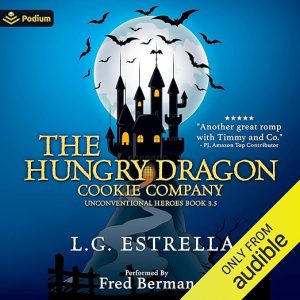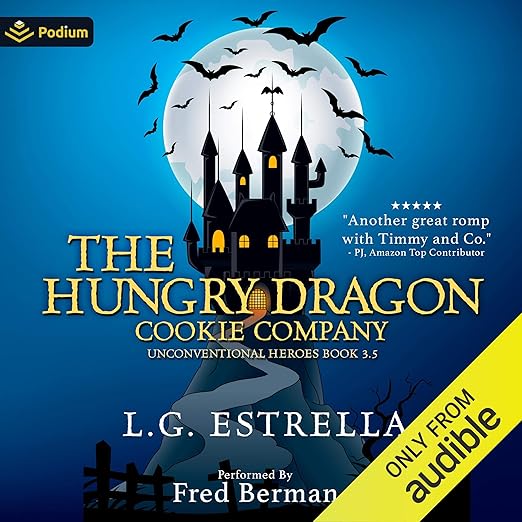
I listened to The Hungry Dragon Cookie Company on a morning when I needed something that would make me laugh without requiring significant cognitive investment, which is a more specific need than it sounds. Comic fantasy audiobooks are unreliable in this regard because the humor depends so heavily on whether you have bonded with the characters, and that bond is almost impossible to establish in a standalone. L.G. Estrella's solution is clever: this is not a standalone. It is fourteen short stories set within the Unconventional Heroes series universe, and the pleasure of it is calibrated for readers who already know and love Timmy, Katie, Avraniel, Gerald, Amanda, and Spot.
That framing matters because it defines who should listen and in what order. The Hungry Dragon Cookie Company is the first entry in the Unconventional Heroes Series Side Stories line, meaning it exists adjacent to the main series rather than as its entry point. Someone who has not spent time with Timmy the Grand Necromancer and his extremely chaotic team will find the stories entertaining but not fully legible. Someone who has will find them illuminating, funny, and occasionally more emotionally resonant than a short story collection has any right to be.
Where This One Lands
The short story format allows Estrella to answer specific questions that novel pacing would never address. How does a cookie company involving a fire-breathing dragon actually operate at a practical level? How did a trans-dimensional protoplasmic horror develop an addiction to cake, and why does the relationship between that horror and Timmy make a certain emotional sense? How does an ancient vampire acquire what she needs to maintain proper vampiric health without appearing socially unacceptable to her neighbors? These are exactly the kind of laterally funny questions that accumulate in a reader's mind during a series and never get answered in the main narrative because the plot has other priorities.
The collection covers the timeline before, during, and after the first three parts of the main series, which means it functions as both backstory and between-scenes content rather than simply an outtake reel. The structural choice to span this range gives the book a completeness that side story collections often lack entirely. You are not getting deleted scenes. You are getting the full dimensional picture of a world that the main series rendered in profile, and the difference is significant.
Why Listen to The Hungry Dragon Cookie Company
The consistent praise across reader reviews returns to the same observation: Estrella writes characters who feel specific and real rather than genre-functional. Katie, the ten-year-old apprentice who is simultaneously maniacally devious and extremely fond of billowy pink robes, is a particular achievement. The humor of her character works because Estrella trusts the inherent absurdity of the setup rather than underlining it for effect. Gerald the hyperventilating bureaucrat, described as being at the top of every monster's menu, is another figure whose comedy comes from exact specificity rather than mere exaggeration of a stock type.
One reviewer highlighted the story involving Mr. Sparkles as a particular standout, though without series context that name means nothing at all. Within the series context, it means everything, and that distinction captures exactly the value proposition of companion content done well. It rewards investment without being required to justify that investment to newcomers. There are also, embedded within the broader humor, lessons about kindness and accepting differences that one reviewer noted with genuine warmth. Estrella is not only funny. The comedy is built on a foundation of actual affection for the strange people in this strange world.
What Gives Us Pause
Fred Berman is one of the more reliable comic fantasy narrators working, and The Hungry Dragon Cookie Company plays to his particular strengths. Ensemble comedy in audio form requires distinctly voiced characters who are immediately identifiable without visual cues, and Berman maintains clear differentiation across a cast that includes a fire-breathing dragon, an ancient vampire, a pyromaniac elf, and a ten-year-old necromancer's apprentice in billowy pink robes. His comic timing is natural rather than performed, which is the correct approach for humor that functions through accumulation rather than punchline delivery. The Podium Audio production at twelve hours and thirty minutes feels generous for a short story collection, but the individual pieces are substantial enough to sustain it without feeling padded.
One more thing the collection demonstrates quietly: L.G. Estrella understands that the best comedy is built on consistent internal logic. The Unconventional Heroes universe has rules, and those rules apply even in the side stories, even when the situations are absurd. The cookie company operates with genuine business logic even though one of its key employees breathes fire and another is a dimension-hopping horror with a cake addiction. That commitment to internal consistency is what separates humor that ages well from humor that depends on the absurdity remaining fresh. These stories will read differently, and better, on a second encounter with the characters, because the jokes assume knowledge rather than performing it for the first-time listener. That is a mark of craft rather than convenience.
Should You Listen to The Hungry Dragon Cookie Company?
Read the Unconventional Heroes main series first. At least the first three books. The side stories assume familiarity with these characters and their dynamics, and the layered jokes, the callbacks to earlier events, and the emotional resonance of certain reveals depend on that context being in place. Approached in the right order, this collection is exactly what a devoted series reader wants: the answer to every question the main narrative was too busy to address. Approached out of order, it is merely amusing rather than the richer pleasure the material is genuinely capable of delivering.
Can The Hungry Dragon Cookie Company be listened to without reading the main Unconventional Heroes series first?
Technically yes, but you will miss most of what makes it work. The humor, the callbacks, and the emotional resonance of the stories depend on knowing the characters from the main series. Multiple reviewers recommend starting with Book 1 of the Unconventional Heroes series and reading through the first three books before coming to this companion volume.
The book is described as 14 short stories. How does that format hold up across a 12-plus-hour audiobook?
Better than you might expect. Each story is substantial rather than flash fiction length, and the timeline spanning before, during, and after the first three main books gives the collection genuine structural range. Fred Berman's narration also provides continuity across the individual pieces so the listening experience does not feel fragmented.
Is this collection primarily for comic effect, or does it offer genuine character development and backstory?
Both. The humor functions because the characters are specific rather than archetypal, and learning how those characters became who they are adds emotional dimension that pure comedy collections rarely achieve. The collection answers questions the main series never had room to address, including origin stories for relationships central to the main narrative.
Is Fred Berman consistent with the main Unconventional Heroes series narrator, and does the vocal characterization carry over?
Berman narrates this companion volume through Podium Audio. His handling of the ensemble is consistently praised, and his comic timing suits Estrella's layered absurdist style. Listeners who have followed the series through other narrators may notice the adjustment, but within this volume the performance stands fully on its own merits.