At a Glance
- Narration: Robertson Dean is a precise match for Sowell's analytical prose; the delivery is authoritative without being dry, and Dean's pacing serves the book's argument-by-argument structure well across a tight runtime.
- Themes: housing market collapse, government policy failures, the mechanics of financial contagion
- Mood: Incisive and controlled; the intellectual satisfaction of a clear argument assembled from specific evidence
- Verdict: An audiobook that remains essential reading on the 2008 housing crisis for anyone who wants the clearest available account of how the policy decisions stacked up before the collapse.
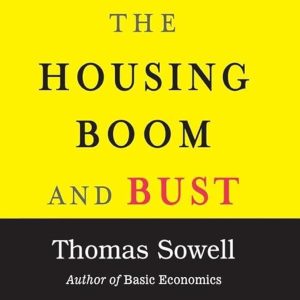
Thomas Sowell approaches the 2008 housing crisis with the same analytical temperament he brings to every economic subject: locate the specific decisions, trace their consequences, resist the temptation to blame a single cause or actor. The Housing Boom and Bust is the audiobook result of that discipline applied to one of the most consequential financial collapses in American history. Robertson Dean narrates it with the precision the material demands, and at under five hours the listen is among the most efficient introductions to the mechanics of the crisis available.
First, the Big Picture
Sowell's central claim is established in the opening paragraphs: no single dramatic event caused the collapse. A long series of questionable decisions, made by many people in many places over many years, built the pressures that eventually became visible as a housing market implosion and a cascade of financial institution failures. That framing is important because it resists the retrospective impulse to identify one villain or one policy mistake and declare the problem solved by eliminating it. Sowell follows the evidence to a more complicated and more accurate picture.
The specific decisions Sowell traces include the political pressure on lenders to extend credit to unqualified borrowers in the name of homeownership expansion, the securitization of those loans into instruments that spread risk across institutions that didn't fully understand what they held, and the regulatory environment that allowed this to develop over years without correction. He is direct about assigning responsibility, and he is not diplomatic about which interventions made things worse rather than better. The analysis is consistent with his broader economic philosophy, which some listeners will receive as confirmation and others will engage with critically, but the specific factual evidence he marshals is not easily dismissed regardless of prior position.
One reviewer who describes Sowell as "perhaps the foremost economic analyst and writer in the US today" notes that the book is "cogent, concise, and easy for even the most jaded Keynesian economist" to understand, which is both high praise and an implicit challenge: Sowell's argument is clear enough that disagreement requires engaging with his specific evidence rather than around it.
Why Listen to The Housing Boom and Bust
Robertson Dean's narration is an important component of what makes this audiobook work. Sowell's prose is dense with specific data points, policy references, and causal chains, and a narrator who rushes or flattens the material would make the argument hard to follow. Dean reads with the measured authority of someone who understands the subject they're delivering, and his pacing at natural argument breaks gives the listener time to integrate each step before the next one arrives.
The four-hour-forty-one-minute runtime is a genuine asset for a subject this complex. Sowell has made choices about what to include and exclude, and the result is a book that earns its brevity rather than using it as an excuse for superficiality. Listeners who have attempted longer academic treatments of the 2008 crisis and found them sprawling will appreciate the discipline of this presentation. Every chapter moves the argument forward.
The book's second function, assessing whether the policy responses to the crisis were likely to help or worsen the underlying problems, is where Sowell is most directly prescriptive. He brings the same analytical clarity to the bailouts, the regulatory responses, and the stimulus programs that he brought to the original boom conditions. Whether the listener agrees with his conclusions about those interventions, the framework he uses to evaluate them is explicit and logically consistent.
A Few Reservations
Sowell writes from a market-oriented perspective, and his analysis of government intervention consistently weighs the evidence on the side of regulatory and political failures rather than market failures. Listeners coming from different economic frameworks will recognize where the analysis aligns with a specific school of thought and should engage accordingly. The data Sowell cites is real; the interpretation of what the data demonstrates is a position rather than a proof, and engaged critical reading is the right relationship to bring to any serious economic argument.
The book was published during the immediate aftermath of the crisis, and some of its forward-looking assessments, particularly around the likely effectiveness of specific policy responses, are now testable against actual history. Listeners returning to this audiobook with the benefit of hindsight will find some of Sowell's concerns validated and others more complicated. The historical distance is part of what makes this a worthwhile audiobook rather than a time-capsule: the core analysis of how the boom conditions developed remains largely intact as an account of what happened.
The Right Listener for The Housing Boom and Bust
Listeners who want a clear, short, analytically rigorous account of the 2008 housing market collapse will find this audiobook difficult to improve on for its purpose. It suits readers who are economically literate enough to follow the policy argument but who don't have the time or appetite for a 500-page academic treatment. The 4.7 average across 335 ratings is a strong signal that this is working across a broad audience of readers who came in with different starting positions and found Sowell's argument worth engaging with.
Listeners who want a politically neutral account of the crisis, one that distributes responsibility evenly across ideological lines, should know this is not that book. Sowell's analysis identifies specific government policies as primary drivers of the conditions that made the collapse possible, and he makes no attempt to present the opposing view charitably. Readers who can engage with a strong argument they may partially disagree with will find the audiobook a valuable exercise; those who want balance as a structural feature will need to supplement it with other sources.
A Few Questions About The Housing Boom and Bust
Does the audiobook require a background in economics to follow Sowell's argument?
No. One reviewer specifically notes it is accessible even to readers without specialist training. The argument moves step by step, and Robertson Dean's pacing gives listeners time to integrate each point before the next one arrives.
Is this audiobook politically one-sided in how it assigns blame for the crisis?
Sowell writes from a market-oriented perspective and consistently finds government policy interventions as primary drivers of the boom conditions. He cites specific evidence for each claim, but the interpretation reflects his analytical framework. Listeners from different economic traditions should engage critically rather than passively.
How does Robertson Dean's narration suit Thomas Sowell's analytical prose style in the audiobook?
Dean is a precise match for Sowell's dense, data-driven writing. He reads with measured authority and paces the argument at natural breaks, giving listeners time to follow the causal chains without losing the thread. The narration serves the argument rather than performing around it.