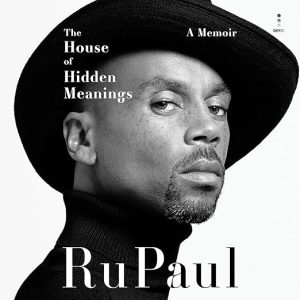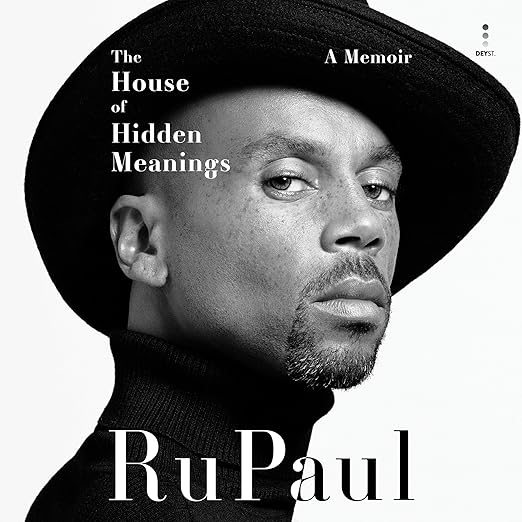
RuPaul Andre Charles grew up a queer Black kid in San Diego decades before 'Supermodel of the World' or RuPaul's Drag Race made him a household name, and this memoir's audiobook spends most of its runtime in that earlier, less famous life rather than rushing toward the fame everyone already knows about.
The synopsis describes his path from San Diego through the punk and drag scenes of Atlanta and New York, a journey shaped early by an absent father and a temperamental mother, long before he became, as the book puts it, both 'supermodel and supermogul.' That 'chameleonic adaptability,' the same quality that built his career, is also what the synopsis says has made him genuinely hard for the public to fully know.
The personal material here runs deep: his marriage to husband Georges LeBar, his sobriety, and the found family he built along the way all get real space, framed by RuPaul himself as something closer to 'a manual for living' than a straightforward celebrity account, with none of it treated as a footnote to the fame. The book's own closing line captures the intent directly: if we're all born naked and the rest is drag, this is RuPaul without any of it.
Reviewer Sherry Frasier brings an unexpected angle worth noting: she describes herself as 'a straight, white, married female from Louisiana' and still found the book compelling, calling it 'raw, real, in your face,' proof the material connects well outside its most obvious built-in audience, which says something about how specific, honest memoir tends to travel further than a book aimed narrowly at fans.
The title itself draws on a real tradition worth knowing: in ballroom and drag culture, a 'house' is a chosen family structure, often led by a 'mother,' that takes in queer and trans youth rejected by their birth families. RuPaul's own found-family story sits directly inside that lineage, which makes the title's double meaning land with real weight rather than reading as clever wordplay alone.
His public persona has moved through genuinely distinct eras, from downtown New York performance artist to the 1993 'Supermodel of the World' pop moment referenced directly in the synopsis, to the producer and host of one of the largest television franchises in the world, and this memoir treats all of those shifts as chapters in one continuous identity rather than a series of reinventions.
The book arrived as an instant number-one New York Times bestseller, a genuinely strong commercial and critical reception for a memoir this introspective, and that response suggests RuPaul's built-in audience was hungry for exactly this kind of unguarded, less produced version of his story.
Why It Works in Audio
RuPaul narrates his own story, and decades of on-camera hosting and performing experience show clearly in the pacing and control here; this is a performer entirely comfortable holding a listener's attention without needing a hired narrator to translate his own voice for him.
Reviewer Michael Collins praises the storytelling as 'bold and unfiltered,' noting that the personal details land with real honesty 'without it ever feeling rushed,' which is exactly the kind of pacing control a practiced on-camera performer, delivering material this personal, is positioned to bring.
The book is structured more essayistically than chronologically in places, circling back to certain formative moments from different angles rather than marching strictly forward through a timeline, which fits RuPaul's own description of himself as someone who examines what lies beneath the surface rather than simply reporting what happened.
What to Watch For in The House of Hidden Meanings
One reviewer's caveat is worth repeating directly: this isn't a book about 'the movies they are in, the celebs they know, drag race or award shows.' Listeners hoping for Drag Race production stories or celebrity-adjacent gossip should recalibrate; the book stays focused on interior formation, not show-business chronicle.
Despite the pop-culture-icon subject, the content here gets genuinely heavy: an absent father, a difficult mother, and a hard early adulthood in the punk and drag underground are all treated with real weight rather than glossed over for a lighter celebrity-memoir read.
The book leans more philosophical and analytical than a typical showbiz memoir, closer in spirit to a long, unhurried conversation about identity than to a breezy string of behind-the-scenes anecdotes, so listeners expecting a lighter celebrity read should adjust their expectations accordingly.
The book's closing line distills its whole philosophy into one sentence RuPaul has used for years in different forms: if everyone is born naked and everything after that is drag, a costume assembled for the world, then this memoir is the rare attempt to describe what's underneath all of it, the self that exists before any performance begins.
Recommended For
Memoir readers, LGBTQ+ listeners, fans wanting the real person behind the television persona, and anyone drawn to stories about chosen family and hard-won self-acceptance will find real substance here, well beyond a typical celebrity memoir.
Listeners specifically wanting Drag Race behind-the-scenes stories or lighter celebrity gossip should look elsewhere; per the book's own reviewers, that material simply isn't the point of this particular memoir.
The book closes on an explicit statement of purpose, that it functions as 'a manual for living,' and the specific lessons it offers are concrete rather than vague: the value of chosen family over inherited family, the importance of embracing what makes a person different instead of hiding it, and the discipline of facing one's own history honestly instead of performing a cleaned-up version of it.
One reviewer who otherwise recommended the book noted a mild reservation about that same structural choice, saying plainly that they didn't 'necessarily love the layout,' a fair caveat for listeners who prefer a strictly linear memoir over one that moves associatively between past and present.
A memoir this reflective rewards a slow, uninterrupted listen rather than functioning as background noise during other tasks; RuPaul's own analytical pacing asks for the same attention a listener would give a long, honest conversation with someone finally telling the whole story.
A Few Questions About The House of Hidden Meanings
Does RuPaul narrate this audiobook himself?
Yes, and his own performing background gives the narration real control and comfort with intensely personal material.
Does this audiobook cover RuPaul's Drag Race?
Not really. One reviewer notes directly that this isn't a book about 'the movies they are in, the celebs they know, drag race or award shows,' but a deeper dive into RuPaul's formation.
Is this audiobook appropriate for listeners unfamiliar with RuPaul's television career?
Yes, it stands on its own as a self-contained memoir about identity and chosen family, not a companion piece requiring prior fandom.
How personal does this audiobook get about RuPaul's early life?
Very. It covers an absent father, a difficult mother, and his formation in the punk and drag underground of Atlanta and New York with real honesty.