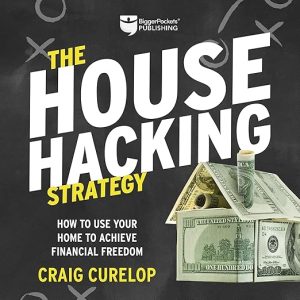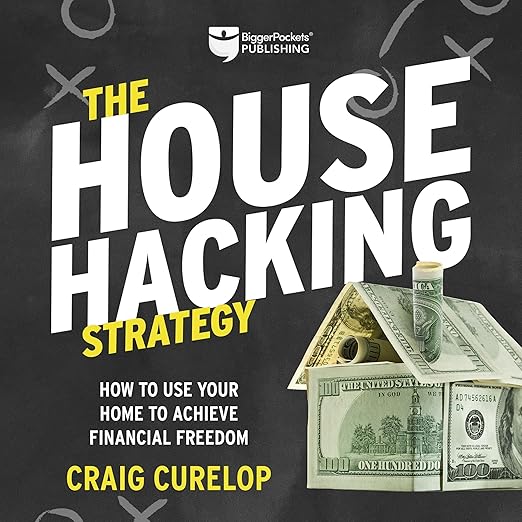
Picture this: you own a small multifamily property, your tenants' rent covers your mortgage entirely, and you live for free while building equity every month. The House Hacking Strategy audiobook, written by Craig Curelop and narrated by Clifford Ponder, is a ten-hour argument that this arrangement is not a fantasy - it is a specific, repeatable method that investors have been using quietly for decades, and the book exists to explain every step of how to do it. Published under the BiggerPockets umbrella, it approaches real estate investment from the ground level: not high-level philosophy about wealth mindsets, but granular instruction about property types, financing structures, tenant management, and the particular challenges of living inside your own investment.
Curelop writes from his own experience as a serial house hacker who used the strategy to reach financial independence before most people have paid off their student loans. That firsthand credibility is one of the audiobook's primary assets. He is not describing a theoretical system - he is describing what he actually did, what went wrong, and how he corrected for it. The combination of personal narrative and instruction is what separates The House Hacking Strategy from more generic real estate education content.
Where This One Lands
The structure of the audiobook is methodical in a way that rewards the specific kind of listener who wants comprehensive coverage over narrative momentum. Curelop begins with definitions and foundational concepts, moves through property selection and financing, addresses the practical challenges of property management, and closes with case studies from real investors around the country. Each chapter builds on the previous one, and the progression from concept to application is clear.
What works particularly well is Curelop's treatment of the different types of house hacking strategies available. He explicitly rejects a one-size-fits-all approach: the strategy looks different for a single-family home with a basement unit than for a small multifamily property in an urban market, and it looks different again for someone house hacking with a family versus independently. That specificity - the willingness to acknowledge that the method requires adaptation to circumstances - is more intellectually honest than most real estate instruction books, which tend to present the author's specific path as universally applicable.
Why Listen to The House Hacking Strategy
Clifford Ponder's narration is a solid match for this material. Real estate instruction tends to run heavy on technical vocabulary and specific numbers, and Ponder maintains clarity through all of it without sounding robotic. He has the professional-narrator quality that distinguishes him from author narration in this genre: he does not over-emphasize the motivational passages or flatten the instructional ones. The ten hours flow consistently, which matters when the content includes chapters on financing structures and property management strategies that could become monotonous under less capable narration.
Reviewers consistently report that the audiobook answered questions they had going in and raised new ones they had not thought to ask. One listener described it as covering "the 411 on the essentials for house hacking" in a way that made them feel equipped rather than overwhelmed. Another noted that the step-by-step approach helped them identify their own "why" - their motivation for pursuing financial independence through property - before getting into the tactical material. That sequencing, from motivation to method, is a deliberate pedagogical choice and it serves the audiobook format well.
What Gives Us Pause
Ten hours of real estate instruction is a commitment, and some of the middle chapters covering property management and financing will be more immediately relevant to listeners who are actively searching for a property than to those in the earlier research phase. The audiobook is designed as a complete reference rather than a quick overview, which means the depth that makes it valuable also makes it dense. Listeners who drive or commute regularly will find the length manageable. Listeners trying to absorb the material in short sessions may want to keep a notepad nearby, since the actionable specifics - loan types, property ratios, management checklists - benefit from being captured as notes rather than trusted to memory.
The case studies in the later chapters are the most compelling narrative content in the audiobook. Real investors describing their house-hacking experiences, including the mistakes they made, provide emotional grounding for the instructional framework. Curelop is smart to include failures alongside successes - the stories of what went wrong and how people recovered are ultimately more instructive than the triumphant accounts.
One area the audiobook addresses that similar books often avoid is the emotional complexity of being both landlord and neighbor to your own tenants. When you live in the same building as the people you collect rent from, the relationship dynamics are different from traditional investment-at-a-distance, and Curelop does not pretend otherwise. His treatment of this interpersonal dimension, including strategies for maintaining professional distance while living in close proximity, is some of the most practically useful material in the book for listeners who have not previously thought about what it actually feels like to house hack day-to-day.
Who Should Pick Up The House Hacking Strategy
This audiobook is for listeners who are seriously considering real estate as a path toward financial independence and want comprehensive instruction rather than inspiration-adjacent content. It works best for people who are either actively preparing for their first house hack or who have completed one and want to optimize for the next. The detail level and the ten-hour runtime signal that this is education material, not casual listening.
Skip it if you want a high-level introduction to real estate concepts. The House Hacking Strategy assumes some baseline financial literacy and moves quickly past the motivational setup into specific methods. Listeners who are brand new to the idea of real estate investing might benefit from reading a broader overview first, then returning to Curelop's audiobook when they are ready to get specific about execution.
Quick Take
- Voice: Clifford Ponder delivers Craig Curelop's dense real-estate instruction with clean professional clarity - he keeps the energy consistent through what is functionally a long how-to, and the pacing works well for note-taking.
- Big ideas: Real estate as wealth-building, creative living arrangements, early retirement through property investment
- Atmosphere: Practical, motivating, and dense with actionable steps
- Worth it?: This audiobook covers the house hacking method more thoroughly than any comparable resource, though the ten-hour runtime requires genuine investment from listeners who want to absorb the full framework.
Questions Listeners Ask
Does this audiobook explain house hacking for complete beginners or does it assume real estate knowledge?
It starts from first principles and covers the basics, but it moves faster than a pure introduction. Some baseline financial literacy helps - understanding mortgages, basic property types, and credit scores is assumed. Complete beginners might want a broader real estate primer alongside this.
Is The House Hacking Strategy audiobook better for active property-searchers or those in the research phase?
Both, but for different reasons. Researchers will benefit from the conceptual framework and the case studies. Active property-searchers will find the financing, property selection, and management chapters most immediately useful. The ten-hour runtime covers both phases thoroughly.
How does narrator Clifford Ponder handle the technical material in this audiobook?
Competently and consistently. Ponder keeps the energy steady through chapters that could become dry, and his pacing is well-suited to content that listeners may want to absorb in detail. This is professional narration in the best sense - unobtrusive and reliable throughout.
Does the audiobook cover house hacking for people who have families or need extra space?
Yes, explicitly. Curelop dedicates material to the specific challenges of house hacking with a family or spouse, which is one of the more useful sections of the audiobook for listeners who cannot live in a studio-converted situation. The method scales for different life circumstances.