Quick Take
- Narration: Schneider narrates his own countdown with the energy of someone who has spent considerable time performing this material online, engaging for his existing audience, occasionally unpolished for listeners expecting formal audiobook production.
- Themes: Biblical inerrancy and its critics, deconstruction from evangelical Christianity, atheist and skeptic perspectives on scripture
- Mood: Irreverent and confrontational, though more focused on entertainment than scholarly argument
- Verdict: Works well for listeners in active deconstruction from fundamentalist faith, less useful as serious theological or hermeneutic study material.
I came to this book somewhat sideways, through a conversation with a listener who told me she had been raised in an evangelical household and had spent two years slowly dismantling what she had been taught. She said Schneider’s audiobook had been one of several that helped her feel less alone in the process. That is a specific kind of value, and it is a real one. It is also a different kind of value than formal biblical scholarship, and the gap between those two things is the central thing to understand about The Holy Shit of the Bible before you decide whether to listen.
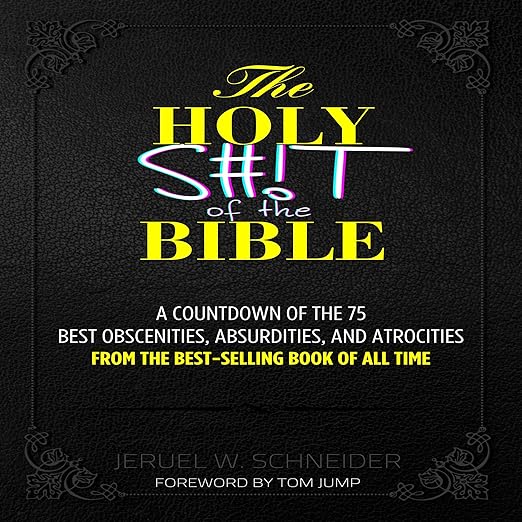
Jeruel Schneider built an audience on YouTube and TikTok before publishing this book, and the book carries the energy of that origin. He is not an academic biblical scholar or a trained theologian. He is a person who read the Bible carefully, found 75 passages that struck him as inane, insane, or illogical, and organized them into a countdown format with commentary. The result is a self-published audiobook that feels handmade in both its strengths and its limitations.
Our Take on The Holy Shit of the Bible
The book’s central question, whether the Bible is the inspired word of God or the uninspired word of man, is not a new question, but Schneider approaches it with the specific energy of someone for whom it is a personal, urgent matter rather than an academic exercise. He examines Paul’s claim of divine scripture origin against the specific passages he has compiled, letting the texts speak against themselves. For readers already skeptical of biblical inerrancy, this is an affirming and entertaining listen. For readers who are somewhere in the middle, questioning but not committed to skepticism, it may feel like preaching to a choir they have not fully joined yet.
The format, a countdown of 75 distasteful passages, is appropriate for the material’s origin in short-form online content. Each entry is relatively brief, which means the book moves quickly across a wide range of biblical territory. Schneider compares multiple translations for each passage, covering KJV, NLT, and others, which several reviewers praised as a specific and useful technique. Showing how a passage reads differently across translations is a concrete demonstration of the interpretive instability that underlies inerrancy claims.
Why Listen to The Holy Shit of the Bible
The audience that will get the most from this book is well-defined by the reviews: former evangelicals in active deconstruction, long-term atheists who want their skepticism organized and articulated, and people approaching faith questions for the first time without established religious background. One reviewer who had been a Christian for nearly forty years described it as confirmation of an exodus from evangelical fundamentalism that was already underway. That is a legitimate use of a book like this. It provides a map for people who are already moving away from something, not a scholarly guide for those studying the terrain objectively.
What to Watch For in The Holy Shit of the Bible
The most critical review in the dataset is also the most informative: a reader who came looking for rigorous counter-arguments for a Bible study context found the arguments weak, poorly presented, and lacking intellectual depth. Specifically, passages were addressed outside their historical and cultural context. That criticism is fair and worth taking seriously. Schneider is writing from a position, not conducting a seminar. If you need arguments that can withstand scrutiny from well-read believers, the scholarship in this book may not hold up under pressure. If you need to feel seen in your own process of questioning, it serves that purpose well.
Who Should Listen to The Holy Shit of the Bible
This is for people deconstructing from fundamentalist or evangelical Christianity, for atheists and agnostics who enjoy having their perspectives articulated, and for curious listeners who want a rapid tour of biblical passages that raise ethical or logical questions. It is not for readers seeking nuanced hermeneutics, balanced theological study, or arguments calibrated to survive engagement with sophisticated believers. Parents questioning how to raise children around faith-based teaching are specifically named in the book’s stated audience, and the accessible, unacademic format may serve that purpose well.
Frequently Asked Questions
Is this book appropriate for serious Bible study or hermeneutics work?
No, and one reviewer who tried to use it for exactly that purpose found it insufficient. Schneider does not provide the historical context, etymological depth, or engagement with counterarguments that serious hermeneutics requires. The book is better suited to personal deconstruction than academic study.
Does Schneider represent a specific religious tradition, or is he writing from outside religion entirely?
Schneider writes from a position of skepticism toward biblical inerrancy rather than from within a particular theological tradition. The book’s framing is atheist-adjacent, though it addresses people across a range of belief positions including those still inside faith communities but questioning.
How does the countdown format affect the listening experience?
Each of the 75 passages gets relatively brief treatment, which means the audiobook moves quickly but does not dwell deeply on any single text. The format works well for listeners who want variety and momentum rather than extended analysis of individual passages.
Is the self-narration effective for this type of content?
Schneider has clearly performed this material before through his online channels, and his delivery has the confidence of someone comfortable with the subject. The production values are modest compared to major publisher releases, and listeners who prefer polished audiobook production should temper expectations accordingly.