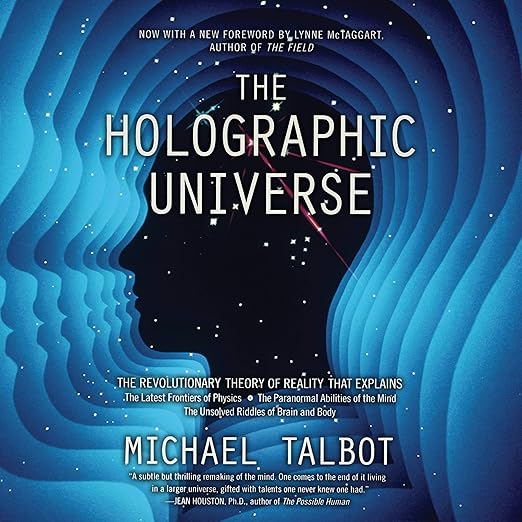
Quick Take
- Narration: Nick Mondelli reads with measured authority, steady and clear, well-suited to this dense blend of physics and metaphysics, though he doesn’t inject much emotional warmth into the more philosophical passages.
- Themes: consciousness and reality, quantum physics meets spirituality, paranormal phenomena reframed
- Mood: Mind-expanding and quietly unsettling
- Verdict: A landmark work of speculative science that holds up decades later, essential listening for anyone curious about where physics and consciousness intersect.
I first came across Michael Talbot’s name not in a bookshop but in a late-night conversation with a physicist friend who spoke about it the way people speak about books that changed something fundamental in how they see the world. I finally sat down with the audiobook on a rainy weekend afternoon, intending to listen for an hour. Six hours later, I was still in my armchair, the tea long cold, genuinely unsettled in the best possible way.
The Holographic Universe, published in 1991, has aged with a strange kind of grace. Talbot’s core proposition, that the universe may be structured like a hologram, with every part containing the information of the whole, draws on the work of physicist David Bohm and neurophysiologist Karl Pribram. These are not fringe figures. Bohm was a protege of Einstein; Pribram helped reshape modern understanding of the brain. Talbot’s contribution is to synthesize their theories into something accessible and, for many readers, personally transformative.
Our Take on The Holographic Universe
What Talbot does brilliantly is refuse to treat physics and mysticism as separate domains. He moves fluidly from Bohm’s implicate order, the idea that beneath the explicate reality we perceive lies a deeper level of interconnected wholeness, to documented accounts of near-death experiences, telepathy, and spontaneous healing. His argument is not that these phenomena are supernatural. It is that our current materialist framework is simply too small to contain them, and that the holographic model offers a more capacious alternative.
The sections on Pribram’s holographic model of the brain are among the most fascinating. If memories are stored throughout the brain rather than in any single location, a finding supported by Karl Lashley’s earlier lesion experiments, then the brain itself operates on holographic principles. Talbot connects this to the phenomenology of lucid dreaming, out-of-body experiences, and even religious visions, suggesting they are not aberrations but features of a consciousness that is itself holographic in structure.
Why Listen to The Holographic Universe
The audiobook format suits this material particularly well. Talbot’s prose has a cumulative momentum; each chapter builds on the last, and Nick Mondelli’s narration respects that architecture. He does not editorialize, which is the right call. The ideas are strange enough without additional dramatization. Where Mondelli is especially effective is in the more technical passages, he paces them carefully, giving the listener time to absorb concepts like non-locality and quantum entanglement before Talbot deploys them in his larger argument.
Listeners who already have some familiarity with quantum physics will find the early chapters move quickly. Those coming to the material fresh will need to pay close attention, but Talbot is a generous explainer, consistently grounding abstract principles in concrete examples and analogies. The foreword by Lynne McTaggart, author of The Field, situates the book within subsequent research that has, in some respects, validated Talbot’s intuitions, a welcome addition to this edition.
What to Watch For in The Holographic Universe
The book’s weakness is also part of its charm: Talbot is an enthusiast, and his enthusiasm sometimes outpaces his skepticism. The anecdotal evidence for paranormal phenomena is presented with considerable confidence, and readers with a strictly empiricist orientation may find the evidentiary bar uncomfortably low. One reviewer described it as accurate based on personal spiritual experience; another called it simply the most interesting book they had ever read. Both reactions tell you something true about the book’s range of effects.
There is also the question of what the holographic model actually predicts and explains versus what it merely accommodates. Talbot is not always careful about this distinction. But these are the limits of a book written in 1991, and they do not undermine the essential value of the project, which is to take seriously a set of phenomena that mainstream science has historically dismissed without adequate examination.
Who Should Listen to The Holographic Universe
This audiobook rewards listeners who are comfortable sitting with open questions, people curious about consciousness, the nature of reality, or the edges of physics where established models start to fray. It is not for those who require peer-reviewed certainty at every step. But if you have ever wondered whether the materialist account of the universe is complete, Talbot offers a remarkably well-reasoned alternative framework. Come with curiosity, leave with questions you will not stop thinking about.
Frequently Asked Questions
Is The Holographic Universe audiobook suitable for someone with no physics background?
Yes. Talbot is a gifted popularizer and explains quantum concepts like non-locality and Bohm’s implicate order through accessible analogies. The technical passages are dense but Mondelli’s pacing helps. A basic familiarity with terms like quantum mechanics will help, but it is not required.
How does this audiobook balance science and spirituality?
Talbot deliberately bridges both. He grounds the argument in the published work of David Bohm and Karl Pribram, credentialed scientists, before extending their models to explain phenomena like telepathy and near-death experiences. He frames mystical experiences as data points that physics has failed to account for, rather than as supernatural events.
Is Nick Mondelli’s narration engaging enough for a 13-hour listen?
Mondelli is measured and authoritative rather than theatrical. He suits the material well, this is not a book that benefits from dramatic delivery. Listeners who prefer a more animated narrator may find him a little flat in places, but he never gets in the way of Talbot’s ideas.
Does the book hold up given advances in physics since 1991?
Surprisingly well in many respects. String theory and aspects of holographic cosmology have given Talbot’s framework unexpected scientific traction. The foreword by Lynne McTaggart addresses some of this. Where it shows its age is in the parapsychology sections, where the evidentiary standards are lower than contemporary science would require.