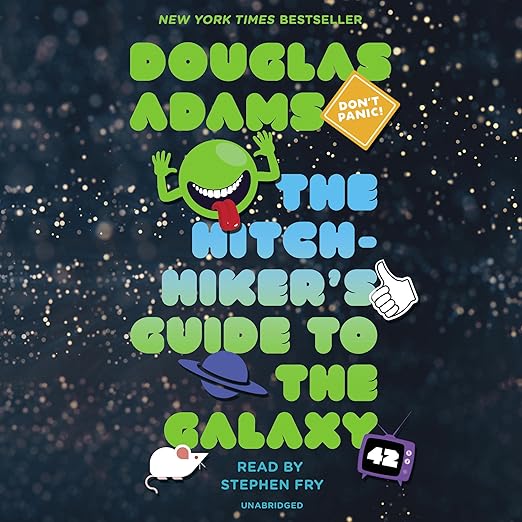
Arthur Dent's house gets demolished before breakfast, then the entire planet follows by lunchtime, and somehow this remains one of the funniest opening sequences in science fiction. Stephen Fry narrates this audiobook edition of The Hitchhiker's Guide to the Galaxy, and listeners who recognize his voice from somewhere unexpected aren't imagining things: Fry voiced the Guide itself in the 2005 film adaptation, which makes this recording feel less like a hired reading and more like a continuation of a role he already knows intimately. Douglas Adams published the original novel in 1979, the first entry in a series he liked to call a trilogy despite it eventually running to five books, and this is widely considered the definitive audio version among longtime fans.
Adams Loved the Whoosh of Deadlines Flying By
The comedy here works by sending 'logic into orbit,' as the synopsis puts it, and then committing completely to the bit: a towel, a small yellow fish that translates every language in the universe, and a guidebook that says DON'T PANIC in large friendly letters become Arthur's entire survival kit for navigating a universe that has just erased his home planet to build a hyperspace bypass. Adams built the whole novel out of this kind of escalating absurdist logic, treating ballpoint pens, potted plants, and digital watches with the same mock-seriousness as galactic bureaucracy, and that tonal consistency is what keeps the jokes landing fifty-plus pages into a premise that could easily have worn thin.
Worth knowing before starting: Hitchhiker's Guide began as a BBC radio series before Adams ever adapted it into novel form, a genuinely unusual origin story that shapes the book's structure even now. Chapters read like radio scenes stitched together, with the Guide's own in-universe entries functioning almost like narrated interludes, and that heritage is part of why an audio performance suits this particular novel better than most.
The book-within-a-book device, the actual Hitchhiker's Guide that Arthur carries and periodically quotes from, lets Adams cut away from the plot entirely whenever he wants to riff on something tangential, planet demolition bureaucracy, the true purpose of ballpoint pens, without breaking the main story's momentum. It's a structural trick that gives the novel permission to be as digressive as its sense of humor wants to be, and it's part of why the prose translates so naturally to audio: these asides were already written to sound like something read aloud from a reference guide.
Ford Prefect, Arthur's alien friend and the researcher secretly gathering material for the Guide itself, gives the story its second engine beyond Arthur's bewilderment: a local expert's eye view of a universe Arthur has no context for at all, which lets Adams explain his own invented cosmology through character dialogue rather than dense exposition.
Adams himself became almost as famous for his writing process as his writing, having supplied one of the most quoted lines about deadlines in the English language, credited to him directly: 'I love deadlines. I love the whooshing sound they make as they fly by.' That reputation for chaos behind the scenes makes the finished novel's tight comic construction even more impressive in hindsight, precision disguised as anarchic looseness.
Fry's Dry Timing Never Pushes for a Laugh
Fry's delivery is built on exactly the dry, over-articulate English comic timing this material demands: understatement where a lesser narrator might push for a laugh, and a straight face maintained through lines that are, on paper, deeply ridiculous. Deadpan absurdist comedy lives or dies on pacing, on knowing precisely how long to let a pause sit before the punchline lands, and that specific skill is what separates a merely competent reading of Adams from one that actually earns the reputation this recording has.
The Guide's own entries function as a kind of second narrative layer, footnote-style asides that comment on the main action from outside it, and Fry reads these with the same care he gives Arthur's bewildered interior monologue, never treating them as filler. Olivia B's review calls the book 'witty, occasionally complex, and accessible to the average reader,' and Travis Bughi's review, arriving skeptical after seeing it recommended constantly on forums, admits it was 'damned clever and funny' once given a real chance.
The novel's cultural footprint extends well past the page: PBS's Great American Read nominated it among America's best-loved novels, and devoted fans worldwide still mark May 25th as Towel Day each year in tribute, carrying a towel in public the way Ford Prefect advises Arthur to here. That kind of grassroots, decades-long fan tradition doesn't attach itself to books that only work as one-time jokes; it signals genuine rereadability, exactly what a strong audio narration needs to reward on a second or third listen.
Earth Dies in Act One, Runtime Matches Print
At five hours and fifty-one minutes, this runtime lines up closely with the novel's actual length in print, reassuring for anyone worried about a hidden abridgment; the pacing here reflects a complete reading rather than a condensed highlight reel. New listeners should also brace for genuinely non-linear plotting: Adams kills off the entire setup, Earth itself, within the first act, then rebuilds the story's stakes from scratch around Arthur's displacement, which is a bolder structural choice than the breezy comic tone initially suggests.
DON'T PANIC Works as the Novel's Thesis
Giovanna Caivano's review captures the book's real staying power: put off for years despite constant recommendations, then unable to stop once actually started, which tracks with how word-of-mouth has kept this novel alive across more than four decades. Listeners expecting tight plot logic in the traditional sense should recalibrate; the pleasure here is digressive and voice-driven rather than mechanically plotted.
DON'T PANIC, printed on the Guide's own cover in large friendly letters, works as more than a joke; it's practically the novel's thesis statement, reassurance offered with a straight face in the middle of genuine cosmic catastrophe. Listeners expecting straightforward hard science fiction should recalibrate toward satire first: the physics and technology here exist to be gently mocked, not rigorously extrapolated, and enjoying the book means accepting its logic on its own absurdist terms rather than nitpicking plausibility.
Purists Miss the Radio Cast's Chaotic Energy
Fans of British absurdist humor, longtime Adams readers revisiting the material through this celebrated Fry edition, and genuinely new science fiction listeners are all well served, since Olivia B's review specifically flags the book as 'accessible to the average reader' despite its reputation for cleverness. It also rewards anyone who has never quite understood why this book is a cultural touchstone; just under six hours is a reasonable investment to find out firsthand.
Purists attached to the original BBC radio cast's chaotic, multi-voice energy get a genuinely different experience here, a single narrator's controlled performance rather than an ensemble production, and should know that going in rather than expecting a direct substitute for the radio version's specific texture.
Is this audiobook the full unabridged novel, or a shortened edition?
The five-hour-fifty-one-minute runtime lines up with the novel's actual print length, consistent with a complete, unabridged reading rather than a condensed adaptation.
Do I need to know Douglas Adams's other work before starting this audiobook?
No prior knowledge is required. Reviewer Olivia B specifically describes the book as accessible to the average reader despite its reputation for cleverness and complexity.
How does Stephen Fry's narration compare to the original BBC radio series?
It's a different format entirely, a single controlled narrator's performance rather than a multi-voice radio ensemble, so longtime radio-series fans should expect a distinct listening experience rather than a direct substitute.
Is this audiobook a complete story, or does it require reading later books in the series?
It stands on its own as a complete comic novel, though it is the first of five books Adams wrote in what he jokingly called a trilogy, and later volumes continue Arthur Dent's story.