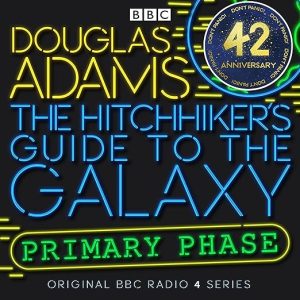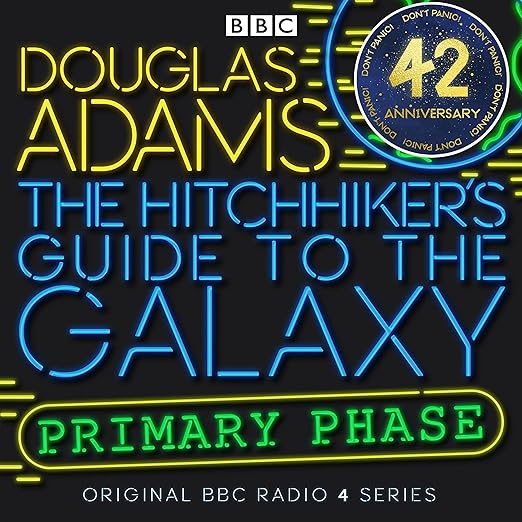
I came to the BBC Primary Phase at what I later realized was entirely the wrong time. I was twenty-two, fresh out of a literary theory seminar on postmodern irony, and I listened to the first episode while waiting for a delayed train at Gare du Nord. I remember laughing so hard at Arthur Dent's pyjama-clad confusion that the woman sitting across from me visibly moved her bag closer. That moment has stuck with me not because the joke was new to me, I had read the novel twice, but because hearing it performed rather than read revealed something about Douglas Adams I had missed entirely: the timing was always meant to be sonic. The book came second. This came first.
The Primary Phase collects the original six BBC Radio 4 episodes broadcast in 1978, presented here in clean digital audio with a re-recorded version of The Eagles' "Journey of the Sorcerer" theme. What you are getting is not an adaptation of a beloved book. You are getting the source material itself, the thing Adams wrote before it was a novel, a trilogy, a film, or a video game. That context changes everything about how you hear it.
What Douglas Adams Delivers
The common assumption about audio adaptations is that they lose something in translation from text. The Primary Phase inverts that logic completely. Adams wrote the Hitchhiker's Guide specifically for radio, and the medium shapes every joke at a structural level. The famous Douglas Adams asides, the digressions about the significance of the number 42, the observations about the peculiar uselessness of Babel fish as proof against God, land differently when they arrive through sound effects and ensemble performance rather than on a page. Peter Jones as the voice of the Guide itself is one of the great audiobook performances in English, though calling it an audiobook feels inadequate. His delivery is documentary-dry, authoritative and absurd simultaneously, and it anchors every episode with a kind of institutional gravity that makes the chaos around it funnier by contrast.
One reviewer noted the "slightly over-the-top use of sound effects" as a drawback, and that is a fair observation for listeners who come in expecting a restrained literary experience. But the sound design is itself a joke. The Vogon ships arrive with the kind of bureaucratic hum that suggests they have been keeping you waiting in a government office for thirty years. The hyperspace jumps sound like someone pressing a large button that should not exist. Adams understood that science fiction absurdism requires its own sonic grammar.
What Douglas Adams Gets Right
Simon Jones as Arthur Dent and Geoffrey McGivern as Ford Prefect have a rapport that was built over years of friendship, and it shows in ways that later castings never quite achieved. Arthur's bewilderment is not performed so much as inhabited. When he learns that his best friend is not from Guildford but from a small planet near Betelgeuse, Jones plays it with a very specific British register: less shock, more the quiet resignation of someone who realizes that nothing in his life has ever quite made sense and this is simply the final confirmation. That undertone of melancholy beneath the comedy is something the radio version carries far better than the 2005 film, which leaned hard into spectacle at the expense of intimacy.
The full cast format also solves a problem that single-narrator audiobook versions of Hitchhiker's Guide have always struggled with: there are simply too many distinct voices that Adams wrote as sonic entities. Marvin the Paranoid Android, voiced by Stephen Moore in these original recordings, is not a character you can do justice to in prose narration alone. The metallic depression in his voice, the way every sentence droops slightly at the end as though it cannot quite bear to finish, is a tonal achievement that Moore crafted in a recording booth and that no written description can fully capture.
Where Douglas Adams Loses Some Ground
If you are approaching the Hitchhiker's Guide for the first time and wondering which format to start with, my honest recommendation is to begin here. The novel is funnier for having heard this first, and the reverse is also true: if you have read the book and think you know what the radio series offers, you are in for small, consistent surprises. The Primary Phase includes material that did not make it into the novel, most notably a few moments involving Zaphod Beeblebrox that read differently when performed by Mark Wing-Davey with the manic charisma of someone who genuinely believes being President of the Galaxy is beneath him.
This Audible release, sourced from the BBC Digital Audio catalog, runs under four hours, which makes it an unusually efficient listen for something this dense with ideas. The pacing is tight in a way that reflects the constraints of its original broadcast format: thirty minutes per episode, six episodes, no room for indulgence. Adams was forced to be economical in ways he later was not, and the discipline shows.
Who Should Pick Up The Hitchhiker's Guide to the Galaxy
If you come to comedy science fiction primarily through American traditions, Adams' particular brand of BBC-inflected absurdism may initially feel unfamiliar in its references and its class-awareness. Arthur Dent is a very specific kind of Englishman, and a lot of the humor depends on recognizing what his mild confusion represents socially. That said, the cosmic stakes of the plot, Earth demolished to make room for a hyperspace bypass while a man worries about a planning notice, translate across cultures precisely because the bureaucratic indifference is universal.
Listeners who need their audio drama to have the production values of a full film score may find the 1978 sound design dated. It is not. It is intentional. But the distinction can be lost if you are listening in a noisy environment where the subtler sonic jokes get swallowed. This one rewards headphones and a quiet evening.
Those who loved the 2005 film or the television series from 1981 and wonder how this compares: it is more intimate, more literary, and significantly funnier. That is not a slight on those adaptations. It is a description of what the original radio format achieves when everything is working as Adams intended.
Frequently Asked Questions
Is the Primary Phase the same story as the Hitchhiker's Guide novel?
Largely yes, but not entirely. The Primary Phase was written and broadcast before the novel existed. Adams adapted the radio scripts into the book, not the other way around, so the radio version contains some material that never made it to print, and a few scenes play out with different emphasis and pacing.
How does this compare to listening to the unabridged novel audiobook?
They are genuinely different experiences. The novel has more of Adams' internal narration and famous footnote-style asides, while the radio version substitutes Peter Jones' delivery of the Guide itself for those asides. Both are worth your time, but the radio version is the original form Adams intended and arguably the more purely comedic of the two.