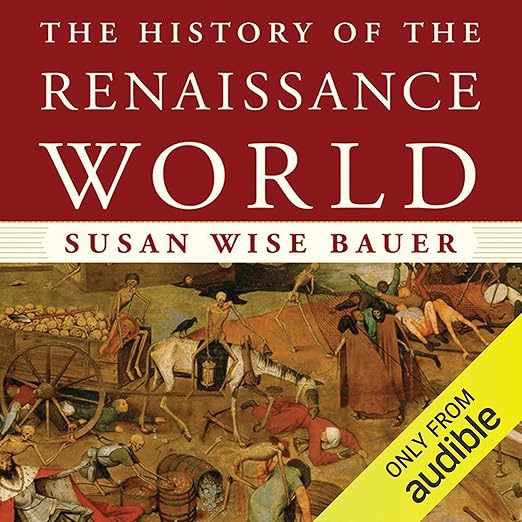
Quick Take
- Narration: John Lee is one of the definitive voices for large-scale narrative history, and his work across 21 hours is authoritative and varied – he manages Bauer’s globe-spanning cast of monarchs, rebels, and catastrophes with consistent energy and excellent pacing.
- Themes: the long transition from medieval to early modern, popular revolt against established power, catastrophe and adaptation (plague, famine, climate)
- Mood: Sweeping and intellectually generous, occasionally bewildering in scope
- Verdict: An ambitious, genuinely global medieval history that resists euro-centric framing – essential for listeners who want the full picture of the 12th through 15th centuries.
I was working through this one during a particularly long research trip – the kind where you’re spending hours on trains and in airports and you need something that holds attention across interrupted sessions. The History of the Renaissance World turned out to be almost ideal for that purpose, partly because its episodic structure means you can pick it up mid-chapter without having entirely lost the thread. That said, one reviewer’s note that the title is a slight misnomer kept returning to me as I listened.
The reviewer is correct. Despite its title, Susan Wise Bauer’s book covers the period 1100 to 1453 – years that historians would more precisely call the High and Late Middle Ages. The Renaissance as a cultural and intellectual movement largely lies beyond this volume’s endpoint. Bauer’s own framing acknowledges this: the Renaissance world she describes is a world that contains the seeds of the Renaissance, not the Renaissance itself. Listeners who arrive expecting Michelangelo and Leonardo will need to adjust. What they will find instead is something arguably more interesting: the full complexity of the centuries that made the Renaissance possible.
The Global Frame as Method
The most significant thing about this book – and what distinguishes it from most medieval history written for general audiences – is its geographical scope. Bauer refuses the standard European frame. Each chapter moves across multiple regions and cultures, setting events in England against events in India, in China, in West Africa, in Mesoamerica. The chapter coverage includes the Lingayat revolt in India, the Red Turban Rebellion in China, the Jacquerie in France, and the English Peasants’ Revolt within a relatively short span. This is deliberate: Bauer is arguing, by structure rather than statement, that popular resistance to established power was a global phenomenon of the period, not a uniquely European one.
That argument is the book’s greatest strength and its greatest challenge for listeners. The geographic breadth means that narrative threads are picked up and set aside and returned to across many chapters. Characters are introduced, recede for a hundred pages, and reappear. The Ottomans emerge as a footnote in one chapter and become a central concern by the volume’s final section. If you have the patience and geographic grounding to follow the structure, this is rewarding. If you need a single continuous narrative arc, the constant shifting can feel disorienting.
Catastrophe and Continuity
The book’s most vivid sections cover the catastrophes of the 14th century: the Little Ice Age, the Great Famine, and above all the Black Death. Bauer is at her best when she is showing how these events – climatic, demographic, political – were not separate shocks but interconnected cascades. The famine weakened populations; the weakened populations were devastated by plague; the devastated populations reshaped political and economic relations. The scale of the Black Death, losing perhaps a third to half of Europe’s population in a few years, produces a narrative of structural transformation that is genuinely shocking even when you know the numbers.
Bauer also handles the Mongol conquests with appropriate complexity. The Mongols appear across multiple chapters and regions, and she tracks both their destructive capacity and the Pax Mongolica that facilitated trade and cultural exchange across Eurasia. The violence and the connectivity were simultaneous and related, and Bauer does not let either erase the other.
John Lee Across Multiple Continents and Centuries
A 21-hour multi-regional history with dozens of named rulers, rebellions, and unfamiliar place names is exactly the kind of material that can overwhelm an unprepared narrator. John Lee is one of the few voices capable of keeping the whole enterprise coherent. His method is careful differentiation: distinct tonal qualities for different regional sections, slight but consistent modulation for quoted speech, a baseline energy that doesn’t flag across the full runtime. The genealogical and dynastic passages – which can be brutal in prose – are delivered with enough clarity that you can actually track succession relationships on first listen.
One reviewer mentions returning to Bauer’s trilogy every five years – that habit suggests something real about the book’s durability. Lee’s narration is a significant part of why that multi-listen relationship is sustainable. He doesn’t flatten the material; each region and period retains distinct character even in audio.
Companion Reference Material
The synopsis notes that reference material is available in the audiobook’s My Library section. This is worth using: Bauer’s genealogical charts and maps are useful context for a book covering this many political entities across this many regions. The audio functions independently, but the reference material fills in the spatial and dynastic context that audio cannot fully convey.
Who Should Listen, Who Should Look Elsewhere
Listen if: you want a genuinely global account of the High and Late Middle Ages; you’ve finished the first two volumes of this series and want to continue; or you’re drawn to history organized by structural patterns across cultures rather than individual national narratives.
Look elsewhere if: you want the Renaissance period specifically – pick up Barbara Tuchman’s A Distant Mirror for the 14th century in focused European detail, or Paul Strathern’s The Medici for the actual Renaissance. This book ends exactly where the Renaissance proper begins.
Frequently Asked Questions
Should you have read the first two volumes of Bauer’s History of the World series before this one?
You can read it standalone, but it functions better as the third volume in a sequence. Bauer’s method and her argument about global historical patterns are established in the earlier volumes, and readers who arrive without that context may find the geographic breadth harder to navigate. Start with The History of the Ancient World if you haven’t already.
One reviewer calls the ‘Renaissance’ title a misnomer – is the book actually about the Renaissance?
The reviewer is right: the book covers 1100 to 1453, which historians classify as the High and Late Middle Ages. The Renaissance as a cultural movement begins after this volume ends. Bauer’s title refers to the world in transition toward the Renaissance, not the Renaissance itself. Adjust expectations accordingly.
How does John Lee handle the non-European sections – India, China, West Africa, Mesoamerica?
Lee manages the geographic range with consistent authority, adjusting his tonal register across different cultural contexts without resorting to caricature. The Mesoamerican and Indian sections receive the same careful delivery as the European material, which matters given Bauer’s argument about global parallels.
Is the included reference material – genealogical charts, maps – necessary to follow the audio?
Not strictly necessary – the audio is self-contained. But the political and dynastic complexity of tracking 350 years of rulers across six continents makes the maps and charts genuinely useful. Check them before or after sessions covering particularly genealogy-heavy sections.