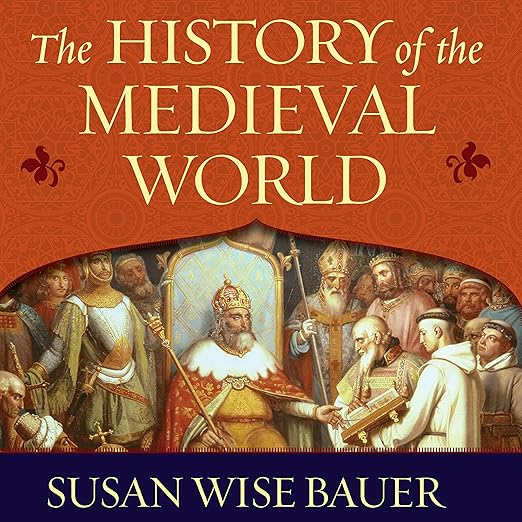
Quick Take
- Narration: John Lee’s narration is authoritative and controlled, matching Bauer’s academic-accessible register without either flattening the prose or over-dramatizing the material.
- Themes: Divine legitimacy as the engine of political power, the parallel development of world religions and state institutions, the global scope of medieval history beyond Europe
- Mood: Substantive and ambitious, organized for steady accumulation rather than dramatic revelation
- Verdict: The most comprehensive single-volume audio survey of medieval world history available, rigorous enough to satisfy serious readers while remaining accessible to newcomers.
When I first came across Susan Wise Bauer’s History of the Ancient World, I was struck by the format: genuinely global in scope, chapter-sized episodes that followed parallel threads across multiple civilizations, and a structural argument that connected political and religious development without reducing one to the other. The History of the Medieval World extends the same approach across the period from roughly the fourth century to the twelfth, and at twenty-two hours and forty-two minutes in audio, it delivers that scope without sacrificing the readability that makes the series unusual.
This is volume two of Bauer’s History of the World series, but it stands independently. The synopsis’s observation that it covers everything from the schism between Rome and Constantinople to the rise of the T’ang Dynasty, from the birth of Muhammad to the crowning of Charlemagne, is accurate and usefully understates the book’s ambition. This is genuinely global medieval history, Japan and the Americas appear alongside the usual European and Near Eastern material, and Bauer’s central argument is presented as a worldwide phenomenon, not a European one.
The Argument That Right Replaced Might
Bauer’s structural thesis, that the medieval period is distinguished from the ancient world by the shift from might to right as the engine of political legitimacy, is one of the book’s strongest contributions. In her Ancient World volume, she traced the emergence of kingship as military power. Here she shows how rulers across cultures and continents, from Christian Europe to Buddhist Japan to Islamic Persia, discovered that divine sanction was a more durable basis for authority than physical force alone. This was not a European invention or a Christian invention. It was a response to a structural problem that every complex society eventually encounters.
Reviewer Gerard A. Proudfoot, who had read Bauer’s previous volumes, identified the house style accurately: easily digestible bites that progress chronologically, with enough cross-referencing between parallel narratives to make the connections legible without becoming confusing. This is a real technical achievement. The medieval period involves enough simultaneous civilizations that a less careful structuring strategy would produce either incoherence or the false impression that everything was happening in Europe while interesting things occurred occasionally elsewhere.
John Lee and the Challenge of Global Scope
John Lee is one of the most reliable narrators working in popular nonfiction, and his performance here is characteristic of his best work, measured, clear, tonally consistent across a text that moves between cultures and centuries without warning. His diction with non-English names and terms (Arabic, Chinese, Sanskrit-derived vocabulary) is careful rather than approximated, which matters more than it might seem for a book that expects listeners to track unfamiliar rulers and dynasties across multiple threads. Bauer’s analytical text is not inherently dramatic, and Lee’s approach honors that by prioritizing clarity and comprehension over performance.
What This Book Does That Others Don’t
Reviewer Glyn Holton, who came to this book after failing to engage with William Manchester’s A World Lit Only by Fire, identified the key differentiator: Bauer writes for someone who wants serious, organized coverage without prior expertise. Manchester’s book is vivid and polemical but covers only Western Europe. Bauer’s Medieval World gives the listener a coherent account of what was happening simultaneously in China, India, the Arab world, and the Byzantine Empire, and more crucially, shows how those parallel histories were structurally related rather than simply coincidental.
The treatment of early Islam is particularly strong. Bauer covers the theological and political development of the early Caliphates with the same structural approach she brings to Carolingian France or Tang China: tracing the relationship between religious authority and political power without privileging one as more important than the other. For listeners whose medieval history education focused primarily on Europe, the Islamic and East Asian material alone justifies the full listen.
Who Should Listen and Who Should Skip
Listen to this if you want the most comprehensive accessible audio survey of medieval world history and are prepared to invest twenty-plus hours in the process. It is best suited for listeners who want to build a framework rather than go deep on any single civilization, the breadth is the point. Listen to it in conjunction with more focused texts on specific regions or periods; this works better as a scaffold than as the final word on any particular topic. Skip it if you have strong existing knowledge and want original argument, Bauer’s thesis is well-constructed but not revisionary for specialists. And listen to volume one, The History of the Ancient World, first if you want the full cumulative effect of Bauer’s framework, though this volume functions independently.
Frequently Asked Questions
Is this book part of a series, and does it need to be read in order?
It is the second volume in Bauer’s History of the World series, following The History of the Ancient World. It functions independently, listeners new to Bauer can begin here without prior context. However, reading or listening to the Ancient World volume first makes the transitional argument about the shift from might-based to divine-legitimacy-based political authority significantly richer.
How does the book handle regions beyond Europe, is the global scope genuine or gestural?
The global scope is genuine and consistent. The T’ang Dynasty, the Arab Caliphates, the Byzantine Empire, Mesoamerican cultures, and Japan all receive sustained, integrated treatment. Bauer’s argument is explicitly that divine authority as a political legitimizing force was a worldwide development, and she pursues that argument across all the civilizations she covers rather than using non-European history as occasional context for a European narrative.
Is this suitable for someone who found Manchester’s A World Lit Only by Fire too narrowly focused?
Yes, directly so. One of the positive reviews mentions exactly this: Manchester covers primarily Western Europe in the medieval period and from a strongly particular perspective, while Bauer’s book is genuinely comparative and global. Listeners who want medieval history beyond the standard European framework will find Bauer far more satisfying.
At twenty-two hours, is this manageable as a commute listen, or does the density require seated study?
It is manageable for attentive commute listening, provided you are listening in reasonably sustained sessions of thirty minutes or more. The chapter-sized episode structure is designed for exactly this kind of incremental listening, and Bauer’s signposting is clear enough that picking up after a break is not disorienting. Very fragmented listening is less effective given the parallel-narrative structure.